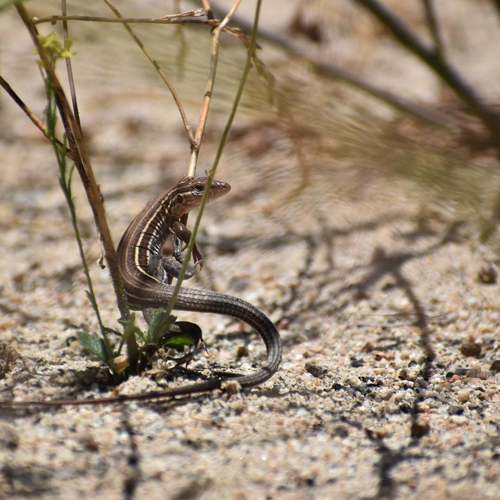
Granite Spiny Lizard

Granite Spiny Lizard

Sceloporus orcutti

Silhouette: SeismicShrimp · PhyloPic

LCLeast ConcernNTVUENCR
Daily sighting probability ~10% · With luck
at Bahía de Loreto National Park

In 3 days ~30% in a week ~50%

12 Verified sightings at Bahía de Loreto National Park From 2019 to 2026
12 In 1 park
May Best month
☀️ Diurnal When it's spotted

About the Granite Spiny Lizard

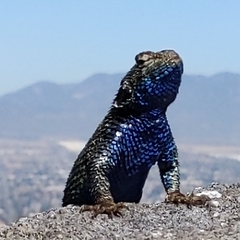
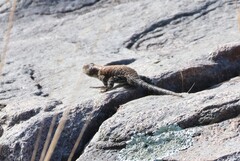
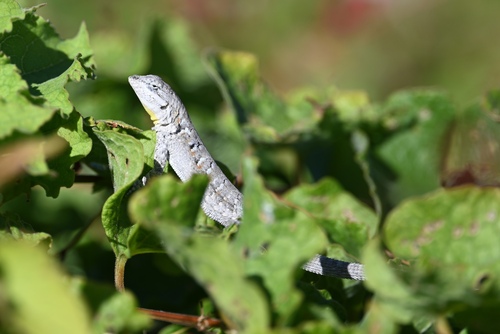
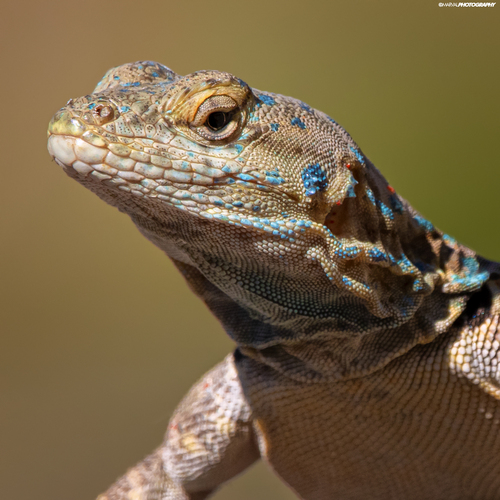
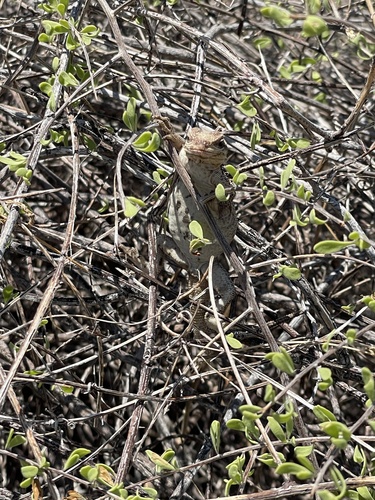
The granite spiny lizard (Sceloporus orcutti), also known commonly as la espinosa del granito in Mexican Spanish, is a species of lizard in the family Phrynosomatidae. The species is native to the southwestern United States and adjacent northwestern Mexico. There are no subspecies.

The epithet, orcutti, honors American naturalist Charles Russell Orcutt (1864–1929), who collected the type specimen in San Diego County, California. Sceloporus orcutti is native to extreme southern California in the United States and Baja California in Mexico.

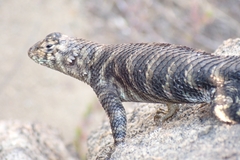
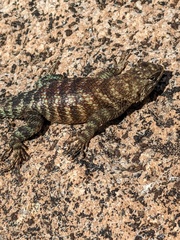
The granite spiny lizard usually has a snout-to-vent length (SVL) of 7.6–10.8 cm (3.0–4.3 in). The maximum recorded total length (tail included) is 28.9 cm (11.4 in). The dorsal scales are strongly keeled and pointed on both the body and the tail. It has a wide purple mid-dorsal stripe. The male of the species has yellow-green and blue-centered scales on the body; the female and juveniles have distinct yellow-tan transverse bands on the body and tail. Additionally, the male has deep-blue ventral patches on its chest and throat, and it has femoral pores.

The granite... Wikipedia →

Global Distribution

Parks Where Found

# Park Country Daily sighting probability
1 Bahía de Loreto National Park 🇲🇽 Mexico
~10%

More parks will be added in future updates.

Cities Where Found

# City Country Daily sighting probability
1 San Diego 🇺🇸 United States
<5%
2 Los Angeles 🇺🇸 United States
<5%

Before you go

What are the chances of seeing a Granite Spiny Lizard in Bahía de Loreto National Park?

With luck

About 10% of wildlife watchers report a Granite Spiny Lizard sighting in Bahía de Loreto National Park on a given day, based on 12 verified sightings from GBIF citizen-science data from 2019 to 2026. It is the 14th most-seen of the 20 reptiles we can rate there. Over three days the chance rises to about 30%, and over a week to about 50%, if each day is a fresh chance.

When is the best time to see a Granite Spiny Lizard in Bahía de Loreto National Park?

May and September

In those months about 30% of wildlife watchers report a Granite Spiny Lizard in Bahía de Loreto National Park on a given day, against under 5% in February, April, June–August and October–December, the lowest months. Those are among Bahía de Loreto National Park's wettest months, with about 40 mm of rain a month against almost none in April.

What time of day is best to see a Granite Spiny Lizard?

Between 9 am and noon

Across all the parks we cover, that three-hour window holds the most Granite Spiny Lizard sightings with a recorded time, and about 9 in 10 of them come between 6 am and 6 pm: it is a daytime animal.

Where else can you see a Granite Spiny Lizard?

Only Bahía de Loreto National Park, in our data

Bahía de Loreto National Park is the only park on Wallace's Line with enough records to rate Granite Spiny Lizard sightings: about 10% of wildlife watchers there report one on a given day.

Where does the Granite Spiny Lizard sighting chance come from?

GBIF citizen-science records

It is estimated from how often the Granite Spiny Lizard is recorded against all the reptiles logged in Bahía de Loreto National Park (12 verified sightings from 2019 to 2026), calibrated against known sighting rates. Figures are rounded to the nearest 10% because citizen-science data supports honest approximations, not decimals, and months with records from fewer than five people show "—". How it works.

← Back to Bahía de Loreto National Park