Santa Catalina Island Rattlesnake

Santa Catalina Island Rattlesnake

Crotalus catalinensis

Silhouette: Bill Bouton (source photo) & T. Michael Keesey (vectorization) · PhyloPic

LCNTVUENCRCritically Endangered Endemic
Daily sighting probability ~10% · With luck
at Bahía de Loreto National Park

In 3 days ~20% in a week ~50%

15 Verified sightings at Bahía de Loreto National Park From 2019 to 2026
15 In 1 park
November Best month
🌅 Crepuscular When it's spotted

About the Santa Catalina Island Rattlesnake

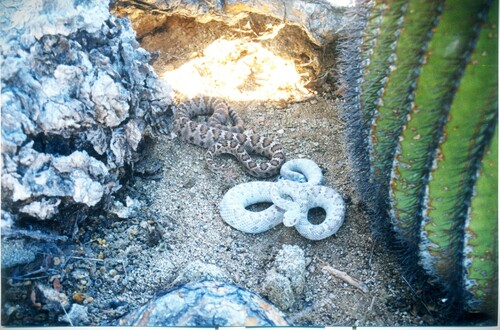
The Santa Catalina rattlesnake (Crotalus catalinensis) is a species of pit viper endemic to Isla Santa Catalina in the Gulf of California just off the east coast of the state of Baja California Sur, Mexico. Like all other pit vipers, it is venomous. No subspecies are currently recognized. A relatively small and slender species, its most distinctive characteristic is that it lacks a rattle. They are also a generally nocturnal species. Though the species is classified as Critically Endangered on the IUCN Red List, there are few efforts for the snake's conservation.

This species is relatively slender and stunted, growing to a maximum of 73.1 cm (2 ft 4.8 in) in length. The most distinctive feature of this snake is its lack of a rattle. The base of the tail, the "button", has degenerated to such an extent that the rattle immediately falls off with each shed instead of forming a new segment, as it does in other species of rattlesnakes. This is widely believed to be a localized adaptation, as the rattle becomes a liability rather than an asset while hunting. The lack of any large predators or hoofed mammals in its natural locale has also played a factor in making the rattle... Wikipedia →

Global Distribution

Parks Where Found

# Park Country Daily sighting probability
1 Bahía de Loreto National Park 🇲🇽 Mexico
~10%

More parks will be added in future updates.

Zoos & Centres Where Found

# Zoo / Centre Country
1 San Diego Zoo 🇺🇸 United States In captivity
2 Bronx Zoo 🇺🇸 United States In captivity
3 Omaha’s Henry Doorly Zoo and Aquarium 🇺🇸 United States In captivity
4 Phoenix Zoo 🇺🇸 United States In captivity
5 Toledo Zoo 🇺🇸 United States In captivity
6 Detroit Zoo 🇺🇸 United States In captivity
7 Oklahoma City Zoo and Botanical Garden 🇺🇸 United States In captivity
8 Fort Worth Zoo 🇺🇸 United States In captivity
9 Indianapolis Zoo 🇺🇸 United States In captivity
10 Memphis Zoo 🇺🇸 United States In captivity
11 San Antonio Zoo 🇺🇸 United States In captivity
12 The Abilene Zoo 🇺🇸 United States In captivity
13 Sacramento Zoo 🇺🇸 United States In captivity
14 Kung Fu Corals 🇺🇸 United States In captivity

Before you go

What are the chances of seeing a Santa Catalina Island Rattlesnake in Bahía de Loreto National Park?

With luck

About 10% of wildlife watchers report a Santa Catalina Island Rattlesnake sighting in Bahía de Loreto National Park on a given day, based on 15 verified sightings from GBIF citizen-science data from 2019 to 2026. It is the 18th most-seen of the 20 reptiles we can rate there. Over three days the chance rises to about 20%, and over a week to about 50%, if each day is a fresh chance.

When is the best time to see a Santa Catalina Island Rattlesnake in Bahía de Loreto National Park?

August and November

In those months about 30% of wildlife watchers report a Santa Catalina Island Rattlesnake in Bahía de Loreto National Park on a given day, against under 5% in March–July, September–October and December–January, the lowest months.

What time of day is best to see a Santa Catalina Island Rattlesnake?

Between 4 and 7 pm

Across all the parks we cover, that three-hour window holds the most Santa Catalina Island Rattlesnake sightings with a recorded time, and about 6 in 10 of them come between 6 pm and 6 am: it is most active around dawn and dusk.

Where else can you see a Santa Catalina Island Rattlesnake?

Only Bahía de Loreto National Park, in our data

Bahía de Loreto National Park is the only park on Wallace's Line with enough records to rate Santa Catalina Island Rattlesnake sightings: about 10% of wildlife watchers there report one on a given day.

Where does the Santa Catalina Island Rattlesnake sighting chance come from?

GBIF citizen-science records

It is estimated from how often the Santa Catalina Island Rattlesnake is recorded against all the reptiles logged in Bahía de Loreto National Park (15 verified sightings from 2019 to 2026), calibrated against known sighting rates. Figures are rounded to the nearest 10% because citizen-science data supports honest approximations, not decimals, and months with records from fewer than five people show "—". How it works.
← Back to Bahía de Loreto National Park