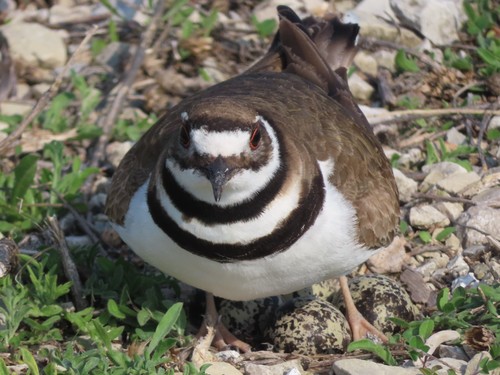
Wilson's Plover

Wilson's Plover

Charadrius wilsonia

LCLeast ConcernNTVUENCR
Daily sighting probability ~30% · Possible
at Bahía de Loreto National Park

In 3 days ~70% in a week ~90%

220 Verified sightings at Bahía de Loreto National Park From 2019 to 2026
1,507 In all 11 parks
December Best month

About the Wilson's Plover

Wilson's plover (Anarhynchus wilsonia) is a small bird of the family Charadriidae. It was named after the Scottish-American ornithologist Alexander Wilson by his friend George Ord in 1814. Wilson's plover is a coastal wader which breeds on both coasts of the Americas from the equator northwards. Its range extends north to include much of the U.S. eastern seaboard, and the Pacific coast of Mexico on the west.

It is a partial migrant. Birds leave the United States, except Florida, to winter south in Brazil. Some Mexican birds leave in winter for Peru. Furthermore, a small resident population is known from Brazil, it being named as a new subspecies, brasiliensis, in 2008. In 2012 it was established that this is a junior synonym, and the correct name for the subspecies is crassirostris. This also means that one of the subspecies of the greater sand plover had to be renamed.

This strictly coastal plover nests on a bare scrape on sandy beaches or sandbars. The breeding male has a black breast band, lores and forecrown, and a rufous mask. Females and non-breeding males have a similar plumage, but the black of the breeding male is replaced by brown...

Wikipedia →

Sounds

Call0:13

Brazil · 2021

© Robson Silva e Silva · XC646551 · CC BY-NC-SA 4.0

Alarm call0:39

Mexico · 2020

© Manuel Grosselet · XC573026 · CC BY-NC-SA 4.0

Flight call0:07

Ecuador · 2003

© John V. Moore · XC257557 · CC BY-NC-SA 4.0

Global Distribution

Parks Where Found

# Park Country Daily sighting probability
1 Bahía de Loreto National Park 🇲🇽 Mexico
~30%
2 Ría Lagartos Biosphere Reserve 🇲🇽 Mexico
~30%
3 Arrecifes de Cozumel National Park 🇲🇽 Mexico
~30%
4 Padre Island National Seashore 🇺🇸 United States
~30%
5 El Vizcaíno Biosphere Reserve 🇲🇽 Mexico
~10%
6 Las Baulas Marine National Park 🇨🇷 Costa Rica
~10%
7 Sian Ka'an Biosphere Reserve 🇲🇽 Mexico
~10%
8 Carara National Park 🇨🇷 Costa Rica
~10%
9 Merritt Island National Wildlife Refuge 🇺🇸 United States
~10%
10 La Amistad International Park (Panama) 🇵🇦 Panama
<5%
11 Everglades National Park 🇺🇸 United States
<5%

Cities Where Found

# City Country Daily sighting probability
1 São Luís 🇧🇷 Brazil
~10%
2 Havana 🇨🇺 Cuba
<5%
3 Panama City 🇵🇦 Panama
<5%
4 Miami 🇺🇸 United States
<5%
5 San Diego 🇺🇸 United States
<5%

Before you go

What are the chances of seeing a Wilson's Plover in Bahía de Loreto National Park?

Possible

About 30% of wildlife watchers report a Wilson's Plover sighting in Bahía de Loreto National Park on a given day, based on 220 verified sightings from GBIF citizen-science data from 2019 to 2026. It is the 27th most-seen of the 172 birds we can rate there. Over three days the chance rises to about 70%, and over a week to about 90%, if each day is a fresh chance.

When is the best time to see a Wilson's Plover in Bahía de Loreto National Park?

December

In that month about 50% of wildlife watchers report a Wilson's Plover in Bahía de Loreto National Park on a given day, against under 5% in May and June, the lowest months. That is one of Bahía de Loreto National Park's driest months, with almost no rain against 80 mm in September.

Is Bahía de Loreto National Park the best place to see a Wilson's Plover?

Yes

Of the 11 parks where we can rate Wilson's Plover sightings, Bahía de Loreto National Park has the highest daily chance: about 30%. Next come Ría Lagartos Biosphere Reserve (Mexico, about 30%) and Arrecifes de Cozumel National Park (Mexico, about 30%).

Which relatives of the Wilson's Plover live in Bahía de Loreto National Park?

Same genus: Charadrius

The closest relatives of the Wilson's Plover that you can see in Bahía de Loreto National Park (genus Charadrius, Holarctic Ringed Plovers and Allies) are Semipalmated Plover (about 20%), Snowy Plover (about 20%) and Killdeer (about 20%), with each one's daily chance of a sighting.

Where does the Wilson's Plover sighting chance come from?

GBIF citizen-science records

It is estimated from how often the Wilson's Plover is recorded against all the birds logged in Bahía de Loreto National Park (220 verified sightings from 2019 to 2026), calibrated against known sighting rates. Figures are rounded to the nearest 10% because citizen-science data supports honest approximations, not decimals, and months with records from fewer than five people show "—". How it works.

← Back to Bahía de Loreto National Park