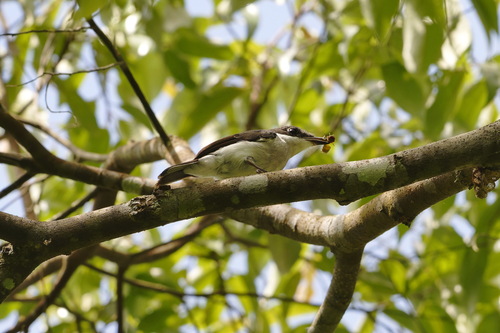
Copper-throated Sunbird

Copper-throated Sunbird

Leptocoma calcostetha

Silhouette: Sheatherius · PhyloPic

LCLeast ConcernNTVUENCR
Daily sighting probability ~10% · With luck
at Bako National Park

In 3 days ~20% in a week ~30%

5 Verified sightings at Bako National Park From 2019 to 2026
268 In all 4 parks
March Best month
☀️ Diurnal When it's spotted

About the Copper-throated Sunbird

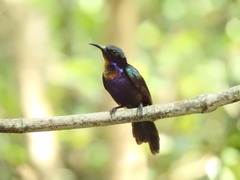
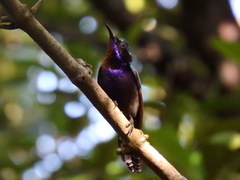
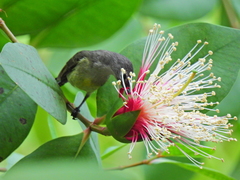
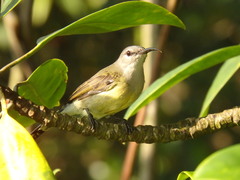
The copper-throated sunbird (Leptocoma calcostetha) is a small passerine within the Nectariniidae family. They sustain themselves by consuming nectar as well as small invertebrates. As a member of the Nectariniidae family, they possess downward curved beaks and have pectoral tufts of yellow feathers. They are found in south-eastern Asia, predominantly in coastal regions.

The copper-throated sunbirds are within the Nectariniidae family, a grouping of sunbirds and spiderhunters. These birds are known for their nectarivorous diets, downward-curved beaks and colorful plumage. The copper-throated sunbird is within the small genus Leptocoma, which contains only 6 extant species. Leptocoma originates from the ancient Greek words leptos which means delicate or refined; and komē which means hair. In addition, the species name calcostetha originates from the words khalkos which means bronze; and stēthos which means breast. Sunbird species can be found in Africa, Asia and Australia. The current consensus is that sunbirds originated and speciated within Asia, and then spread to other continents over time.

Copper-throated sunbirds are small sized birds ranging from... Wikipedia →

Sounds

Call0:14

Philippines · 2026

© Kelle Moreau · XC1161841 · CC BY-NC-SA 4.0

Song0:46

Singapore · 2024

© Ding Li Yong · XC946416 · CC BY-NC-ND 4.0

Uncertain0:25

Malaysia · 2023

© Lim Ying Hien · XC795367 · CC BY-NC-ND 4.0

Global Distribution

Parks Where Found

# Park Country Daily sighting probability
1 Tanjung Puting National Park 🇮🇩 Indonesia
~10%
2 Sepilok 🇲🇾 Malaysia
~10%
3 Bako National Park 🇲🇾 Malaysia
~10%
4 Kinabatangan Wildlife Sanctuary 🇲🇾 Malaysia
<5%

Cities Where Found

# City Country Daily sighting probability
1 Ho Chi Minh City 🇻🇳 Vietnam
~10%
2 Kuala Lumpur 🇲🇾 Malaysia
<5%
3 Singapore 🇸🇬 Singapore
<5%

Before you go

What are the chances of seeing a Copper-throated Sunbird in Bako National Park?

With luck

About 10% of wildlife watchers report a Copper-throated Sunbird sighting in Bako National Park on a given day, based on 5 verified sightings from GBIF citizen-science data from 2019 to 2026. It is the 66th most-seen of the 70 birds we can rate there. Over three days the chance rises to about 20%, and over a week to about 30%, if each day is a fresh chance.

When is the best time to see a Copper-throated Sunbird in Bako National Park?

March

In that month about 20% of wildlife watchers report a Copper-throated Sunbird in Bako National Park on a given day, against under 5% in January–February, April–July and September–October, the lowest months. November and December have too few records to rate.

What time of day is best to see a Copper-throated Sunbird?

Between 9 am and noon

Across all the parks we cover, that three-hour window holds the most Copper-throated Sunbird sightings with a recorded time, and about 9 in 10 of them come between 6 am and 6 pm: it is a daytime animal.

Is Bako National Park the best place to see a Copper-throated Sunbird?

Among the best

Of the 4 parks where we can rate Copper-throated Sunbird sightings, Bako National Park ranks 3rd at about 10%, level with the leaders once rounded. The best odds are in Tanjung Puting National Park (Indonesia, about 10%) and Sepilok (Malaysia, about 10%).

Where does the Copper-throated Sunbird sighting chance come from?

GBIF citizen-science records

It is estimated from how often the Copper-throated Sunbird is recorded against all the birds logged in Bako National Park (5 verified sightings from 2019 to 2026), calibrated against known sighting rates. Figures are rounded to the nearest 10% because citizen-science data supports honest approximations, not decimals, and months with records from fewer than five people show "—". How it works.

← Back to Bako National Park