Van Hasselt's Sunbird

Van Hasselt's Sunbird

Leptocoma brasiliana

Silhouette: Sheatherius · PhyloPic

LCLeast ConcernNTVUENCR
Daily sighting probability ~10% · With luck
at Bako National Park

In 3 days ~20% in a week ~40%

10 Verified sightings at Bako National Park From 2019 to 2026
595 In all 6 parks
July Best month
☀️ Diurnal When it's spotted

About the Van Hasselt's Sunbird

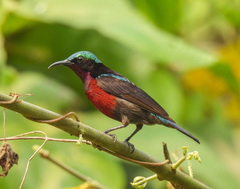
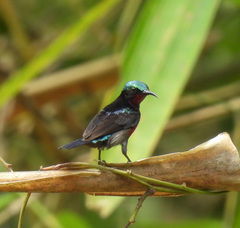
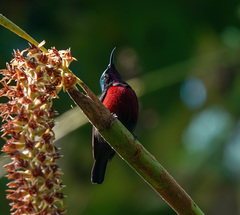
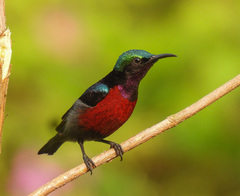
Van Hasselt's sunbird (Leptocoma brasiliana), is a species of bird in the family Nectariniidae. It is found in Northeast India, Bangladesh and Southeast Asia. Its natural habitats are subtropical or tropical moist lowland forests and subtropical or tropical mangrove forests.

Van Hasselt's sunbird was described and illustrated in 1760 by the French zoologist Mathurin Jacques Brisson. He introduced the French name "Le grimpereau violet de Brésil" in the mistakenly belief that his specimen had been collected in Brazil. When the German naturalist Johann Friedrich Gmelin revised and expanded Carl Linnaeus's Systema Naturae in 1788 he included Van Hasselt's sunbird using Brisson's account. He placed it with the tree-creepers in the genus Certhia and coined the binomial name Certhia brasiliana. He specified the location as Brazil and cited Brisson's book. In 1825 the Dutch zoologist Coenraad Jacob Temminck described and illustrated Van Hasselt's sunbird based on a specimen that had been collected on the island of Java by Johan Conrad van Hasselt. Temminck coined the binomial name Nectarinia hasseltii, choosing the specific epithet to honour the collector. Under the rules of... Wikipedia →

Sounds

Call0:20

Vietnam · 2026

© Tim Dinh / Annambirding · XC1155915 · CC BY-NC-SA 4.0

Song1:13

Cambodia · 2018

© Ding Li Yong · XC665703 · CC BY-NC-ND 4.0

Call0:10

Malaysia · 2023

© Lim Ying Hien · XC817646 · CC BY-NC-ND 4.0

Global Distribution

Parks Where Found

# Park Country Daily sighting probability
1 Sepilok 🇲🇾 Malaysia
~20%
2 Khao Yai National Park 🇹🇭 Thailand
~10%
3 Cat Tien National Park 🇻🇳 Vietnam
~10%
4 Bako National Park 🇲🇾 Malaysia
~10%
5 Kinabatangan Wildlife Sanctuary 🇲🇾 Malaysia
<5%
6 Danum Valley Conservation Area 🇲🇾 Malaysia
<5%

Cities Where Found

# City Country Daily sighting probability
1 Kuala Lumpur 🇲🇾 Malaysia
<5%
2 Singapore 🇸🇬 Singapore
<5%

Zoos & Centres Where Found

# Zoo / Centre Country
1 Gembira Loka Zoo 🇮🇩 Indonesia In captivity

Before you go

What are the chances of seeing a Van Hasselt's Sunbird in Bako National Park?

With luck

About 10% of wildlife watchers report a Van Hasselt's Sunbird sighting in Bako National Park on a given day, based on 10 verified sightings from GBIF citizen-science data from 2019 to 2026. It is the 56th most-seen of the 70 birds we can rate there. Over three days the chance rises to about 20%, and over a week to about 40%, if each day is a fresh chance.

When is the best time to see a Van Hasselt's Sunbird in Bako National Park?

July

In that month about 30% of wildlife watchers report a Van Hasselt's Sunbird in Bako National Park on a given day, against under 5% in February–May and August–October, the lowest months. That is one of Bako National Park's driest months, with about 160 mm of rain against 440 mm in January. November and December have too few records to rate.

What time of day is best to see a Van Hasselt's Sunbird?

Between 8 and 11 am

Across all the parks we cover, that three-hour window holds the most Van Hasselt's Sunbird sightings with a recorded time, and about 9 in 10 of them come between 6 am and 6 pm: it is a daytime animal.

Is Bako National Park the best place to see a Van Hasselt's Sunbird?

4th of 6

Of the 6 parks where we can rate Van Hasselt's Sunbird sightings, Bako National Park ranks 4th at about 10%. The best odds are in Sepilok (Malaysia, about 20%), Khao Yai National Park (Thailand, about 10%) and Cat Tien National Park (Vietnam, about 10%).

Where does the Van Hasselt's Sunbird sighting chance come from?

GBIF citizen-science records

It is estimated from how often the Van Hasselt's Sunbird is recorded against all the birds logged in Bako National Park (10 verified sightings from 2019 to 2026), calibrated against known sighting rates. Figures are rounded to the nearest 10% because citizen-science data supports honest approximations, not decimals, and months with records from fewer than five people show "—". How it works.

← Back to Bako National Park