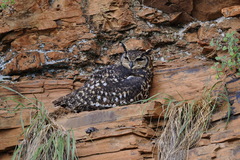
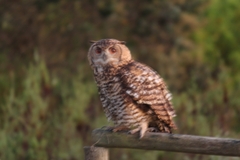

Cape Eagle-Owl

Cape Eagle-Owl

Bubo capensis

Silhouette: Steven Traver · PhyloPic

LCLeast ConcernNTVUENCR
Daily sighting probability ~10% · With luck
at Bale Mountains National Park

In 3 days ~40% in a week ~70%

26 Verified sightings at Bale Mountains National Park From 2019 to 2026
26 In 1 park
May Best month
☀️ Diurnal When it's spotted

About the Cape Eagle-Owl

The Cape eagle-owl (Bubo capensis) is a species of owl in the family Strigidae. It is one of several large species of the eagle-owl genus Bubo. Its range is limited to the southernmost regions of southern Africa as well as parts of East Africa. Claims that this species is found in the southern Arabian Peninsula are erroneous and presumably due to confusion with Bubo milesi.

The Cape eagle-owl is primarily found in mountainous regions or hilly areas with rocks where they find areas to roost, but can also be found in adjacent woodlands, grasslands, and wooded gullies. They are found from sea level up to 2,500 meters above sea level. These owls may also wander into human settlements or even towns, often specifically to prey on pigeons.

This is a large owl, though intermediate in size among other large Bubo owls. Its total length ranges from 46 to 61 cm (18 to 24 in). Males weigh from 905 to 1,387 g (32 to 49 oz) while the larger females range from 1,240 to 1,800 g (44 to 63 oz). The wing chord measures 34.3–41.8 cm (13.5–16.5 in) while the tail measures 15.5–26.6 cm (6.1–10.5 in). This owl is dark brown above with prominent ear-tufts and yellow... Wikipedia →

Sounds

Call1:25

South Africa · 2023

© Lynette Rudman · XC808452 · CC BY-NC-SA 4.0

Recording0:12

South Africa · 2019

© Marian Oliver · iNaturalist · CC BY-NC 4.0

Recording1:29

South Africa · 2026

© Luke Goddard · iNaturalist · CC BY-NC 4.0

Global Distribution

Parks Where Found

# Park Country Daily sighting probability
1 Bale Mountains National Park 🇪🇹 Ethiopia
~10%

More parks will be added in future updates.

Zoos & Centres Where Found

# Zoo / Centre Country
1 Tierpark Berlin 🇩🇪 Germany In captivity
2 Dullstroom Bird Of Prey & Rehabilitation Centre 🇿🇦 South Africa In captivity
3 World of Birds Wildlife Sanctuary and Monkey Park 🇿🇦 South Africa In captivity
4 Cim d'Àligues 🇪🇸 Spain In captivity
5 Montecasino Bird Gardens 🇿🇦 South Africa In captivity
6 Cotswold Falconry Center 🇬🇧 United Kingdom In captivity

Before you go

What are the chances of seeing a Cape Eagle-Owl in Bale Mountains National Park?

With luck

About 10% of wildlife watchers report a Cape Eagle-Owl sighting in Bale Mountains National Park on a given day, based on 26 verified sightings from GBIF citizen-science data from 2019 to 2026. It is the 59th most-seen of the 117 birds we can rate there. Over three days the chance rises to about 40%, and over a week to about 70%, if each day is a fresh chance.

When is the best time to see a Cape Eagle-Owl in Bale Mountains National Park?

May

In that month about 40% of wildlife watchers report a Cape Eagle-Owl in Bale Mountains National Park on a given day, against about 10% in June–August and November–February, the lowest months. March and September have too few records to rate.

What time of day is best to see a Cape Eagle-Owl?

Between 4 and 7 pm

Across all the parks we cover, that three-hour window holds the most Cape Eagle-Owl sightings with a recorded time, and about 7 in 10 of them come between 6 am and 6 pm: it is a daytime animal.

Where else can you see a Cape Eagle-Owl?

Only Bale Mountains National Park, in our data

Bale Mountains National Park is the only park on Wallace's Line with enough records to rate Cape Eagle-Owl sightings: about 10% of wildlife watchers there report one on a given day.

Where does the Cape Eagle-Owl sighting chance come from?

GBIF citizen-science records

It is estimated from how often the Cape Eagle-Owl is recorded against all the birds logged in Bale Mountains National Park (26 verified sightings from 2019 to 2026), calibrated against known sighting rates. Figures are rounded to the nearest 10% because citizen-science data supports honest approximations, not decimals, and months with records from fewer than five people show "—". How it works.

← Back to Bale Mountains National Park