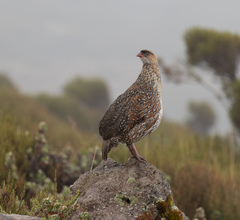
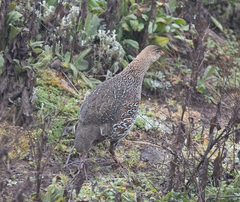

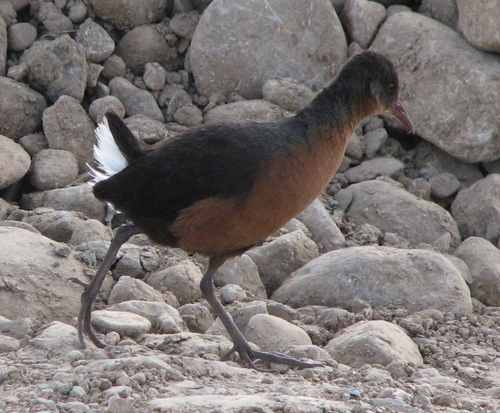
Chestnut-naped Spurfowl

Chestnut-naped Spurfowl

Pternistis castaneicollis

Silhouette: Amanda Kuhlman · PhyloPic

LCLeast ConcernNTVUENCR
Daily sighting probability ~60% · Likely
at Bale Mountains National Park

In 3 days ~90% in a week >90%

151 Verified sightings at Bale Mountains National Park From 2019 to 2026
151 In 1 park
July Best month
☀️ Diurnal When it's spotted

About the Chestnut-naped Spurfowl

The chestnut-naped spurfowl (Pternistis castaneicollis) is a species of bird in the pheasant family Phasianidae. At 33–37 cm (13–15 in) in length and weighing 550–1,200 g (19–42 oz), it is a large species of spurfowl. It is found in Ethiopia and Somaliland. The population is believed to be stable but according to the International Union for Conservation of Nature (IUCN) there is insufficient data to make an estimate of the population.

The chestnut-naped spurfowl was described in 1888 by the Italian zoologist Tommaso Salvadori based on a specimen collected near "Lago Ciar-Ciar" (now Haro Ch'erch'er Hayk') in the Ahmar Mountains of central Ethiopia. He coined the binomial name Francolinus castaneicollis. The species is now placed in the genus Pternistis that was introduced by the German naturalist Johann Georg Wagler in 1832. The specific epithet castaneicollis combines the Latin castaneus meaning "chestnut-brown" and the Modern Latin -collis meaning "necked".

Some taxonomies (eBird/Clements; IOC) list the black-fronted spurfowl as a subspecies (P. c. atrifrons). Others, such as the IUCN, currently maintain the black-fronted spurfowl as a separate species (Pternis atrifrons... Wikipedia →

Sounds

Song0:52

Ethiopia · 2015

© Hans Matheve · XC305862 · CC BY-NC-ND 4.0

Call0:23

Ethiopia · 2014

© Andrew Spencer · XC278213 · CC BY-NC-ND 4.0

Recording0:14

Kenya · 2023

© Victor Ikawa · XC976599 · CC BY-NC-SA 4.0

Global Distribution

Parks Where Found

# Park Country Daily sighting probability
1 Bale Mountains National Park 🇪🇹 Ethiopia
~60%

More parks will be added in future updates.

Before you go

What are the chances of seeing a Chestnut-naped Spurfowl in Bale Mountains National Park?

Likely

About 60% of wildlife watchers report a Chestnut-naped Spurfowl sighting in Bale Mountains National Park on a given day, based on 151 verified sightings from GBIF citizen-science data from 2019 to 2026. It is the 12th most-seen of the 117 birds we can rate there. Over three days the chance rises to about 90%, and over a week to over 90%, if each day is a fresh chance.

When is the best time to see a Chestnut-naped Spurfowl in Bale Mountains National Park?

January, May and July

In those months about 70% of wildlife watchers report a Chestnut-naped Spurfowl in Bale Mountains National Park on a given day, against about 40% in February and December, the lowest months. March and September have too few records to rate.

What time of day is best to see a Chestnut-naped Spurfowl?

Between noon and 3 pm

Across all the parks we cover, that three-hour window holds the most Chestnut-naped Spurfowl sightings with a recorded time, and about 7 in 10 of them come between 6 am and 6 pm: it is a daytime animal.

Where else can you see a Chestnut-naped Spurfowl?

Only Bale Mountains National Park, in our data

Bale Mountains National Park is the only park on Wallace's Line with enough records to rate Chestnut-naped Spurfowl sightings: about 60% of wildlife watchers there report one on a given day.

Where does the Chestnut-naped Spurfowl sighting chance come from?

GBIF citizen-science records

It is estimated from how often the Chestnut-naped Spurfowl is recorded against all the birds logged in Bale Mountains National Park (151 verified sightings from 2019 to 2026), calibrated against known sighting rates. Figures are rounded to the nearest 10% because citizen-science data supports honest approximations, not decimals, and months with records from fewer than five people show "—". How it works.

← Back to Bale Mountains National Park