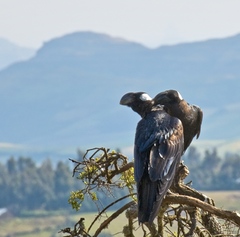
Thick-billed Raven

Thick-billed Raven

Corvus crassirostris

Silhouette: Peileppe · PhyloPic

LCLeast ConcernNTVUENCR
Daily sighting probability ~20% · Possible
at Bale Mountains National Park

In 3 days ~60% in a week ~90%

38 Verified sightings at Bale Mountains National Park From 2019 to 2026
38 In 1 park
January Best month
☀️ Diurnal When it's spotted

About the Thick-billed Raven

The thick-billed raven (Corvus crassirostris) is a large passerine bird in the family Corvidae. It is endemic to the Horn of Africa, including parts of Ethiopia, Eritrea, Sudan, and Somalia. The thick-billed raven shares with the common raven the distinction of being the world's largest corvid.

The thick-billed raven averages 64 cm (25 in) in length, with a range of 60 to 70 cm (24 to 28 in) and weighs approximately 1.15 kg (2.5 lb) in females and 1.5 kg (3.3 lb) in males on average. Its size is about the same as the largest subspecies of common raven (i.e. those from the Himalayas and Greenland/Canadian Northwest Atlantic) but some common raven subspecies are rather smaller and, going on average weights, the thick-billed raven is likely the heaviest extant passerine. The thick-billed raven is about 25% heavier on average than the Australasian superb lyrebird, which is sometimes erroneously titled the largest passerine.

Its bill is laterally compressed and is deeply curved in profile. This bill, the largest of any passerine at 8–9 cm (3.1–3.5 in) in length, is black with a white tip, with deep nasal grooves and only light nasal bristle covers. This raven has very short... Wikipedia →

Sounds

Call0:12

Ethiopia · 2011

© Jelmer Poelstra · XC83697 · CC BY-NC-ND 2.5

Song0:38

Ethiopia · 2012

© Huw Lloyd · XC134292 · CC BY-NC-SA 3.0

Call0:15

Ethiopia · 2010

© Rory Nefdt · XC44593 · CC BY-NC-ND 2.5

Global Distribution

Parks Where Found

# Park Country Daily sighting probability
1 Bale Mountains National Park 🇪🇹 Ethiopia
~20%

More parks will be added in future updates.

Cities Where Found

# City Country Daily sighting probability
1 Addis Ababa 🇪🇹 Ethiopia
<5%

Before you go

What are the chances of seeing a Thick-billed Raven in Bale Mountains National Park?

Possible

About 20% of wildlife watchers report a Thick-billed Raven sighting in Bale Mountains National Park on a given day, based on 38 verified sightings from GBIF citizen-science data from 2019 to 2026. It is the 39th most-seen of the 117 birds we can rate there. Over three days the chance rises to about 60%, and over a week to about 90%, if each day is a fresh chance.

When is the best time to see a Thick-billed Raven in Bale Mountains National Park?

January and October

In those months about 40% of wildlife watchers report a Thick-billed Raven in Bale Mountains National Park on a given day, against about 10% in July and December, the lowest months. March and September have too few records to rate.

What time of day is best to see a Thick-billed Raven?

Between 10 am and 1 pm

Across all the parks we cover, that three-hour window holds the most Thick-billed Raven sightings with a recorded time, and about 8 in 10 of them come between 6 am and 6 pm: it is a daytime animal.

Where else can you see a Thick-billed Raven?

Only Bale Mountains National Park, in our data

Bale Mountains National Park is the only park on Wallace's Line with enough records to rate Thick-billed Raven sightings: about 20% of wildlife watchers there report one on a given day.

Which relatives of the Thick-billed Raven live in Bale Mountains National Park?

Same genus: Corvus

The closest relatives of the Thick-billed Raven that you can see in Bale Mountains National Park (genus Corvus, Crows and Ravens) are Cape Crow (about 50%), Fan-tailed Raven (about 30%) and Pied Crow (about 20%), with each one's daily chance of a sighting.

Where does the Thick-billed Raven sighting chance come from?

GBIF citizen-science records

It is estimated from how often the Thick-billed Raven is recorded against all the birds logged in Bale Mountains National Park (38 verified sightings from 2019 to 2026), calibrated against known sighting rates. Figures are rounded to the nearest 10% because citizen-science data supports honest approximations, not decimals, and months with records from fewer than five people show "—". How it works.

← Back to Bale Mountains National Park