

Muskrat

Muskrat

Ondatra zibethicus

Silhouette: PhyloPic

LCLeast ConcernNTVUENCR
Daily sighting probability ~10% · With luck
at Banff National Park

In 3 days ~30% in a week ~50%

24 Verified sightings at Banff National Park From 2019 to 2026
473 In all 14 parks
April Best month
☀️🌙 Day & Night When it's spotted

About the Muskrat

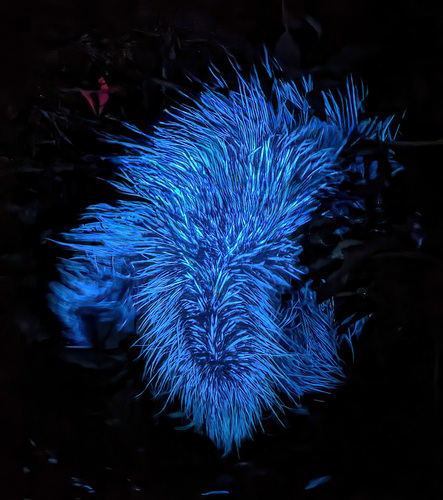
The muskrat or common muskrat (Ondatra zibethicus) is a medium-sized semiaquatic rodent. Adult muskrats weigh 0.6–2 kg (1+1⁄4–4+1⁄2 lb), with a body length (excluding the tail) of 20–35 cm (8–14 in). They are covered with short, thick fur of medium to dark brown color. Their long tails, covered with scales rather than hair, are laterally compressed and generate a small amount of thrust, with their webbed hind feet being the main means of propulsion and the unique tail mainly important in directional stability. Muskrats spend most of their time in the water and can swim underwater for 12 to 17 minutes. They live in families of a male and female pair and their young. They build nests to protect themselves from the cold and predators, often burrowed into the bank with an underwater entrance. Muskrats feed mostly on cattail and other aquatic vegetation but also eat small animals.

Ondatra zibethicus is the only extant species in the genus Ondatra; its closest relative is the round-tailed muskrat (Neofiber alleni). It is the largest species in the subfamily Arvicolinae, which includes 142 other species of rodents, mostly voles and lemmings.

The species is native to North America and an introduced species in parts of Eurasia and South America. The muskrat is found in various wetlands and has crucial effects on their ecology. It is also a resource of food and fur for humans. Wikipedia →

Sounds

Recording1:12

United States · 2026

© Wayne Longbottom · iNaturalist · CC BY-NC 4.0

Recording0:13

Canada · 2023

© Biscotte · iNaturalist · CC BY-NC 4.0

Recording0:23

Russia · 2023

© Юлия Урюпина · iNaturalist · CC BY-NC 4.0

Global Distribution

Parks Where Found

# Park Country Daily sighting probability
1 Elk Island National Park 🇨🇦 Canada
~50%
2 Hortobágy National Park 🇭🇺 Hungary
~30%
3 Riding Mountain National Park 🇨🇦 Canada
~20%
4 Point Pelee National Park 🇨🇦 Canada
~20%
5 Grand Teton National Park 🇺🇸 United States
~20%
6 Denali National Park 🇺🇸 United States
~20%
7 Yellowstone National Park 🇺🇸 United States
~20%
8 Rocky Mountain National Park 🇺🇸 United States
~20%
9 Tierra del Fuego National Park 🇦🇷 Argentina
~10%
10 Channel Islands National Park 🇺🇸 United States
~10%
11 Banff National Park 🇨🇦 Canada
~10%
12 Wadden Sea National Park 🇩🇪 Germany
~10%
13 Acadia National Park 🇺🇸 United States
~10%
14 Great Bear Rainforest 🇨🇦 Canada
<5%

Cities Where Found

# City Country Daily sighting probability
1 Anchorage 🇺🇸 United States
~30%
2 Kazan 🇷🇺 Russia
~30%
3 Minsk 🇧🇾 Belarus
~30%
4 Minneapolis [Saint Paul] 🇺🇸 United States
~20%
5 Calgary 🇨🇦 Canada
~20%
6 Denver 🇺🇸 United States
~20%
7 Astana 🇰🇿 Kazakhstan
~20%
8 Edmonton 🇨🇦 Canada
~20%
9 Rostov-on-Don 🇷🇺 Russia
~20%
10 Toronto 🇨🇦 Canada
~20%

Zoos & Centres Where Found

# Zoo / Centre Country
1 Ralph Perkins II Wildlife Center and Woods Garden 🇺🇸 United States In captivity
2 Museum of Life and Science 🇺🇸 United States In captivity

Before you go

What are the chances of seeing a Muskrat in Banff National Park?

With luck

About 10% of wildlife watchers report a Muskrat sighting in Banff National Park on a given day, based on 24 verified sightings from GBIF citizen-science data from 2019 to 2026. It is the 21st most-seen of the 29 mammals we can rate there. Over three days the chance rises to about 30%, and over a week to about 50%, if each day is a fresh chance.

When is the best time to see a Muskrat in Banff National Park?

April

In that month about 30% of wildlife watchers report a Muskrat in Banff National Park on a given day, against under 5% in February–March and December, the lowest months.

What time of day is best to see a Muskrat?

Between 9 am and noon

Across all the parks we cover, that three-hour window holds the most Muskrat sightings with a recorded time, and about 7 in 10 of them come between 6 am and 6 pm: it is seen both by day and at night.

Where does the Muskrat sighting chance come from?

GBIF citizen-science records

It is estimated from how often the Muskrat is recorded against all the mammals logged in Banff National Park (24 verified sightings from 2019 to 2026), calibrated against known sighting rates. Figures are rounded to the nearest 10% because citizen-science data supports honest approximations, not decimals, and months with records from fewer than five people show "—". How it works.

← Back to Banff National Park