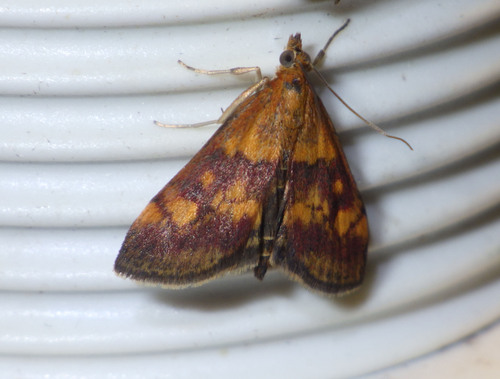
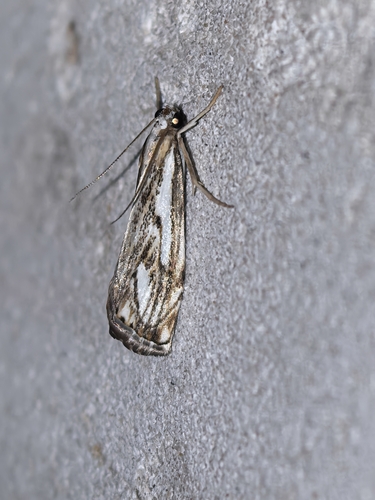
Brown China-Mark

Brown China-Mark

Elophila nymphaeata

Daily sighting probability ~10% · With luck
at Bavarian Forest National Park

In 3 days ~20% in a week ~30%

10 Verified sightings at Bavarian Forest National Park From 2019 to 2026
47 In all 6 parks
August Best month
☀️ Diurnal When it's spotted

About the Brown China-Mark

Elophila nymphaeata, the brown china mark, is a species of moth of the family Crambidae. It was described by Carl Linnaeus in his 1758 10th edition of Systema Naturae. It is found in Europe and across the Palearctic to the Russian Far East and China. The moth is notable as its larva, like most members of the crambid subfamily Acentropinae, is aquatic and has tracheal gills.

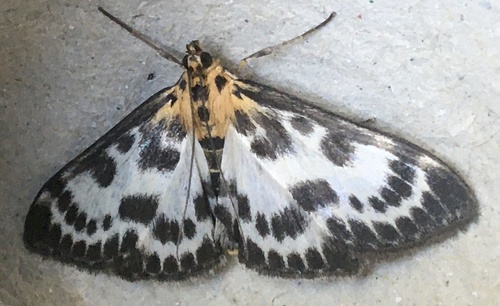
The wingspan is 16–20 mm. The forewings vary from yellow-ochreous to rather dark fuscous; basal area with dentate white and dark fuscous lines; a white subcostal spot before first line; lines whitish, obscure, dark-margined, first angulated above middle, second with deep abrupt sinuation inwards below middle; median band almost occupied by three white dark edged blotches; an irregular interrupted white dark-edged and dark-veined subterminal streak. Hindwings as forewings, but base white, median band white except discal spot, second lineless sinuate. The larva is light brownish; dorsal line darker; head light brown; plate of 2 black-edged. In flat oval

floating cases of leaf-fragments, on Potamogeton, Hydrocharis, Sparganium, etc. See also Parsons et al. The moth... Wikipedia →
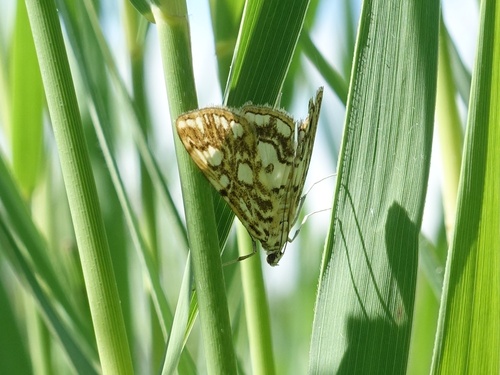
Global Distribution

Parks Where Found

# Park Country Daily sighting probability
1 Hortobágy National Park 🇭🇺 Hungary
~30%
2 Kiskunság National Park 🇭🇺 Hungary
~20%
3 Snowdonia National Park 🇬🇧 United Kingdom
~10%
4 Cairngorms National Park 🇬🇧 United Kingdom
~10%
5 Bavarian Forest National Park 🇩🇪 Germany
~10%
6 Wadden Sea National Park 🇩🇪 Germany
<5%

Cities Where Found

# City Country Daily sighting probability
1 Hamburg 🇩🇪 Germany
~10%
2 Liverpool 🇬🇧 United Kingdom
<5%
3 Helsinki 🇫🇮 Finland
<5%
4 Munich 🇩🇪 Germany
<5%
5 Copenhagen 🇩🇰 Denmark
<5%
6 Nizhny Novgorod 🇷🇺 Russia
<5%
7 Moscow 🇷🇺 Russia
<5%
8 Paris 🇫🇷 France
<5%

Before you go

What are the chances of seeing a Brown China-Mark in Bavarian Forest National Park?

With luck

About 10% of wildlife watchers report a Brown China-Mark sighting in Bavarian Forest National Park on a given day, based on 10 verified sightings from GBIF citizen-science data from 2019 to 2026. It is the 585th most-seen of the 1115 insects we can rate there. Over three days the chance rises to about 20%, and over a week to about 30%, if each day is a fresh chance.

When is the best time to see a Brown China-Mark in Bavarian Forest National Park?

May–June and August–September

In those months about 10% of wildlife watchers report a Brown China-Mark in Bavarian Forest National Park on a given day, against under 5% in July and October–April, the lowest months.

What time of day is best to see a Brown China-Mark?

Between 9 am and noon

Across all the parks we cover, that three-hour window holds the most Brown China-Mark sightings with a recorded time, and about 8 in 10 of them come between 6 am and 6 pm: it is a daytime animal.

Is Bavarian Forest National Park the best place to see a Brown China-Mark?

5th of 6

Of the 6 parks where we can rate Brown China-Mark sightings, Bavarian Forest National Park ranks 5th at about 10%. The best odds are in Hortobágy National Park (Hungary, about 30%), Kiskunság National Park (Hungary, about 20%) and Snowdonia National Park (United Kingdom, about 10%).

Which relatives of the Brown China-Mark live in Bavarian Forest National Park?

Same family: Crambidae

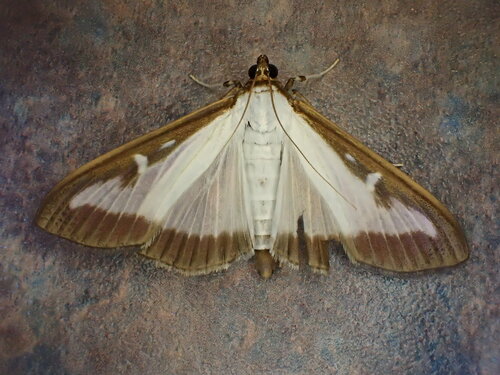
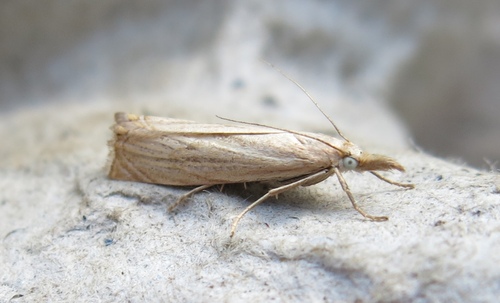
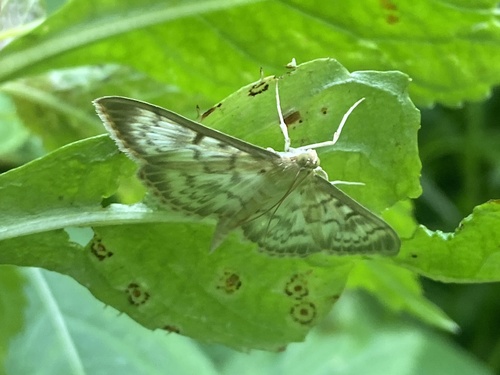
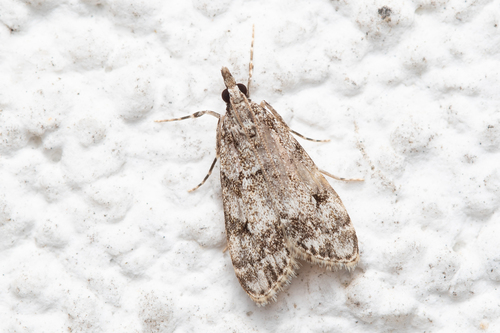
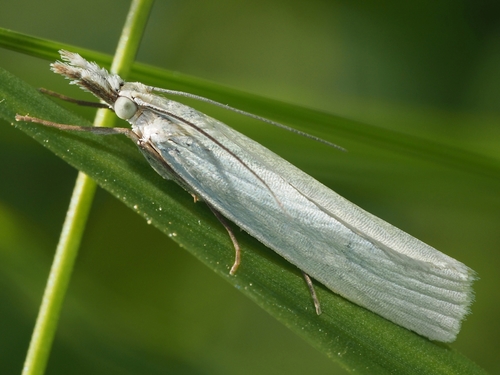
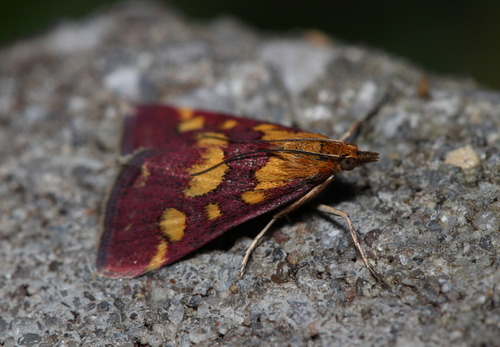
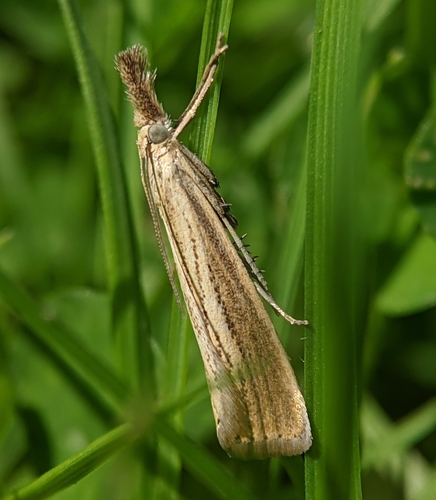
The closest relatives of the Brown China-Mark that you can see in Bavarian Forest National Park (family Crambidae, Crambid Snout Moths) are Straw-Barred Pearl (about 10%), Box Tree Moth (about 10%) and Garden Grass-Veneer (about 10%), with each one's daily chance of a sighting.

Where does the Brown China-Mark sighting chance come from?

GBIF citizen-science records

It is estimated from how often the Brown China-Mark is recorded against all the insects logged in Bavarian Forest National Park (10 verified sightings from 2019 to 2026), calibrated against known sighting rates. Figures are rounded to the nearest 10% because citizen-science data supports honest approximations, not decimals, and months with records from fewer than five people show "—". How it works.

← Back to Bavarian Forest National Park