Common Shrew

Common Shrew

Sorex araneus

Silhouette: Becky Barnes · PhyloPic

LCLeast ConcernNTVUENCR
Daily sighting probability ~20% · Possible
at Białowieża National Park

In 3 days ~50% in a week ~80%

8 Verified sightings at Białowieża National Park From 2019 to 2026
30 In all 3 parks
May Best month
☀️ Diurnal When it's spotted

About the Common Shrew

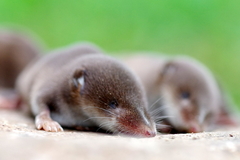
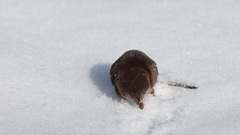
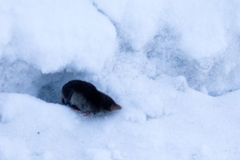
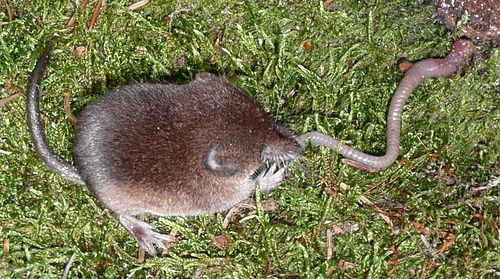
The common shrew (Sorex araneus), also known as the Eurasian shrew, is the most common shrew, and one of the most common mammals, throughout Northern Europe, including Great Britain, but excluding Ireland. It is 55 to 82 millimetres (2.2 to 3.2 in) long and weighs 5 to 12 grams (0.2 to 0.4 oz), and has velvety dark brown fur with a pale underside. It is one of the rare venomous mammals. Juvenile shrews have lighter fur until their first moult. The common shrew has small eyes, a pointed, mobile snout and red-tipped teeth. It has a life span of approximately 14 months.

Shrews are active day and night, taking short periods of rest between relatively long bursts of activity. Common shrews are found throughout the woodlands, grasslands, and hedgelands of Britain, Scandinavia, and Eastern Europe. Each shrew establishes a home range of 370 to 630 m2 (440 to 750 yd²). Males often extend the boundaries during the breeding season to find females. Shrews are extremely territorial and will aggressively defend their home ranges from other shrews. They make their nests underground or under dense vegetation.

The common shrew's carnivorous and insectivorous diet consists... Wikipedia →
Sounds

Recording0:09

Sweden · 2025

© Ulf Elman · XC995629 · CC BY-NC-ND 4.0

Call0:10

United Kingdom · 2014

© Marc Anderson · XC979786 · CC BY-NC-ND 4.0

Global Distribution

Parks Where Found

# Park Country Daily sighting probability
1 Białowieża National Park 🇵🇱 Poland
~20%
2 Snowdonia National Park 🇬🇧 United Kingdom
~20%
3 Cairngorms National Park 🇬🇧 United Kingdom
~10%

Cities Where Found

# City Country Daily sighting probability
1 Manchester 🇬🇧 United Kingdom
~10%
2 Liverpool 🇬🇧 United Kingdom
~10%
3 Birmingham 🇬🇧 United Kingdom
~10%
4 Leeds 🇬🇧 United Kingdom
~10%
5 Helsinki 🇫🇮 Finland
~10%
6 Copenhagen 🇩🇰 Denmark
~10%
7 London 🇬🇧 United Kingdom
~10%
8 Kyiv 🇺🇦 Ukraine
~10%
9 Moscow 🇷🇺 Russia
<5%
10 Saint Petersburg 🇷🇺 Russia
<5%

Before you go

What are the chances of seeing a Common Shrew in Białowieża National Park?

Possible

About 20% of wildlife watchers report a Common Shrew sighting in Białowieża National Park on a given day, based on 8 verified sightings from GBIF citizen-science data from 2019 to 2026. It is the 17th most-seen of the 18 mammals we can rate there. Over three days the chance rises to about 50%, and over a week to about 80%, if each day is a fresh chance.

When is the best time to see a Common Shrew in Białowieża National Park?

May–June and September

In those months about 30% of wildlife watchers report a Common Shrew in Białowieża National Park on a given day, against under 5% in July–August and October–April, the lowest months.

What time of day is best to see a Common Shrew?

Between 11 am and 2 pm

Across all the parks we cover, that three-hour window holds the most Common Shrew sightings with a recorded time, and about 8 in 10 of them come between 6 am and 6 pm: it is a daytime animal.

Is Białowieża National Park the best place to see a Common Shrew?

Yes

Of the 3 parks where we can rate Common Shrew sightings, Białowieża National Park has the highest daily chance: about 20%. Next come Snowdonia National Park (United Kingdom, about 20%) and Cairngorms National Park (United Kingdom, about 10%).

Where does the Common Shrew sighting chance come from?

GBIF citizen-science records

It is estimated from how often the Common Shrew is recorded against all the mammals logged in Białowieża National Park (8 verified sightings from 2019 to 2026), calibrated against known sighting rates. Figures are rounded to the nearest 10% because citizen-science data supports honest approximations, not decimals, and months with records from fewer than five people show "—". How it works.

← Back to Białowieża National Park