Moor Frog

Moor Frog

Rana arvalis

Silhouette: Sharp Photography, sharpphotography.co.uk · PhyloPic

LCLeast ConcernNTVUENCR
Daily sighting probability ~20% · Possible
at Białowieża National Park

In 3 days ~50% in a week ~80%

10 Verified sightings at Białowieża National Park From 2019 to 2026
62 In all 3 parks
November Best month
☀️ Diurnal When it's spotted

About the Moor Frog

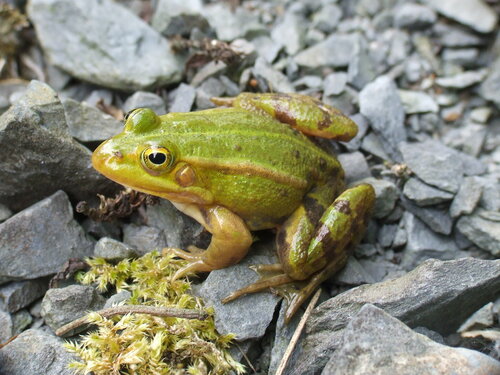
The moor frog (Rana arvalis) is a slim, reddish-brown, semiaquatic amphibian native to Europe and Asia. Moor frogs are known for their ability to freeze solid and survive thawing. The frog makes use of various cryoprotectants i.e. antifreeze that decrease its internal freezing temperature. The species is distributed over a large range, covering a significant portion of Eurasia. Male moor frogs are known to turn blue temporarily during the height of mating season. This coloration is assumed to signal a mate's fitness. Moor frogs typically mate through multimale amplexus, a form of polyandry.

The moor frog spawns its eggs in large batches in still bodies of acidic waters. Human-caused pollution is causing excessive acidification of habitat which harms egg health. The moor frog's habitat is also under destruction due to a variety of other anthropogenic means. The species has an IUCN listing of Least Concern. However, a majority of European states independently consider the conservation status of the moor frog to be unfavorable. The moor frog, like other members of Rana, is omnivorous and will consume anything that it can physically ingest.

The moor frog is a medium to... Wikipedia →

Sounds

Advertisement call0:15

France · 2008

© Olivier SWIFT · XC889788 · CC BY-NC-SA 4.0

Advertisement call0:48

Germany · 2026

© Henning Pehlemann · XC1099403 · CC BY-NC-SA 4.0

Advertisement call0:50

Poland · 2014

© Grzegorz Michalski, Dorota Anders · XC1001105 · CC BY-NC-SA 4.0

Global Distribution

Parks Where Found

# Park Country Daily sighting probability
1 Biebrza National Park 🇵🇱 Poland
~50%
2 Białowieża National Park 🇵🇱 Poland
~20%
3 Wadden Sea National Park 🇩🇪 Germany
~10%

Cities Where Found

# City Country Daily sighting probability
1 Novosibirsk 🇷🇺 Russia
~10%
2 Yekaterinburg 🇷🇺 Russia
~10%
3 Helsinki 🇫🇮 Finland
~10%
4 Moscow 🇷🇺 Russia
~10%
5 Nizhny Novgorod 🇷🇺 Russia
~10%
6 Copenhagen 🇩🇰 Denmark
~10%
7 Berlin 🇩🇪 Germany
<5%
8 Saint Petersburg 🇷🇺 Russia
<5%

Before you go

What are the chances of seeing a Moor Frog in Białowieża National Park?

Possible

About 20% of wildlife watchers report a Moor Frog sighting in Białowieża National Park on a given day, based on 10 verified sightings from GBIF citizen-science data from 2019 to 2026. It is the 3rd most-seen of the 5 amphibians we can rate there. Over three days the chance rises to about 50%, and over a week to about 80%, if each day is a fresh chance.

When is the best time to see a Moor Frog in Białowieża National Park?

November

In that month about 40% of wildlife watchers report a Moor Frog in Białowieża National Park on a given day, against under 5% in May, October and December–February, the lowest months.

What time of day is best to see a Moor Frog?

Between 10 am and 1 pm

Across all the parks we cover, that three-hour window holds the most Moor Frog sightings with a recorded time, and about 9 in 10 of them come between 6 am and 6 pm: it is a daytime animal.

Is Białowieża National Park the best place to see a Moor Frog?

2nd of 3

Of the 3 parks where we can rate Moor Frog sightings, Białowieża National Park ranks 2nd at about 20%. The best odds are in Biebrza National Park (Poland, about 50%).

Where does the Moor Frog sighting chance come from?

GBIF citizen-science records

It is estimated from how often the Moor Frog is recorded against all the amphibians logged in Białowieża National Park (10 verified sightings from 2019 to 2026), calibrated against known sighting rates. Figures are rounded to the nearest 10% because citizen-science data supports honest approximations, not decimals, and months with records from fewer than five people show "—". How it works.

← Back to Białowieża National Park