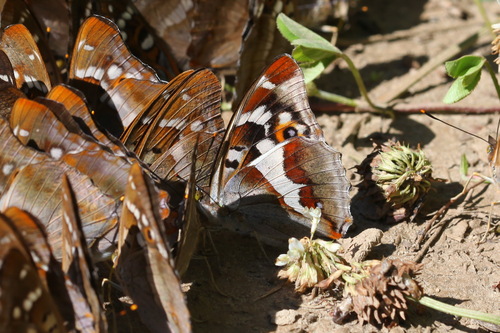
Coenonympha iphis

Coenonympha iphis

Coenonympha iphis

Daily sighting probability ~20% · Possible
at Biebrza National Park

In 3 days ~50% in a week ~80%

8 Verified sightings at Biebrza National Park From 2019 to 2026
167 In all 10 parks
June Best month
☀️ Diurnal When it's spotted

About the Coenonympha iphis

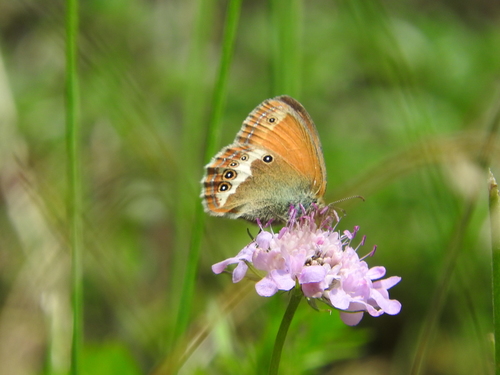
Coenonympha glycerion, the chestnut heath, is a butterfly species belonging to the family Nymphalidae. It is also known as Coenonympha iphis. It can be found in Eastern Europe and east across the Palearctic to Siberia and the Caucasus to North Korea.

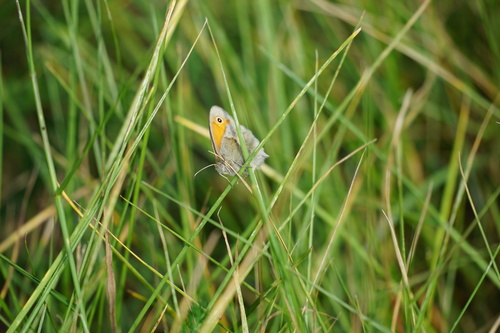
C. glycerion is a small orange-brown butterfly, similar in size to a small heath but with distinct eye-spots (ocelli) on its hindwing. The hindwing has several ocelli on the underside, often five or six. Beyond the middle are two large irregular white sinuous patches, either separate or thinly connected. The underside of the forewing is meanwhile either entirely without ocelli, or has a small, pale, ocellus near the tip of the wing.

There is some variation between sexes: the disc of the forewing of the male on the upperside is washed with copper-brown, while that of the female is yellowish brown, in varying shades. The hindwing is uniformly blackish brown.

The Larva is dull green with a blue-green head, a dark dorsal stripe, a pale lateral one, as well as a red anal fork; the spiracles yellowish red. The pupa is green with white-spotted abdomen and dark-edged wing-cases. Ssp. anaxagoras - Central & Eastern... Wikipedia →

Global Distribution

Parks Where Found

# Park Country Daily sighting probability
1 Mercantour National Park 🇫🇷 France
~30%
2 Biebrza National Park 🇵🇱 Poland
~20%
3 Kiskunság National Park 🇭🇺 Hungary
~20%
4 Ordesa y Monte Perdido National Park 🇪🇸 Spain
~10%
5 Tatra National Park 🇸🇰 Slovakia
~10%
6 Fertő-Hanság National Park 🇭🇺 Hungary
~10%
7 Vanoise National Park 🇫🇷 France
~10%
8 Ecrins National Park 🇫🇷 France
~10%
9 Pyrénées National Park 🇫🇷 France
~10%
10 Bavarian Forest National Park 🇩🇪 Germany
<5%

Cities Where Found

# City Country Daily sighting probability
1 Vienna 🇦🇹 Austria
~10%
2 Helsinki 🇫🇮 Finland
<5%
3 Moscow 🇷🇺 Russia
<5%

Before you go

What are the chances of seeing a Coenonympha iphis in Biebrza National Park?

Possible

About 20% of wildlife watchers report a Coenonympha iphis sighting in Biebrza National Park on a given day, based on 8 verified sightings from GBIF citizen-science data from 2019 to 2026. It is the 52nd most-seen of the 97 insects we can rate there. Over three days the chance rises to about 50%, and over a week to about 80%, if each day is a fresh chance.

When is the best time to see a Coenonympha iphis in Biebrza National Park?

June

In that month about 40% of wildlife watchers report a Coenonympha iphis in Biebrza National Park on a given day, against under 5% in March–May and August–October, the lowest months. December has too few records to rate.

What time of day is best to see a Coenonympha iphis?

Between 9 am and noon

Across all the parks we cover, that three-hour window holds the most Coenonympha iphis sightings with a recorded time, and about 8 in 10 of them come between 6 am and 6 pm: it is a daytime animal.

Is Biebrza National Park the best place to see a Coenonympha iphis?

2nd of 10

Of the 10 parks where we can rate Coenonympha iphis sightings, Biebrza National Park ranks 2nd at about 20%. The best odds are in Mercantour National Park (France, about 30%).

Which relatives of the Coenonympha iphis live in Biebrza National Park?

Same genus: Coenonympha

The closest relatives of the Coenonympha iphis that you can see in Biebrza National Park (genus Coenonympha) are Small Heath (about 30%) and Pearly Heath (about 20%), with each one's daily chance of a sighting.

Where does the Coenonympha iphis sighting chance come from?

GBIF citizen-science records

It is estimated from how often the Coenonympha iphis is recorded against all the insects logged in Biebrza National Park (8 verified sightings from 2019 to 2026), calibrated against known sighting rates. Figures are rounded to the nearest 10% because citizen-science data supports honest approximations, not decimals, and months with records from fewer than five people show "—". How it works.

← Back to Biebrza National Park