Eurasian River Warbler

Eurasian River Warbler

Locustella fluviatilis

Silhouette: Afsarnayakkan · PhyloPic

LCLeast ConcernNTVUENCR
Daily sighting probability <5% · Rare
at Biebrza National Park

In 3 days ~10% in a week ~20%

49 Verified sightings at Biebrza National Park From 2019 to 2026
349 In all 5 parks
June Best month
☀️ Diurnal When it's spotted

About the Eurasian River Warbler

The river warbler (Locustella fluviatilis) is an Old World warbler in the genus Locustella. It breeds in eastern and central Europe and is migratory, wintering in inland southern Africa, from around the Zambezi River south to the vicinity of Pretoria in South Africa.

The genus name Locustella is from Latin and is a diminutive of locusta, "grasshopper". This refers to the song of the common grasshopper warbler and some others in this genus. The specific fluviatilis is Latin for "of a river".

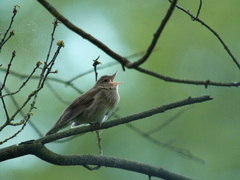
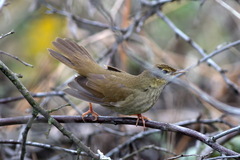
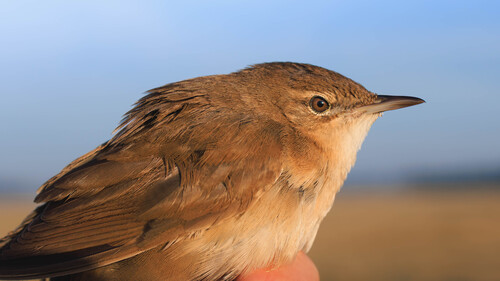
It is a monotypic species, meaning it has no subspecies. This is a largish warbler. The adult has an unstreaked grey-brown back, whitish grey underparts, and a darker undertail, which has white feather tips giving a contrasting pattern. The sexes are identical, as with most warblers, but young birds are yellower below. Some birds can show reduced dark markings on the undertail coverts (caused by more extensive than usual white tips) and thus are closer in appearance to Savi's warbler than typical river warblers. However, they typically still have a streaked breast and more olive colouration on the upperparts.

This is a skulking species which is very... Wikipedia →

Sounds

Song0:18

Sweden · 2025

© Johan Andin · XC1090236 · CC BY-NC-SA 4.0

Call0:04

Estonia · 2020

© Stanislas Wroza · XC575434 · CC BY-NC-SA 4.0

Alarm call0:07

Poland · 2015

© Jarek Matusiak · XC245646 · CC BY-NC-SA 4.0

Global Distribution

Parks Where Found

# Park Country Daily sighting probability
1 Białowieża National Park 🇵🇱 Poland
~20%
2 Fertő-Hanság National Park 🇭🇺 Hungary
~10%
3 Tsavo West National Park 🇰🇪 Kenya
~10%
4 Biebrza National Park 🇵🇱 Poland
<5%
5 Kiskunság National Park 🇭🇺 Hungary
<5%

Cities Where Found

# City Country Daily sighting probability
1 Moscow 🇷🇺 Russia
<5%
2 Jerusalem 🇮🇱 Israel
<5%
3 Warsaw 🇵🇱 Poland
<5%
4 Kyiv 🇺🇦 Ukraine
<5%
5 Helsinki 🇫🇮 Finland
<5%
6 Istanbul 🇹🇷 Turkey
<5%

Before you go

What are the chances of seeing a Eurasian River Warbler in Biebrza National Park?

Rare

Under 5% of wildlife watchers report a Eurasian River Warbler sighting in Biebrza National Park on a given day, based on 49 verified sightings from GBIF citizen-science data from 2019 to 2026. It is the 163rd most-seen of the 202 birds we can rate there. Over three days the chance rises to about 10%, and over a week to about 20%, if each day is a fresh chance.

When is the best time to see a Eurasian River Warbler in Biebrza National Park?

May and June

In those months about 10% of wildlife watchers report a Eurasian River Warbler in Biebrza National Park on a given day, against under 5% in July to April, the lowest months.

What time of day is best to see a Eurasian River Warbler?

Between 9 am and noon

Across all the parks we cover, that three-hour window holds the most Eurasian River Warbler sightings with a recorded time, and about 7 in 10 of them come between 6 am and 6 pm: it is a daytime animal.

Which relatives of the Eurasian River Warbler live in Biebrza National Park?

Same genus: Locustella

The closest relatives of the Eurasian River Warbler that you can see in Biebrza National Park (genus Locustella, Locustellid Bush Warblers and Allies) are Savi's Warbler (about 30%) and Grasshopper Warbler (about 20%), with each one's daily chance of a sighting.

Where does the Eurasian River Warbler sighting chance come from?

GBIF citizen-science records

It is estimated from how often the Eurasian River Warbler is recorded against all the birds logged in Biebrza National Park (49 verified sightings from 2019 to 2026), calibrated against known sighting rates. Figures are rounded to the nearest 10% because citizen-science data supports honest approximations, not decimals, and months with records from fewer than five people show "—". How it works.

← Back to Biebrza National Park