Crescent-chested Warbler

Crescent-chested Warbler

Oreothlypis superciliosa

Silhouette: Andy Wilson · PhyloPic

LCLeast ConcernNTVUENCR
Daily sighting probability <5% · Rare
at Big Bend National Park

In 3 days <5%

24 Verified sightings at Big Bend National Park From 2019 to 2026
612 In all 6 parks
May Best month
☀️ Diurnal When it's spotted

About the Crescent-chested Warbler

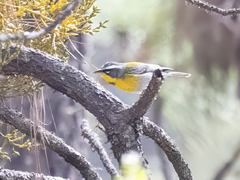
The crescent-chested warbler (Oreothlypis superciliosa) is a small New World warbler. It is common throughout its montane range, from northern Mexico to northern Nicaragua, and is an occasional vagrant to Arizona and Texas. It shows an affinity for oaks.

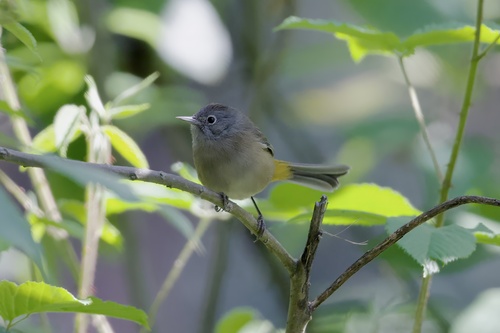
The crescent-chested warbler is superficially similar to both the northern parula and the tropical parula, with yellow underparts, a gray head, and a greenish back, but neither of these has a bold white eyebrow. Adult males have a discrete chestnut crescent on the breast, which is less prominent and sometimes lacking in females and young birds.

The species was formerly placed in the genus Parula, or Vermivora, but transferred to Oreothlypis following genetic analysis of the family Parulidae. Five subspecies are accepted: Oreothlypis superciliosa sodalis (Moore, RT, 1941) — Sierra Madre Occidental of western Mexico

Oreothlypis superciliosa mexicana (Bonaparte, CLJL, 1850) — Sierra Madre Oriental of eastern Mexico Oreothlypis superciliosa palliata (Van Rossem, AJ, 1939) — southwestern Mexico (southern Jalisco to western Michoacán and Guerrero)

Oreothlypis superciliosa superciliosa (Hartlaub, KJG, 1844... Wikipedia →

Sounds

Song0:55

United States · 2020

© Pat Goltz · XC1140247 · CC BY-NC-SA 4.0

Call0:28

Mexico · 2018

© Richard E. Webster · XC451049 · CC BY-NC-SA 4.0

Song0:23

Mexico · 2023

© Matthew L. Brady · XC980080 · CC BY-NC-SA 4.0

Global Distribution

Parks Where Found

# Park Country Daily sighting probability
1 La Tigra National Park 🇭🇳 Honduras
~30%
2 Cumbres de Monterrey National Park 🇲🇽 Mexico
~20%
3 Celaque National Park 🇭🇳 Honduras
~20%
4 Reserva de la Biosfera Mariposa Monarca 🇲🇽 Mexico
~20%
5 El Triunfo 🇲🇽 Mexico
~10%
6 Big Bend National Park 🇺🇸 United States
<5%

Cities Where Found

# City Country Daily sighting probability
1 Guatemala City 🇬🇹 Guatemala
<5%
2 Mexico City 🇲🇽 México
<5%
3 Puebla 🇲🇽 México
<5%

Before you go

What are the chances of seeing a Crescent-chested Warbler in Big Bend National Park?

Rare

Under 5% of wildlife watchers report a Crescent-chested Warbler sighting in Big Bend National Park on a given day, based on 24 verified sightings from GBIF citizen-science data from 2019 to 2026. It is the 219th most-seen of the 270 birds we can rate there. Over three days the chance rises to under 5%, if each day is a fresh chance.

When is the best time to see a Crescent-chested Warbler in Big Bend National Park?

Any time of year

In every month with enough records, under 5% of wildlife watchers report a Crescent-chested Warbler in Big Bend National Park on a given day, so our monthly data shows no clear season.

What time of day is best to see a Crescent-chested Warbler?

Between 8 and 11 am

Across all the parks we cover, that three-hour window holds the most Crescent-chested Warbler sightings with a recorded time, and about 9 in 10 of them come between 6 am and 6 pm: it is a daytime animal.

Which relatives of the Crescent-chested Warbler live in Big Bend National Park?

Same family: Parulidae

The closest relatives of the Crescent-chested Warbler that you can see in Big Bend National Park (family Parulidae, New World Warblers) are Yellow-rumped Warbler (about 50%), Wilson's Warbler (about 30%) and Audubon's Warbler (about 20%), with each one's daily chance of a sighting.

Where does the Crescent-chested Warbler sighting chance come from?

GBIF citizen-science records

It is estimated from how often the Crescent-chested Warbler is recorded against all the birds logged in Big Bend National Park (24 verified sightings from 2019 to 2026), calibrated against known sighting rates. Figures are rounded to the nearest 10% because citizen-science data supports honest approximations, not decimals, and months with records from fewer than five people show "—". How it works.

← Back to Big Bend National Park