
Flammulated Owl

Flammulated Owl

Psiloscops flammeolus

Silhouette: Ferran Sayol · PhyloPic

LCLeast ConcernNTVUENCR
Daily sighting probability <5% · Rare
at Big Bend National Park

In 3 days <5% in a week ~10%

46 Verified sightings at Big Bend National Park From 2019 to 2026
118 In all 6 parks
June Best month
☀️🌙 Day & Night When it's spotted

About the Flammulated Owl

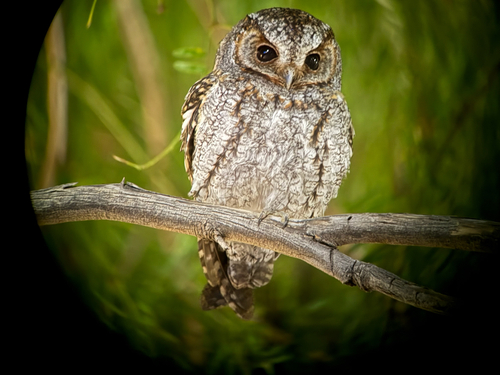
The flammulated owl (Psiloscops flammeolus) is a small migratory North American owl in the family Strigidae. It is the only species placed in the genus Psiloscops. The flammulated owl was formally described in 1852 by the German naturalist Johann Jakob Kaup under the binomial name Scops flammeola. He specified the type location as Mexico. This species was formerly placed with the scops owls in the genus Otus but is now placed in its own genus Psiloscops that was introduced in 1899 by Elliott Coues. The name Psiloscops combines the Ancient Greek psilos meaning "naked" or "smooth" with the genus name Scops, a synonym of Otus. The specific epithet flammeolus is Latin meaning "flame-coloured", "with flame-like markings" or "flammulated". The species is monotypic: no subspecies are recognised.

A molecular phylogenetic study of the owls published in 2019 found that the flammulated owl is a sister species to the Puerto Rican owl (Gymnasio nudipes). The flammulated owl is a small, nocturnal owl approximately 15 cm (6 in) long with a 36 cm (14 in) wingspan. With such large wings for a small body, they can fly rapidly from tree to tree. Males and females can... Wikipedia →

Sounds

Call1:04

Canada · 1984

© Peter Ward and Ken Hall · XC613540 · CC BY-NC-SA 4.0

Song0:50

United States · 2020

© Lance A. M. Benner · XC553928 · CC BY-NC-SA 4.0

Begging call0:13

United States · 2010

© Tayler Brooks · XC61480 · CC BY-NC-ND 2.5

Global Distribution

Parks Where Found

# Park Country Daily sighting probability
1 Big Bend National Park 🇺🇸 United States
<5%
2 Guadalupe Mountains National Park 🇺🇸 United States
<5%
3 Sequoia and Kings Canyon National Parks 🇺🇸 United States
<5%
4 Zion National Park 🇺🇸 United States
<5%
5 Yosemite National Park 🇺🇸 United States
<5%
6 Rocky Mountain National Park 🇺🇸 United States
<5%

Before you go

What are the chances of seeing a Flammulated Owl in Big Bend National Park?

Rare

Under 5% of wildlife watchers report a Flammulated Owl sighting in Big Bend National Park on a given day, based on 46 verified sightings from GBIF citizen-science data from 2019 to 2026. It is the 197th most-seen of the 270 birds we can rate there. Over three days the chance rises to under 5%, and over a week to about 10%, if each day is a fresh chance.

When is the best time to see a Flammulated Owl in Big Bend National Park?

Any time of year

In every month with enough records, under 5% of wildlife watchers report a Flammulated Owl in Big Bend National Park on a given day, so our monthly data shows no clear season.

What time of day is best to see a Flammulated Owl?

Between 8 and 11 pm

Across all the parks we cover, that three-hour window holds the most Flammulated Owl sightings with a recorded time, and about half of them come between 6 pm and 6 am: it is seen both by day and at night.

Which relatives of the Flammulated Owl live in Big Bend National Park?

Same family: Strigidae

The closest relatives of the Flammulated Owl that you can see in Big Bend National Park (family Strigidae, Typical Owls) are Western Screech-Owl (about 10%) and Elf Owl (about 10%), with each one's daily chance of a sighting.

Where does the Flammulated Owl sighting chance come from?

GBIF citizen-science records

It is estimated from how often the Flammulated Owl is recorded against all the birds logged in Big Bend National Park (46 verified sightings from 2019 to 2026), calibrated against known sighting rates. Figures are rounded to the nearest 10% because citizen-science data supports honest approximations, not decimals, and months with records from fewer than five people show "—". How it works.

← Back to Big Bend National Park