Southwestern Blackhead Snake

Southwestern Blackhead Snake

Tantilla hobartsmithi

Silhouette: Jessica Tingle · PhyloPic

LCLeast ConcernNTVUENCR
Daily sighting probability ~10% · With luck
at Big Bend National Park

In 3 days ~20% in a week ~40%

10 Verified sightings at Big Bend National Park From 2019 to 2026
16 In all 2 parks
July Best month
☀️🌙 Day & Night When it's spotted

About the Southwestern Blackhead Snake

Tantilla hobartsmithi, commonly known as Smith's black-headed snake and the southwestern blackhead snake, is a species of small snake in the subfamily Colubrinae of the family Colubridae. The species is native to the southwestern United States and adjacent northern Mexico.

The specific name or epithet, hobartsmithi, is in honor of American zoologist and herpetologist Hobart M. Smith (1912–2013). Tantilla hobartsmithi was first described by Edward Harrison Taylor in 1936. The southwestern blackhead snake is a small snake, growing to a maximum total length (tail included) of 15 in (38 cm), but typically averaging around 8 in (20 cm) in total length.

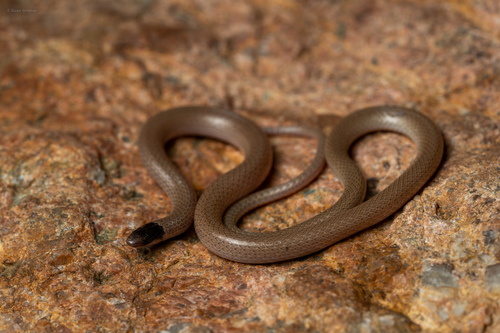
Dorsally, it is uniformly brown in color, except for the black-colored head, which gives it its common name, and a cream-colored or white collar. On the belly, there is a broad reddish stripe, which runs down the center of the ventral scales.

Tantilla hobartsmithi is rear-fanged, having enlarged rear teeth and a modified saliva, which while harmless to mammals, is believed to be toxic to arthropods, its primary prey. Blackhead snakes (genus Tantilla... Wikipedia →
Global Distribution

Parks Where Found

# Park Country Daily sighting probability
1 Big Bend National Park 🇺🇸 United States
~10%
2 Saguaro National Park 🇺🇸 United States
<5%

Before you go

What are the chances of seeing a Southwestern Blackhead Snake in Big Bend National Park?

With luck

About 10% of wildlife watchers report a Southwestern Blackhead Snake sighting in Big Bend National Park on a given day, based on 10 verified sightings from GBIF citizen-science data from 2019 to 2026. It is the 37th most-seen of the 48 reptiles we can rate there. Over three days the chance rises to about 20%, and over a week to about 40%, if each day is a fresh chance.

When is the best time to see a Southwestern Blackhead Snake in Big Bend National Park?

July

In that month about 20% of wildlife watchers report a Southwestern Blackhead Snake in Big Bend National Park on a given day, against under 5% in October to March, the lowest months.

What time of day is best to see a Southwestern Blackhead Snake?

Between 9 pm and midnight

Across all the parks we cover, that three-hour window holds the most Southwestern Blackhead Snake sightings with a recorded time, and about half of them come between 6 am and 6 pm: it is seen both by day and at night.

Is Big Bend National Park the best place to see a Southwestern Blackhead Snake?

Yes

Of the 2 parks where we can rate Southwestern Blackhead Snake sightings, Big Bend National Park has the highest daily chance: about 10%. Next come Saguaro National Park (United States, under 5%).

Which relatives of the Southwestern Blackhead Snake live in Big Bend National Park?

Same family: Colubridae

The closest relatives of the Southwestern Blackhead Snake that you can see in Big Bend National Park (family Colubridae, Colubrid Snakes) are Trans-pecos Ratsnake (about 30%), Coachwhip (about 20%) and Long-nosed Snake (about 20%), with each one's daily chance of a sighting.

Where does the Southwestern Blackhead Snake sighting chance come from?

GBIF citizen-science records

It is estimated from how often the Southwestern Blackhead Snake is recorded against all the reptiles logged in Big Bend National Park (10 verified sightings from 2019 to 2026), calibrated against known sighting rates. Figures are rounded to the nearest 10% because citizen-science data supports honest approximations, not decimals, and months with records from fewer than five people show "—". How it works.

← Back to Big Bend National Park
