
Texas Antelope Squirrel

Texas Antelope Squirrel

Ammospermophilus interpres

Silhouette: Joseph Smit · PhyloPic

LCLeast ConcernNTVUENCR
Daily sighting probability ~10% · With luck
at Big Bend National Park

In 3 days ~30% in a week ~60%

26 Verified sightings at Big Bend National Park From 2019 to 2026
26 In 1 park
October Best month
☀️ Diurnal When it's spotted

About the Texas Antelope Squirrel

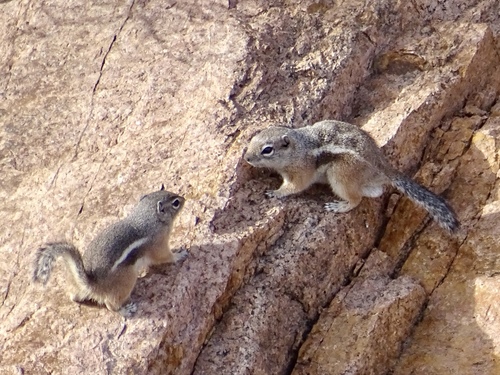
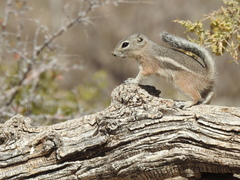
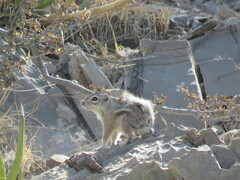
The Texas antelope squirrel (Ammospermophilus interpres) is a species of rodent in the family Sciuridae. It is found in Mexico and in both Texas and New Mexico within the United States. Adults can measure up to 220–235 millimetres (8.7–9.3 in) long, and weigh 99–112 grams (0.218–0.247 lb). They have a white stripe along the side of their torso, highlighted with black markings both above and below the stripe. The rest of the fur is grey with either black or brown markings, with the exception of the underside of the tail which is also white. They are active throughout the year and do not hibernate. They are thought to have evolved to their present state by the Clarendonian period (13.6 to 10.3 mya).

The breeding cycle begins in February, with one to two litters of between five and fourteen young raised each year. The young remain in the nest until they are about a quarter grown, which coincides with the move to solid food. Their diet includes insects, seeds and berries, including the fruit and seeds of a variety of cactus species. One adult found in 1905 had eaten the fruit of Opuntia engelmannii in sufficient quantities that its flesh was tinted purple. Wikipedia →

Sounds

Recording0:20

United States · 2026

© James N. Stuart · iNaturalist · CC BY-NC 4.0

Global Distribution

Parks Where Found

# Park Country Daily sighting probability
1 Big Bend National Park 🇺🇸 United States
~10%

More parks will be added in future updates.

Before you go

What are the chances of seeing a Texas Antelope Squirrel in Big Bend National Park?

With luck

About 10% of wildlife watchers report a Texas Antelope Squirrel sighting in Big Bend National Park on a given day, based on 26 verified sightings from GBIF citizen-science data from 2019 to 2026. It is the 11th most-seen of the 21 mammals we can rate there. Over three days the chance rises to about 30%, and over a week to about 60%, if each day is a fresh chance.

When is the best time to see a Texas Antelope Squirrel in Big Bend National Park?

October

In that month about 30% of wildlife watchers report a Texas Antelope Squirrel in Big Bend National Park on a given day, against under 5% in July and September, the lowest months.

What time of day is best to see a Texas Antelope Squirrel?

Between 9 am and noon

Across all the parks we cover, that three-hour window holds the most Texas Antelope Squirrel sightings with a recorded time, and about 9 in 10 of them come between 6 am and 6 pm: it is a daytime animal.

Where else can you see a Texas Antelope Squirrel?

Only Big Bend National Park, in our data

Big Bend National Park is the only park on Wallace's Line with enough records to rate Texas Antelope Squirrel sightings: about 10% of wildlife watchers there report one on a given day.

Where does the Texas Antelope Squirrel sighting chance come from?

GBIF citizen-science records

It is estimated from how often the Texas Antelope Squirrel is recorded against all the mammals logged in Big Bend National Park (26 verified sightings from 2019 to 2026), calibrated against known sighting rates. Figures are rounded to the nearest 10% because citizen-science data supports honest approximations, not decimals, and months with records from fewer than five people show "—". How it works.

← Back to Big Bend National Park