

Merriam's Kangaroo Rat

Merriam's Kangaroo Rat

Dipodomys merriami

Silhouette: PhyloPic

LCLeast ConcernNTVUENCR
Daily sighting probability ~10% · With luck
at Big Bend National Park

In 3 days ~20% in a week ~40%

10 Verified sightings at Big Bend National Park From 2019 to 2026
24 In all 2 parks
July Best month
🌅 Crepuscular When it's spotted

About the Merriam's Kangaroo Rat

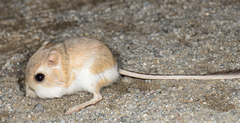
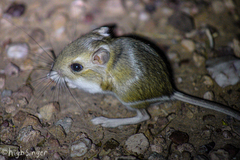
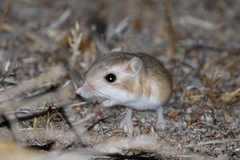
Merriam's kangaroo rat (Dipodomys merriami) is a species of rodent in the family Heteromyidae. The species name commemorates Clinton Hart Merriam. It is found in the Upper and Lower Sonoran life zones of the southwestern United States, Baja California, and northern Mexico.

Merriam's kangaroo rats, like other kangaroo rats and pocket mice, are members of the family Heteromyidae. Each species within this family has fur-lined food storage pouches. The cheek pouch is utilized as a portable cache for food while foraging. Kangaroo rats are named for their extremely long, kangaroo-like hind feet and they are almost completely bipedal. They hop or jump rather than scurry or run. Because of this, most heteromyid rodents also have a relatively long tail that acts to counterbalance the hopping/jumping form of locomotion.

Fur color varies between populations within the species' range, but the back color is generally light brown or tan. The merriami species is smaller than most of the other kangaroo rats in the southwest. Adults average about 14 inches in length. The tail is relatively long with a large tuft of hair at the tip. The tuft is thought to act like fletching on an arrow... Wikipedia →

Global Distribution

Parks Where Found

# Park Country Daily sighting probability
1 Joshua Tree National Park 🇺🇸 United States
~10%
2 Big Bend National Park 🇺🇸 United States
~10%

Before you go

What are the chances of seeing a Merriam's Kangaroo Rat in Big Bend National Park?

With luck

About 10% of wildlife watchers report a Merriam's Kangaroo Rat sighting in Big Bend National Park on a given day, based on 10 verified sightings from GBIF citizen-science data from 2019 to 2026. It is the 15th most-seen of the 21 mammals we can rate there. Over three days the chance rises to about 20%, and over a week to about 40%, if each day is a fresh chance.

When is the best time to see a Merriam's Kangaroo Rat in Big Bend National Park?

July and October

In those months about 20% of wildlife watchers report a Merriam's Kangaroo Rat in Big Bend National Park on a given day, against under 5% in June, August and November–March, the lowest months.

What time of day is best to see a Merriam's Kangaroo Rat?

Between 9 pm and midnight

Across all the parks we cover, that three-hour window holds the most Merriam's Kangaroo Rat sightings with a recorded time, and about half of them come between 6 pm and 6 am: it is most active around dawn and dusk.

Is Big Bend National Park the best place to see a Merriam's Kangaroo Rat?

Among the best

Of the 2 parks where we can rate Merriam's Kangaroo Rat sightings, Big Bend National Park ranks 2nd at about 10%, level with the leaders once rounded. The best odds are in Joshua Tree National Park (United States, about 10%).

Which relatives of the Merriam's Kangaroo Rat live in Big Bend National Park?

Same order: Rodentia

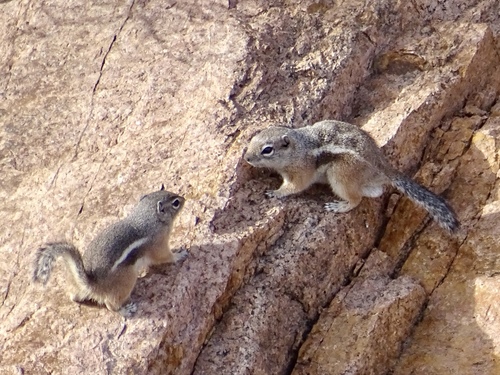
The closest relatives of the Merriam's Kangaroo Rat that you can see in Big Bend National Park (order Rodentia, Rodents) are Rock Squirrel (about 30%), Texas Antelope Squirrel (about 10%) and American Beaver (about 10%), with each one's daily chance of a sighting.

Where does the Merriam's Kangaroo Rat sighting chance come from?

GBIF citizen-science records

It is estimated from how often the Merriam's Kangaroo Rat is recorded against all the mammals logged in Big Bend National Park (10 verified sightings from 2019 to 2026), calibrated against known sighting rates. Figures are rounded to the nearest 10% because citizen-science data supports honest approximations, not decimals, and months with records from fewer than five people show "—". How it works.

← Back to Big Bend National Park