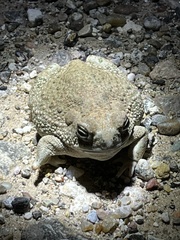
Texas Toad

Texas Toad

Anaxyrus speciosus

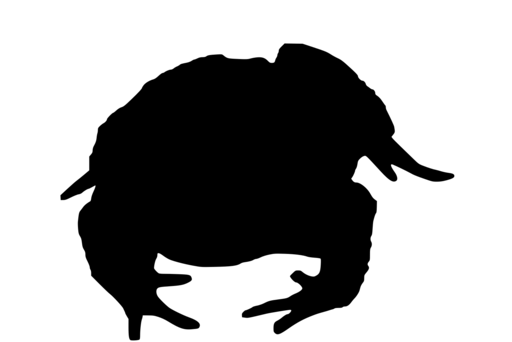
Silhouette: Michael Scroggie, from original photograph by Gary M. Stolz, USFWS (original photograph in public domain). · PhyloPic

LCLeast ConcernNTVUENCR
Daily sighting probability ~10% · With luck
at Big Bend National Park

In 3 days ~40% in a week ~70%

33 Verified sightings at Big Bend National Park From 2019 to 2026
33 In 1 park
September Best month
🌙 Nocturnal When it's spotted

About the Texas Toad

The Texas toad (Anaxyrus speciosus) is a species of medium-sized (to 9 cm (3.5 in)) toad that occurs in the southern United States and northern Mexico. It breeds in temporary water pools after heavy rains. The Texas toad is native to the United States where it is found in the state of Texas, wherein 2009 it was designated as the Texas State Amphibian, its range also extends northward to Oklahoma, westward to New Mexico and southward to northern Mexico. It is a desert species and is found in dry grassland, savannahs with scattered mesquite and open woodland, usually on sandy or frequently inundated soils.

Males measure 52–78 mm (2.0–3.1 in) and females 54–91 mm (2.1–3.6 in) in snout–vent length. The Texas toad feeds on insects such as beetles, ants and bugs. It digs a burrow in soft soil and can bury itself in mud. It sometimes conceals itself in a gopher burrow, under a log or in a deep crack in the mud to prevent desiccation, spending much of its time dormant in prolonged dry weather.

Breeding occurs after heavy rains when male frogs congregate at temporary pools, ditches, cattle tanks and other wet places and call continuously... Wikipedia →

Sounds

Advertisement call0:10

United States · 2012

© Chris Harrison · XC890494 · CC BY-NC-SA 4.0

Recording0:17

United States · 2025

© crawfishking · iNaturalist · CC BY-NC 4.0

Recording0:12

United States · 2020

© Jon McIntyre · iNaturalist · CC BY-NC 4.0

Global Distribution

Parks Where Found

# Park Country Daily sighting probability
1 Big Bend National Park 🇺🇸 United States
~10%

More parks will be added in future updates.

Before you go

What are the chances of seeing a Texas Toad in Big Bend National Park?

With luck

About 10% of wildlife watchers report a Texas Toad sighting in Big Bend National Park on a given day, based on 33 verified sightings from GBIF citizen-science data from 2019 to 2026. It is the 3rd most-seen of the 8 amphibians we can rate there. Over three days the chance rises to about 40%, and over a week to about 70%, if each day is a fresh chance.

When is the best time to see a Texas Toad in Big Bend National Park?

September

In that month about 40% of wildlife watchers report a Texas Toad in Big Bend National Park on a given day, against under 5% in November to March, the lowest months. That is one of Big Bend National Park's wettest months, with about 50 mm of rain against 10 mm in April.

What time of day is best to see a Texas Toad?

Between 9 pm and midnight

Across all the parks we cover, that three-hour window holds the most Texas Toad sightings with a recorded time, and about 9 in 10 of them come between 6 pm and 6 am: it is mostly seen at night.

Where else can you see a Texas Toad?

Only Big Bend National Park, in our data

Big Bend National Park is the only park on Wallace's Line with enough records to rate Texas Toad sightings: about 10% of wildlife watchers there report one on a given day.

Where does the Texas Toad sighting chance come from?

GBIF citizen-science records

It is estimated from how often the Texas Toad is recorded against all the amphibians logged in Big Bend National Park (33 verified sightings from 2019 to 2026), calibrated against known sighting rates. Figures are rounded to the nearest 10% because citizen-science data supports honest approximations, not decimals, and months with records from fewer than five people show "—". How it works.

← Back to Big Bend National Park