Cliff Chirping Frog

Cliff Chirping Frog

Eleutherodactylus marnockii

Silhouette: Jose Carlos Arenas-Monroy · PhyloPic

LCLeast ConcernNTVUENCR
Daily sighting probability ~10% · With luck
at Big Bend National Park

In 3 days ~20% in a week ~40%

6 Verified sightings at Big Bend National Park From 2019 to 2026
6 In 1 park
September Best month
☀️🌙 Day & Night When it's spotted

About the Cliff Chirping Frog

Eleutherodactylus marnockii, the cliff chirping frog, is a small eleutherodactylid frog found in Central and West Texas, United States, and in Coahuila and Chihuahua, northern Mexico. It is also known as the cliff frog and Marnock's frog.

Synonymy of Eleutherodactylus guttilatus with this species has been proposed but is not accepted by all authors. Intermediates between the two species have been reported from Nuevo León in northern Mexico. Some subpopulations of E. guttilatus from Big Bend, Texas, northern Coahuila and Chihuahua are treated as E. marnockii by the International Union for Conservation of Nature.

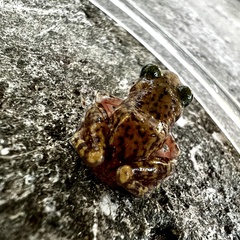
Adult cliff frogs are 19–38 mm (0.75–1.5 in) in length. They have greenish ground color with brown mottling, often with banding on the rear legs. They have somewhat flattened bodies which allow them to hide in rock crevices.

Cliff chirping frogs are nocturnal and live most of their lives on limestone rock faces. They may also be found in caves, pinion forests, juniper forests, scrub, grassland, suburban areas and city parks. Like most frogs, they will hop, but they are also capable of crawling, which aids them... Wikipedia →

Sounds

Advertisement call0:59

United States · 2015

© Chris Harrison · XC890502 · CC BY-NC-SA 4.0

Recording0:02

United States · 2022

© Ashwin Narayanan · iNaturalist · CC BY-NC 4.0

Recording0:28

United States · 2020

© caglaror · iNaturalist · CC BY-NC 4.0

Global Distribution

Parks Where Found

# Park Country Daily sighting probability
1 Big Bend National Park 🇺🇸 United States
~10%

More parks will be added in future updates.

Cities Where Found

# City Country Daily sighting probability
1 Austin 🇺🇸 United States
~10%
2 San Antonio 🇺🇸 United States
<5%

Before you go

What are the chances of seeing a Cliff Chirping Frog in Big Bend National Park?

With luck

About 10% of wildlife watchers report a Cliff Chirping Frog sighting in Big Bend National Park on a given day, based on 6 verified sightings from GBIF citizen-science data from 2019 to 2026. It is the 8th most-seen of the 8 amphibians we can rate there. Over three days the chance rises to about 20%, and over a week to about 40%, if each day is a fresh chance.

When is the best time to see a Cliff Chirping Frog in Big Bend National Park?

September

In that month about 20% of wildlife watchers report a Cliff Chirping Frog in Big Bend National Park on a given day, against under 5% in June–July and October–April, the lowest months. That is one of Big Bend National Park's wettest months, with about 50 mm of rain against 10 mm in April.

What time of day is best to see a Cliff Chirping Frog?

Between 8 and 11 pm

Across all the parks we cover, that three-hour window holds the most Cliff Chirping Frog sightings with a recorded time, and about half of them come between 6 pm and 6 am: it is seen both by day and at night.

Where else can you see a Cliff Chirping Frog?

Only Big Bend National Park, in our data

Big Bend National Park is the only park on Wallace's Line with enough records to rate Cliff Chirping Frog sightings: about 10% of wildlife watchers there report one on a given day.

Which relatives of the Cliff Chirping Frog live in Big Bend National Park?

Same order: Anura

The closest relatives of the Cliff Chirping Frog that you can see in Big Bend National Park (order Anura, Frogs and Toads) are Red-spotted Toad (about 30%), Rio Grande Leopard Frog (about 20%) and Texas Toad (about 10%), with each one's daily chance of a sighting.

Where does the Cliff Chirping Frog sighting chance come from?

GBIF citizen-science records

It is estimated from how often the Cliff Chirping Frog is recorded against all the amphibians logged in Big Bend National Park (6 verified sightings from 2019 to 2026), calibrated against known sighting rates. Figures are rounded to the nearest 10% because citizen-science data supports honest approximations, not decimals, and months with records from fewer than five people show "—". How it works.

← Back to Big Bend National Park
