Rio Grande Leopard Frog

Rio Grande Leopard Frog

Lithobates berlandieri

Silhouette: Jose Carlos Arenas-Monroy · PhyloPic

LCLeast ConcernNTVUENCR
Daily sighting probability ~20% · Possible
at Big Bend National Park

In 3 days ~50% in a week ~80%

49 Verified sightings at Big Bend National Park From 2019 to 2026
155 In all 3 parks
December Best month
☀️🌙 Day & Night When it's spotted

About the Rio Grande Leopard Frog

The Rio Grande leopard frog (Lithobates berlandieri or Rana berlandieri) is a species of aquatic frog native to the southern United States in Texas and New Mexico, and south through Mexico and Central America. It is also sometimes referred to as the Mexican leopard frog. The epithet berlandieri is in honor of the naturalist Jean Louis Berlandier, who worked for the Mexican government on one of the first biological surveys of Texas.

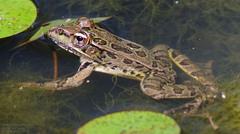
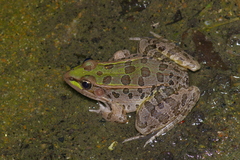
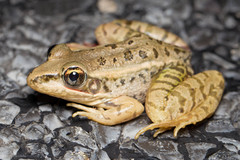
Rio Grande leopard frogs grow from 2.2 to 4.5 inches (5.6 to 11.4 cm) in length. They are usually tan, brown, or pale green in color, with distinctive black spotting with prominent light-colored ridges down either side of their backs. Their noses are angular, and they have long, powerful legs with webbed feet.

The species is primarily aquatic, and mostly nocturnal, though they can be often found during the day resting along the edge of the water. Despite their geographic range being mostly arid or semiarid, they inhabit permanent water sources, such as streams, creeks, and ponds. They are insectivorous, but like most frogs, will eat almost anything they can overpower and swallow. Mating occurs during... Wikipedia →

Sounds

Advertisement call0:38

United States · 2024

© Chris Harrison · XC904482 · CC BY-NC-SA 4.0

Recording1:33

United States · 2023

© k_mccormack · iNaturalist · CC BY-NC 4.0

Recording0:25

United States · 2026

© Betsy Brown · iNaturalist · CC BY-NC 4.0

Global Distribution

Parks Where Found

# Park Country Daily sighting probability
1 Padre Island National Seashore 🇺🇸 United States
~20%
2 Big Bend National Park 🇺🇸 United States
~20%
3 Cumbres de Monterrey National Park 🇲🇽 Mexico
~10%

Cities Where Found

# City Country Daily sighting probability
1 Austin 🇺🇸 United States
~10%
2 San Antonio 🇺🇸 United States
~10%
3 Monterrey 🇲🇽 México
~10%
4 Mesa 🇺🇸 United States
<5%

Zoos & Centres Where Found

# Zoo / Centre Country
1 Arizona-Sonora Desert Museum 🇺🇸 United States In captivity
2 Fluviário de Mora 🇵🇹 Portugal In captivity

Before you go

What are the chances of seeing a Rio Grande Leopard Frog in Big Bend National Park?

Possible

About 20% of wildlife watchers report a Rio Grande Leopard Frog sighting in Big Bend National Park on a given day, based on 49 verified sightings from GBIF citizen-science data from 2019 to 2026. It is the 2nd most-seen of the 8 amphibians we can rate there. Over three days the chance rises to about 50%, and over a week to about 80%, if each day is a fresh chance.

When is the best time to see a Rio Grande Leopard Frog in Big Bend National Park?

December

In that month about 30% of wildlife watchers report a Rio Grande Leopard Frog in Big Bend National Park on a given day, against under 5% in July–August and October, the lowest months.

What time of day is best to see a Rio Grande Leopard Frog?

Between 8 and 11 pm

Across all the parks we cover, that three-hour window holds the most Rio Grande Leopard Frog sightings with a recorded time, and about half of them come between 6 am and 6 pm: it is seen both by day and at night.

Is Big Bend National Park the best place to see a Rio Grande Leopard Frog?

Among the best

Of the 3 parks where we can rate Rio Grande Leopard Frog sightings, Big Bend National Park ranks 2nd at about 20%, level with the leaders once rounded. The best odds are in Padre Island National Seashore (United States, about 20%).

Where does the Rio Grande Leopard Frog sighting chance come from?

GBIF citizen-science records

It is estimated from how often the Rio Grande Leopard Frog is recorded against all the amphibians logged in Big Bend National Park (49 verified sightings from 2019 to 2026), calibrated against known sighting rates. Figures are rounded to the nearest 10% because citizen-science data supports honest approximations, not decimals, and months with records from fewer than five people show "—". How it works.

← Back to Big Bend National Park