Bird Nest Moth

Bird Nest Moth

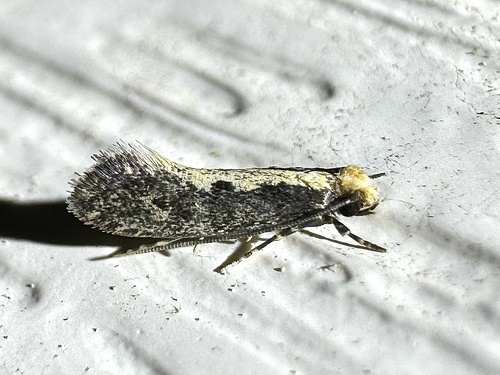
Monopis crocicapitella

Daily sighting probability ~10% · With luck
at Blue Mountains National Park

In 3 days ~20% in a week ~40%

14 Verified sightings at Blue Mountains National Park From 2019 to 2026
14 In 1 park
August Best month
☀️ Diurnal When it's spotted

About the Bird Nest Moth

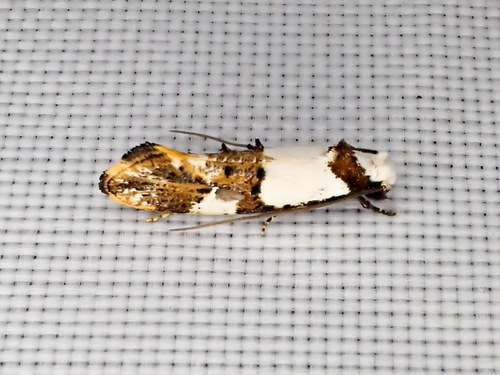
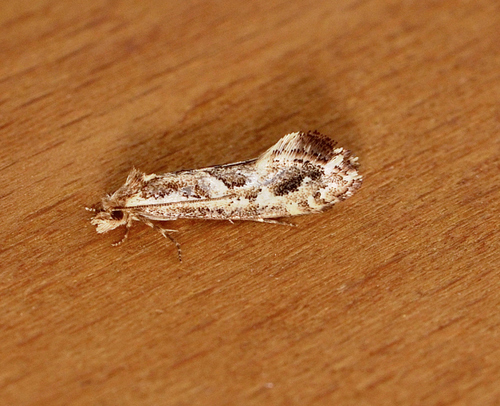
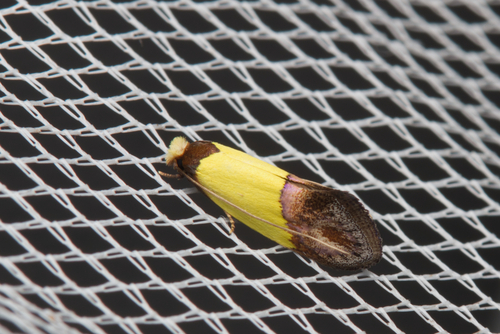
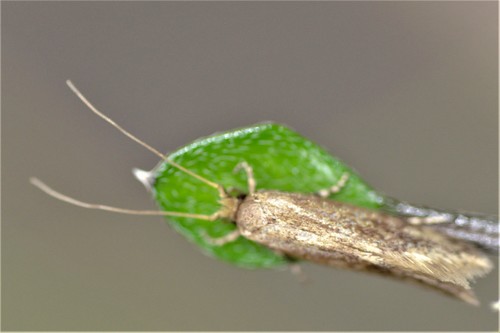
Monopis crocicapitella, the pale-backed clothes moth, or the bird-nest moth, is a moth of the family Tineidae described by James Brackenridge Clemens in 1859. It has a nearly cosmopolitan distribution. It was first described from the eastern United States.

The wingspan is 10–16 mm. In western Europe, adults are on wing from June to October. This species can easily be mistaken for Monopis obviella due to almost indistinguishable markings. The capability of this species to infest human dwellings is unknown. Larvae of this species were found to not survive at 51% relative humidity, thriving at 93% relative humidity.

Petersen, G., 1957: Die Genitalien der paläarktischen Tineiden (Lepidoptera: Tineidae). Beiträge zur Entomologie 7 (1/2): 55–176. Pelham-Clinton E.C., 1985.Tineidae. In: The Moths and Butterflies of Great Britain and Ireland (Heath J & Emmet AM, eds) 2: 152–207.

UKMoths Lepidoptera of Belgium Zimmerman, Elwood C. (1978). Insects of Hawaii. Vol. 9 Microlepidoptera. The University Press of Hawaii, Honolulu. hdl:10125/7338. "Taxonomy Browser: Monopis crocicapitella". Barcode of Life Data System. Retrieved July 21, 2018.

Lepiforum.de Wikipedia →
Global Distribution

Parks Where Found

# Park Country Daily sighting probability
1 Blue Mountains National Park 🇦🇺 Australia
~10%

More parks will be added in future updates.

Cities Where Found

# City Country Daily sighting probability
1 Auckland 🇳🇿 New Zealand
~10%
2 Rotterdam [The Hague] 🇳🇱 Netherlands
~10%
3 London 🇬🇧 United Kingdom
<5%
4 Boston 🇺🇸 United States
<5%
5 Seattle 🇺🇸 United States
<5%
6 Portland 🇺🇸 United States
<5%
7 Sacramento 🇺🇸 United States
<5%
8 San Diego 🇺🇸 United States
<5%
9 Vienna 🇦🇹 Austria
<5%
10 San Francisco 🇺🇸 United States
<5%

Before you go

What are the chances of seeing a Bird Nest Moth in Blue Mountains National Park?

With luck

About 10% of wildlife watchers report a Bird Nest Moth sighting in Blue Mountains National Park on a given day, based on 14 verified sightings from GBIF citizen-science data from 2019 to 2026. It is the 294th most-seen of the 789 insects we can rate there. Over three days the chance rises to about 20%, and over a week to about 40%, if each day is a fresh chance.

When is the best time to see a Bird Nest Moth in Blue Mountains National Park?

August

In that month about 20% of wildlife watchers report a Bird Nest Moth in Blue Mountains National Park on a given day, against under 5% in March–June and December, the lowest months. That is one of Blue Mountains National Park's driest months, with about 50 mm of rain against 150 mm in March.

What time of day is best to see a Bird Nest Moth?

Between 9 am and noon

Across all the parks we cover, that three-hour window holds the most Bird Nest Moth sightings with a recorded time, and nearly all of them come between 6 am and 6 pm: it is a daytime animal.

Where else can you see a Bird Nest Moth?

Only Blue Mountains National Park, in our data

Blue Mountains National Park is the only park on Wallace's Line with enough records to rate Bird Nest Moth sightings: about 10% of wildlife watchers there report one on a given day.

Which relatives of the Bird Nest Moth live in Blue Mountains National Park?

Same genus: Monopis

The closest relatives of the Bird Nest Moth that you can see in Blue Mountains National Park (genus Monopis) are Wool Moth (about 10%) and Blotched Monopis Moth (about 10%), with each one's daily chance of a sighting.

Where does the Bird Nest Moth sighting chance come from?

GBIF citizen-science records

It is estimated from how often the Bird Nest Moth is recorded against all the insects logged in Blue Mountains National Park (14 verified sightings from 2019 to 2026), calibrated against known sighting rates. Figures are rounded to the nearest 10% because citizen-science data supports honest approximations, not decimals, and months with records from fewer than five people show "—". How it works.

← Back to Blue Mountains National Park