Giant Burrowing Frog

Giant Burrowing Frog

Heleioporus australiacus

Silhouette: Dmitry Bogdanov (vectorized by T. Michael Keesey) · PhyloPic

LCNTVUENEndangeredCR Endemic
Daily sighting probability ~10% · With luck
at Blue Mountains National Park

In 3 days ~10% in a week ~30%

6 Verified sightings at Blue Mountains National Park From 2019 to 2026
28 In all 2 parks
January Best month
🌙 Nocturnal When it's spotted

About the Giant Burrowing Frog

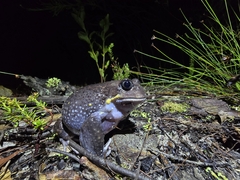
The giant burrowing frog or eastern owl frog (Heleioporus australiacus) is a large frog species that occurs in coastal south-east New South Wales and Victoria in Australia. It is also known as the owl frog, southern owl frog, spotted owl frog, burrowing owl frog.

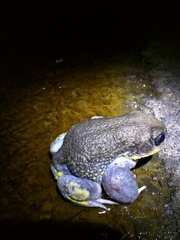
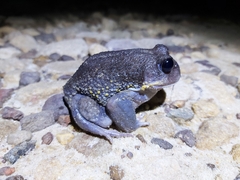
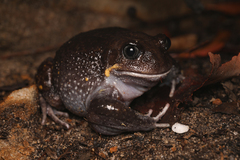
This is a large species of frog, up to 10 centimetres (3.9 in) in length. It is normally grey, dark brown or black on the back. It is white on the belly. There are yellow spots on the side and a yellow stripe on the upper lip, from the back of the eye to the back of the tympanum. In metamorph frogs, this stripe is pink-orange in colour. The skin is rough and bumpy, males often have black spines on their fingers during the breeding season. The iris is silver and the pupil is vertical.

This is quite a large species of frog and the largest frog in Victoria. It is often mistaken for the cane toad because of its large size and bumpy skin; however, cane toads do not have vertical irises, and the range of the cane toad currently does not overlap into giant burrowing frog habitat.

This species inhabits sandstone heathland, dry, and also wet sclerophyll forest from north of Sydney to eastern... Wikipedia →

Sounds

Recording0:22

Australia · 2024

© JIN Pin-Tsen · iNaturalist · CC BY-NC 4.0

Recording0:26

Australia · 2021

© Matt Clancy · iNaturalist · CC BY-NC 4.0

Recording0:23

Australia · 2024

© Jono Dashper · iNaturalist · CC BY-NC 4.0

Global Distribution

Parks Where Found

# Park Country Daily sighting probability
1 Royal National Park 🇦🇺 Australia
~20%
2 Blue Mountains National Park 🇦🇺 Australia
~10%

Before you go

What are the chances of seeing a Giant Burrowing Frog in Blue Mountains National Park?

With luck

About 10% of wildlife watchers report a Giant Burrowing Frog sighting in Blue Mountains National Park on a given day, based on 6 verified sightings from GBIF citizen-science data from 2019 to 2026. It is the 12th most-seen of the 12 amphibians we can rate there. Over three days the chance rises to about 10%, and over a week to about 30%, if each day is a fresh chance.

When is the best time to see a Giant Burrowing Frog in Blue Mountains National Park?

January–March and October

In those months about 10% of wildlife watchers report a Giant Burrowing Frog in Blue Mountains National Park on a given day, against under 5% in April–September and November–December, the lowest months. Those are among Blue Mountains National Park's wettest months, with about 120 mm of rain a month against 40 mm in May.

What time of day is best to see a Giant Burrowing Frog?

Between 8 and 11 pm

Across all the parks we cover, that three-hour window holds the most Giant Burrowing Frog sightings with a recorded time, and about 9 in 10 of them come between 6 pm and 6 am: it is mostly seen at night.

Is Blue Mountains National Park the best place to see a Giant Burrowing Frog?

2nd of 2

Of the 2 parks where we can rate Giant Burrowing Frog sightings, Blue Mountains National Park ranks 2nd at about 10%. The best odds are in Royal National Park (Australia, about 20%).

Which relatives of the Giant Burrowing Frog live in Blue Mountains National Park?

Same family: Limnodynastidae

The closest relatives of the Giant Burrowing Frog that you can see in Blue Mountains National Park (family Limnodynastidae, Foam-nesting Ground Frogs) are Striped Marsh Frog (about 30%) and Pobblebonk (about 10%), with each one's daily chance of a sighting.

Where does the Giant Burrowing Frog sighting chance come from?

GBIF citizen-science records

It is estimated from how often the Giant Burrowing Frog is recorded against all the amphibians logged in Blue Mountains National Park (6 verified sightings from 2019 to 2026), calibrated against known sighting rates. Figures are rounded to the nearest 10% because citizen-science data supports honest approximations, not decimals, and months with records from fewer than five people show "—". How it works.

← Back to Blue Mountains National Park