Red-crowned Toadlet

Red-crowned Toadlet

Pseudophryne australis

Silhouette: Jose Carlos Arenas-Monroy · PhyloPic

LCNTNear ThreatenedVUENCR Endemic
Daily sighting probability ~10% · With luck
at Blue Mountains National Park

In 3 days ~30% in a week ~50%

19 Verified sightings at Blue Mountains National Park From 2019 to 2026
44 In all 2 parks
September Best month
☀️🌙 Day & Night When it's spotted

About the Red-crowned Toadlet

The red-crowned toadlet (Pseudophryne australis) is a species of Australian ground frog, restricted to the Sydney Basin, New South Wales. It is only found around sandstone escarpment areas around Sydney, from Ourimbah in the north, Nowra to the south and the Blue Mountains areas to the west.

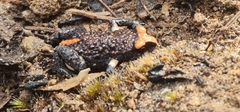
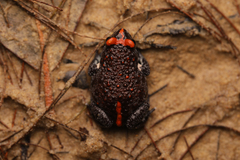
This is a small species of frog, reaching 30 mm in length. It is characterised by the red T-shaped mark on its head. It is dark brown or black above with a red wash or spots over its back, and a red mark near the vent. The sides are a blue-grey and there is a white mark in the armpits and thighs. The ventral surface is very strongly marbled black and white, with a bluish colour in some areas between the black and white.

This species is only found around temporary creeks and soaks in sandstone habitats in woodland, heathland and dry sclerophyll forest around the Sydney basin. Males make an ark call from nest sites under leaf litter and rocks, in areas likely to be inundated, generally only after heavy rain. Eggs are laid under leaf litter and tadpoles begin developing inside the egg, the males stays with the eggs in the nest. Once heavy rain floods the... Wikipedia →

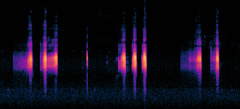
Sounds

Recording0:08

Australia · 2021

© guydutson · iNaturalist · CC BY-NC 4.0

Recording0:31

Australia · 2026

© hlogie · iNaturalist · CC BY-NC 4.0

Recording0:23

Australia · 2023

© Jono Dashper · iNaturalist · CC BY-NC 4.0

Global Distribution

Parks Where Found

# Park Country Daily sighting probability
1 Royal National Park 🇦🇺 Australia
~20%
2 Blue Mountains National Park 🇦🇺 Australia
~10%

Cities Where Found

# City Country Daily sighting probability
1 Sydney 🇦🇺 Australia
<5%

Before you go

What are the chances of seeing a Red-crowned Toadlet in Blue Mountains National Park?

With luck

About 10% of wildlife watchers report a Red-crowned Toadlet sighting in Blue Mountains National Park on a given day, based on 19 verified sightings from GBIF citizen-science data from 2019 to 2026. It is the 8th most-seen of the 12 amphibians we can rate there. Over three days the chance rises to about 30%, and over a week to about 50%, if each day is a fresh chance.

When is the best time to see a Red-crowned Toadlet in Blue Mountains National Park?

September

In that month about 20% of wildlife watchers report a Red-crowned Toadlet in Blue Mountains National Park on a given day, against under 5% in April and June–July, the lowest months. That is one of Blue Mountains National Park's driest months, with about 50 mm of rain against 150 mm in March.

What time of day is best to see a Red-crowned Toadlet?

Between 8 and 11 pm

Across all the parks we cover, that three-hour window holds the most Red-crowned Toadlet sightings with a recorded time, and about half of them come between 6 am and 6 pm: it is seen both by day and at night.

Is Blue Mountains National Park the best place to see a Red-crowned Toadlet?

2nd of 2

Of the 2 parks where we can rate Red-crowned Toadlet sightings, Blue Mountains National Park ranks 2nd at about 10%. The best odds are in Royal National Park (Australia, about 20%).

Which relatives of the Red-crowned Toadlet live in Blue Mountains National Park?

Same family: Myobatrachidae

The closest relatives of the Red-crowned Toadlet that you can see in Blue Mountains National Park (family Myobatrachidae, Australian Ground Frogs) are Common Eastern Froglet (about 30%) and Smooth Toadlet (about 10%), with each one's daily chance of a sighting.

Where does the Red-crowned Toadlet sighting chance come from?

GBIF citizen-science records

It is estimated from how often the Red-crowned Toadlet is recorded against all the amphibians logged in Blue Mountains National Park (19 verified sightings from 2019 to 2026), calibrated against known sighting rates. Figures are rounded to the nearest 10% because citizen-science data supports honest approximations, not decimals, and months with records from fewer than five people show "—". How it works.

← Back to Blue Mountains National Park