
Glossy Black-Cockatoo

Glossy Black-Cockatoo

Calyptorhynchus lathami

Silhouette: Ferran Sayol · PhyloPic

LCNTVUVulnerableENCR Endemic
Daily sighting probability ~10% · With luck
at Blue Mountains National Park

In 3 days ~20% in a week ~30%

538 Verified sightings at Blue Mountains National Park From 2019 to 2026
1,139 In all 5 parks
October Best month
☀️ Diurnal When it's spotted

About the Glossy Black-Cockatoo

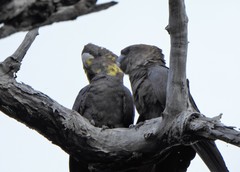
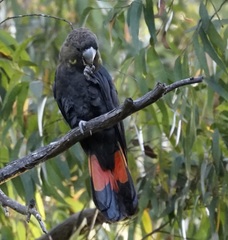
The glossy black cockatoo (Calyptorhynchus lathami) is a species of bird found in Australia. It is the smallest member of the subfamily Calyptorhynchinae, and found in eastern Australia. Adult glossy black cockatoos may reach 50 cm (19.5 in) in length. They are sexually dimorphic. Males are blackish brown, except for their prominent sub-terminal red tail bands; the females are dark brownish with idiosyncratic yellow marking around the neck and prominent sub-terminal tail band of red with black bars.

Three subspecies have been recognised. Wikipedia →

Sounds

Call0:45

Australia · 2026

© Marc Anderson · XC1084923 · CC BY-NC-ND 4.0

Begging call1:13

Australia · 2019

© Greg McLachlan · XC503216 · CC BY-NC-SA 4.0

Song0:58

Australia · 2023

© nick talbot · XC794569 · CC BY-NC-SA 4.0

Global Distribution

Parks Where Found

# Park Country Daily sighting probability
1 Booderee National Park 🇦🇺 Australia
~10%
2 Blue Mountains National Park 🇦🇺 Australia
~10%
3 Springbrook National Park 🇦🇺 Australia
<5%
4 Lamington National Park 🇦🇺 Australia
<5%
5 Noosa National Park 🇦🇺 Australia
<5%

Cities Where Found

# City Country Daily sighting probability
1 Sydney 🇦🇺 Australia
<5%

Zoos & Centres Where Found

# Zoo / Centre Country
1 Lone Pine Koala Sanctuary 🇦🇺 Australia In captivity
2 Bird Paradise 🇸🇬 Singapore In captivity
3 Rainforest Wild Asia 🇸🇬 Singapore In captivity
4 Paphos Zoo 🇨🇾 Cyprus In captivity
5 Loro Parque 🇪🇸 Spain In captivity
6 Featherdale Sydney Wildlife Park 🇦🇺 Australia In captivity
7 Tralaga Wildlife park 🇦🇺 Australia In captivity

Before you go

What are the chances of seeing a Glossy Black-Cockatoo in Blue Mountains National Park?

With luck

About 10% of wildlife watchers report a Glossy Black-Cockatoo sighting in Blue Mountains National Park on a given day, based on 538 verified sightings from GBIF citizen-science data from 2019 to 2026. It is the 76th most-seen of the 196 birds we can rate there. Over three days the chance rises to about 20%, and over a week to about 30%, if each day is a fresh chance.

When is the best time to see a Glossy Black-Cockatoo in Blue Mountains National Park?

July and September–March

In those months about 10% of wildlife watchers report a Glossy Black-Cockatoo in Blue Mountains National Park on a given day, against under 5% in April–June and August, the lowest months.

What time of day is best to see a Glossy Black-Cockatoo?

Between 9 am and noon

Across all the parks we cover, that three-hour window holds the most Glossy Black-Cockatoo sightings with a recorded time, and nearly all of them come between 6 am and 6 pm: it is a daytime animal.

Is Blue Mountains National Park the best place to see a Glossy Black-Cockatoo?

Among the best

Of the 5 parks where we can rate Glossy Black-Cockatoo sightings, Blue Mountains National Park ranks 2nd at about 10%, level with the leaders once rounded. The best odds are in Booderee National Park (Australia, about 10%).

Where does the Glossy Black-Cockatoo sighting chance come from?

GBIF citizen-science records

It is estimated from how often the Glossy Black-Cockatoo is recorded against all the birds logged in Blue Mountains National Park (538 verified sightings from 2019 to 2026), calibrated against known sighting rates. Figures are rounded to the nearest 10% because citizen-science data supports honest approximations, not decimals, and months with records from fewer than five people show "—". How it works.

← Back to Blue Mountains National Park