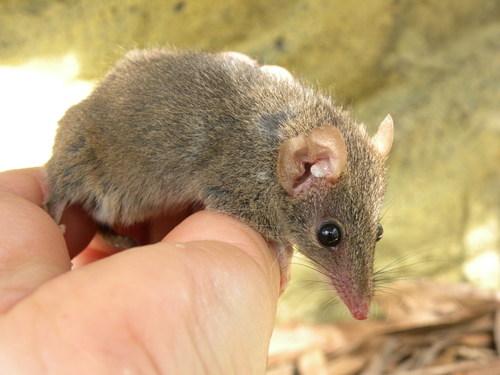
Tiger Quoll

Tiger Quoll

Dasyurus maculatus

Silhouette: Sarah Werning · PhyloPic

LCNTNear ThreatenedVUENCR Endemic
Daily sighting probability ~10% · With luck
at Blue Mountains National Park

In 3 days ~30% in a week ~50%

21 Verified sightings at Blue Mountains National Park From 2019 to 2026
21 In 1 park
April Best month
☀️🌙 Day & Night When it's spotted

About the Tiger Quoll

The tiger quoll (Dasyurus maculatus), also known as the spotted-tailed quoll, spotted quoll, spotted-tailed dasyure, or tiger cat, is a carnivorous marsupial of the quoll genus Dasyurus native to Australia. With males and females weighing around 3.5 and 1.8 kg (7.7 and 4.0 lb), respectively, it is the world's second-largest extant carnivorous marsupial, behind the Tasmanian devil. Two subspecies are recognised; the nominate is found in wet forests of southeastern Australia and Tasmania, and a northern subspecies, D. m. gracilis, is found in a small area of northern Queensland and is endangered.

The tiger quoll commonly preys on small mammals, insects, birds, domestic poultry and large marsupials such as wombats. It mostly hunts live prey but occasionally scavenges when the opportunity arises. The tiger quoll kills its prey by executing a killing bite to the base of the skull or top of the neck, depending on the size of the prey. The species is listed as near-threatened on the IUCN Red List, and is primarily threatened by habitat loss caused by human activities.

The tiger quoll is the largest of the quolls. Adult females of the northern subspecies are generally smaller... Wikipedia →

Sounds

Call0:04

Australia · 2020

© Marc Anderson · XC979792 · CC BY-NC-ND 4.0

Recording0:07

Australia · 2024

© larkinc_91 · iNaturalist · CC BY-NC 4.0

Global Distribution

Parks Where Found

# Park Country Daily sighting probability
1 Blue Mountains National Park 🇦🇺 Australia
~10%

More parks will be added in future updates.

Zoos & Centres Where Found

# Zoo / Centre Country
1 Kyabram Fauna Park 🇦🇺 Australia In captivity
2 Australia Walkabout Wildlife Park 🇦🇺 Australia In captivity
3 Taronga Zoo 🇦🇺 Australia In captivity
4 Phillip Island Wildlife Park 🇦🇺 Australia In captivity
5 East Coast Natureworld 🇦🇺 Australia In captivity
6 Moonlit Sanctuary Wildlife Conservation Park 🇦🇺 Australia In captivity
7 Rainforestation Nature Park 🇦🇺 Australia In captivity
8 Featherdale Sydney Wildlife Park 🇦🇺 Australia In captivity
9 Bonorong Wildlife Sanctuary 🇦🇺 Australia In captivity
10 Ipswich Nature Centre 🇦🇺 Australia In captivity
11 devils@cradle 🇦🇺 Australia In captivity
12 Sea Life Sydney Aquarium 🇦🇺 Australia In captivity
13 Wild Life Sydney 🇦🇺 Australia In captivity
14 Caversham Wildlife Park 🇦🇺 Australia In captivity
15 Ranger Red’s Zoo & Conservation Park 🇦🇺 Australia In captivity
16 Trowunna Wildlife Park 🇦🇺 Australia In captivity
17 Wildlife Habitat Port Douglas 🇦🇺 Australia In captivity

Before you go

What are the chances of seeing a Tiger Quoll in Blue Mountains National Park?

With luck

About 10% of wildlife watchers report a Tiger Quoll sighting in Blue Mountains National Park on a given day, based on 21 verified sightings from GBIF citizen-science data from 2019 to 2026. It is the 13th most-seen of the 21 mammals we can rate there. Over three days the chance rises to about 30%, and over a week to about 50%, if each day is a fresh chance.

When is the best time to see a Tiger Quoll in Blue Mountains National Park?

April

In that month about 20% of wildlife watchers report a Tiger Quoll in Blue Mountains National Park on a given day, against under 5% in June, the lowest month.

What time of day is best to see a Tiger Quoll?

Between 8 and 11 am

Across all the parks we cover, that three-hour window holds the most Tiger Quoll sightings with a recorded time, and about 6 in 10 of them come between 6 am and 6 pm: it is seen both by day and at night.

Where else can you see a Tiger Quoll?

Only Blue Mountains National Park, in our data

Blue Mountains National Park is the only park on Wallace's Line with enough records to rate Tiger Quoll sightings: about 10% of wildlife watchers there report one on a given day.

Where does the Tiger Quoll sighting chance come from?

GBIF citizen-science records

It is estimated from how often the Tiger Quoll is recorded against all the mammals logged in Blue Mountains National Park (21 verified sightings from 2019 to 2026), calibrated against known sighting rates. Figures are rounded to the nearest 10% because citizen-science data supports honest approximations, not decimals, and months with records from fewer than five people show "—". How it works.

← Back to Blue Mountains National Park