




Completed


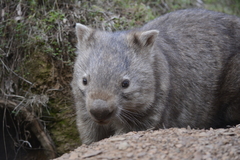
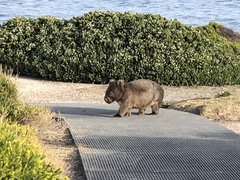

Common Wombat
Vombatus ursinus
Silhouette: Sarah Werning · PhyloPic
- KingdomAnimalia (Animals)
- PhylumChordata (Chordates)
- ClassMammalia (Mammals)
- OrderDiprotodontia (Kangaroos, Possums, Wombats, and Allies)
- FamilyVombatidae (Wombats)
- GenusVombatus (Bare-nosed Wombats)
- SpeciesVombatus ursinus (Common Wombat)
In 3 days ~50% in a week ~80%
59 Verified sightings at Blue Mountains National Park From 2019 to 2026
1,920 In all 6 parks
August Best month
☀️ Diurnal When it's spotted
About the Common Wombat
The common wombat (Vombatus ursinus), also known as the bare-nosed wombat, is a marsupial, one of three extant species of wombats and the sole extant member of the genus Vombatus. It has three subspecies: Vombatus ursinus hirsutus, found on the Australian mainland;
Vombatus ursinus tasmaniensis (Tasmanian wombat), found in Tasmania; and Vombatus ursinus ursinus (Bass Strait wombat), found on Flinders Island and Maria Island in the Bass Strait. The mainland subspecies is the largest of the three, with its largest specimens measuring up to 1.2 m (3 ft 11 in) and 35 kg (77 lb). The common wombat is herbivorous, mainly nocturnal, and lives in burrows. Being a marsupial, its joeys inhabit a pouch on the mother for around five months after birth.
The common wombat was first described by George Shaw in 1800. Wikipedia →
Sounds
Call0:04
Australia · 2020
© Marc Anderson · XC959819 · CC BY-NC-ND 4.0
Recording0:26
Australia · 2025
© katyw · iNaturalist · CC BY-NC 4.0
Recording0:15
Australia · 2024
© Julie K · iNaturalist · CC BY-NC 4.0
Recent sightings of Common Wombat in Blue Mountains National Park
LIVEiNaturalistGlobal Distribution
Parks Where Found
| # | Park | Country | Daily sighting probability |
|---|---|---|---|
| 1 | Maria Island National Park | 🇦🇺 Australia | |
| 2 | Cradle Mountain-Lake St Clair National Park | 🇦🇺 Australia | |
| 3 | Wilsons Promontory National Park | 🇦🇺 Australia | |
| 4 | Kosciuszko National Park | 🇦🇺 Australia | |
| 5 | Freycinet National Park | 🇦🇺 Australia | |
| 6 | Blue Mountains National Park | 🇦🇺 Australia |
Cities Where Found
| # | City | Country | Daily sighting probability |
|---|---|---|---|
| 1 | Melbourne | 🇦🇺 Australia |
Zoos & Centres Where Found
Closest Relatives at Blue Mountains National Park



Before you go
What are the chances of seeing a Common Wombat in Blue Mountains National Park?
Possible
About 20% of wildlife watchers report a Common Wombat sighting in Blue Mountains National Park on a given day, based on 59 verified sightings from GBIF citizen-science data from 2019 to 2026. It is the 6th most-seen of the 21 mammals we can rate there. Over three days the chance rises to about 50%, and over a week to about 80%, if each day is a fresh chance.
When is the best time to see a Common Wombat in Blue Mountains National Park?
August
In that month about 40% of wildlife watchers report a Common Wombat in Blue Mountains National Park on a given day, against about 10% in October and December–February, the lowest months. That is one of Blue Mountains National Park's driest months, with about 50 mm of rain against 150 mm in March.
What time of day is best to see a Common Wombat?
Between 3 and 6 pm
Across all the parks we cover, that three-hour window holds the most Common Wombat sightings with a recorded time, and about 8 in 10 of them come between 6 am and 6 pm: it is a daytime animal.
Is Blue Mountains National Park the best place to see a Common Wombat?
6th of 6
Of the 6 parks where we can rate Common Wombat sightings, Blue Mountains National Park ranks 6th at about 20%. The best odds are in Maria Island National Park (Australia, over 90%), Cradle Mountain-Lake St Clair National Park (Australia, over 90%) and Wilsons Promontory National Park (Australia, about 90%). All parks ranked.
Which relatives of the Common Wombat live in Blue Mountains National Park?
Same order: Diprotodontia
The closest relatives of the Common Wombat that you can see in Blue Mountains National Park (order Diprotodontia, Kangaroos, Possums, Wombats, and Allies) are Eastern Grey Kangaroo (about 30%), Common Brushtail (about 30%) and Common Ringtail Possum (about 30%), with each one's daily chance of a sighting.
Where does the Common Wombat sighting chance come from?
GBIF citizen-science records
It is estimated from how often the Common Wombat is recorded against all the mammals logged in Blue Mountains National Park (59 verified sightings from 2019 to 2026), calibrated against known sighting rates. Figures are rounded to the nearest 10% because citizen-science data supports honest approximations, not decimals, and months with records from fewer than five people show "—". How it works.
