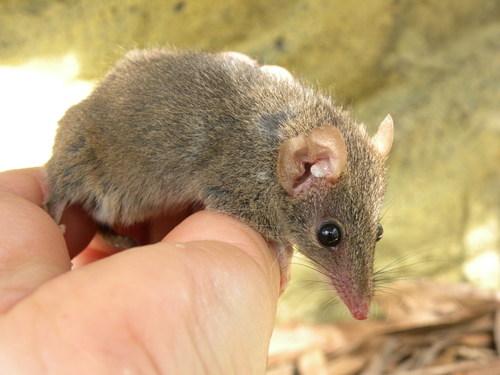
Common Brushtail

Common Brushtail

Trichosurus vulpecula

Silhouette: Gavin Prideaux · PhyloPic

LCLeast ConcernNTVUENCR Endemic
Daily sighting probability ~30% · Possible
at Blue Mountains National Park

In 3 days ~60% in a week ~90%

101 Verified sightings at Blue Mountains National Park From 2019 to 2026
789 In all 22 parks
May Best month
🌅 Crepuscular When it's spotted

About the Common Brushtail

The common brushtail possum (Trichosurus vulpecula, from the Greek for "furry tailed" and the Latin for "little fox", previously in the genus Phalangista) is a nocturnal, semiarboreal marsupial of the family Phalangeridae, native to Australia and invasive in New Zealand, and the second-largest of the Australasian possums.

Like most possums, the common brushtail possum is nocturnal. It is mainly a folivore, but has been known to eat small mammals such as rats. In most Australian habitats, eucalyptus leaves are a significant part of the diet, but rarely the sole item eaten. Its tail is prehensile and naked on its lower underside. The four colour variations are silver-grey, brown, black, and gold.

It is the Australian marsupial most often seen by city dwellers, as it is one of few that thrive in cities and a wide range of natural and human-modified environments. Around human habitations, common brushtails are inventive and determined foragers with a liking for fruit trees, vegetable gardens, and kitchen raids. Its once vast distribution has been greatly affected by drought, epizootic disease and intrusion of invasive mammals into its habitat.

The common brushtail possum was introduced to New Zealand in the 1850s to establish a fur industry, but in the mild subtropical climate of New Zealand, and with few to no natural predators, it thrived to the extent that it became a major agricultural and conservation pest. Wikipedia →

Sounds

Call0:15

Australia · 2024

© Marc Anderson · XC1104548 · CC BY-NC-ND 4.0

Call0:23

Australia · 2023

© Romuald Mikusek · XC1054596 · CC BY-NC-SA 4.0

Recording1:17

Australia · 2026

© Mononymous · iNaturalist · CC BY-NC 4.0

Global Distribution

Parks Where Found

# Park Country Daily sighting probability
1 Cradle Mountain-Lake St Clair National Park 🇦🇺 Australia
~60%
2 Aoraki Mount Cook National Park 🇳🇿 New Zealand
~40%
3 Egmont National Park 🇳🇿 New Zealand
~40%
4 Maria Island National Park 🇦🇺 Australia
~40%
5 Wilsons Promontory National Park 🇦🇺 Australia
~40%
6 Booderee National Park 🇦🇺 Australia
~40%
7 Flinders Ranges National Park 🇦🇺 Australia
~40%
8 Freycinet National Park 🇦🇺 Australia
~40%
9 Kosciuszko National Park 🇦🇺 Australia
~30%
10 Arthur's Pass National Park 🇳🇿 New Zealand
~30%
11 Flinders Chase 🇦🇺 Australia
~30%
12 Rakiura National Park 🇳🇿 New Zealand
~30%
13 Blue Mountains National Park 🇦🇺 Australia
~30%
14 Hattah-Kulkyne National Park 🇦🇺 Australia
~20%
15 Royal National Park 🇦🇺 Australia
~20%
16 Great Otway National Park 🇦🇺 Australia
~20%
17 Grampians National Park 🇦🇺 Australia
~20%
18 Kakadu National Park 🇦🇺 Australia
~20%
19 Fiordland National Park 🇳🇿 New Zealand
~10%
20 Lamington National Park 🇦🇺 Australia
~10%
21 Springbrook National Park 🇦🇺 Australia
~10%
22 Abel Tasman National Park 🇳🇿 New Zealand
~10%

Cities Where Found

# City Country Daily sighting probability
1 Brisbane 🇦🇺 Australia
~40%
2 Hobart 🇦🇺 Australia
~30%
3 Melbourne 🇦🇺 Australia
~30%
4 Auckland 🇳🇿 New Zealand
~20%
5 Sydney 🇦🇺 Australia
~20%
6 Perth 🇦🇺 Australia
~10%

Zoos & Centres Where Found

# Zoo / Centre Country
1 Australia Zoo 🇦🇺 Australia In captivity
2 Tama Zoological Park 🇯🇵 Japan In captivity
3 Currumbin Wildlife Sanctuary 🇦🇺 Australia In captivity
4 Perth Zoo 🇦🇺 Australia In captivity
5 Krakow Zoo 🇵🇱 Poland In captivity
6 Adelaide Zoo 🇦🇺 Australia In captivity
7 Willowbank Wildlife Reserve 🇳🇿 New Zealand In captivity
8 Paradise Valley Springs 🇳🇿 New Zealand In captivity
9 Featherdale Sydney Wildlife Park 🇦🇺 Australia In captivity
10 Kiwi Park 🇳🇿 New Zealand In captivity
11 Bonorong Wildlife Sanctuary 🇦🇺 Australia In captivity
12 Caversham Wildlife Park 🇦🇺 Australia In captivity
13 Ranger Red’s Zoo & Conservation Park 🇦🇺 Australia In captivity
14 Wildlife Habitat Port Douglas 🇦🇺 Australia In captivity

Before you go

What are the chances of seeing a Common Brushtail in Blue Mountains National Park?

Possible

About 30% of wildlife watchers report a Common Brushtail sighting in Blue Mountains National Park on a given day, based on 101 verified sightings from GBIF citizen-science data from 2019 to 2026. It is the 2nd most-seen of the 21 mammals we can rate there. Over three days the chance rises to about 60%, and over a week to about 90%, if each day is a fresh chance.

When is the best time to see a Common Brushtail in Blue Mountains National Park?

May and June

In those months about 40% of wildlife watchers report a Common Brushtail in Blue Mountains National Park on a given day, against about 20% in July, September–October and December–January, the lowest months.

What time of day is best to see a Common Brushtail?

Between 7 and 10 pm

Across all the parks we cover, that three-hour window holds the most Common Brushtail sightings with a recorded time, and about 7 in 10 of them come between 6 pm and 6 am: it is most active around dawn and dusk.

Which relatives of the Common Brushtail live in Blue Mountains National Park?

Same order: Diprotodontia

The closest relatives of the Common Brushtail that you can see in Blue Mountains National Park (order Diprotodontia, Kangaroos, Possums, Wombats, and Allies) are Eastern Grey Kangaroo (about 30%), Common Ringtail Possum (about 30%) and Swamp Wallaby (about 20%), with each one's daily chance of a sighting.

Where does the Common Brushtail sighting chance come from?

GBIF citizen-science records

It is estimated from how often the Common Brushtail is recorded against all the mammals logged in Blue Mountains National Park (101 verified sightings from 2019 to 2026), calibrated against known sighting rates. Figures are rounded to the nearest 10% because citizen-science data supports honest approximations, not decimals, and months with records from fewer than five people show "—". How it works.

← Back to Blue Mountains National Park