
Square-tailed Kite

Square-tailed Kite

Lophoictinia isura

Silhouette: Sheatherius · PhyloPic

LCLeast ConcernNTVUENCR Endemic
Daily sighting probability <5% · Rare
at Booderee National Park

In 3 days <5% in a week ~10%

31 Verified sightings at Booderee National Park From 2019 to 2026
328 In all 4 parks
May Best month
☀️ Diurnal When it's spotted

About the Square-tailed Kite

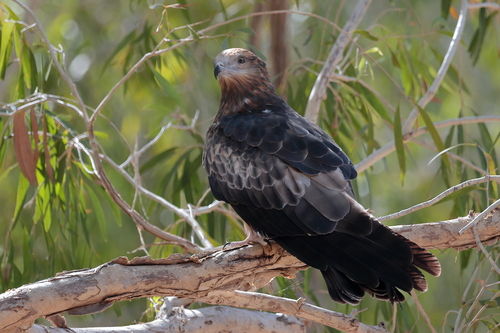
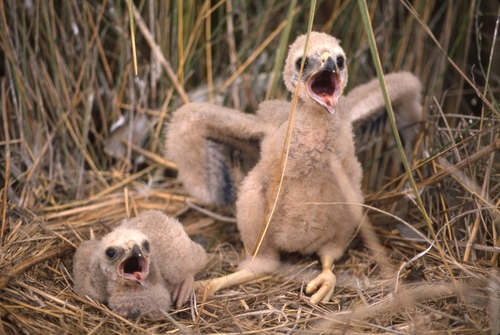
The square-tailed kite (Lophoictinia isura) is a medium-sized bird of prey native to Australia. It is in the family Accipitridae, which also includes many other diurnal raptors such as kites, eagles and harriers. German naturalist Johann Jakob Kaup described the square-tailed kite in 1847.

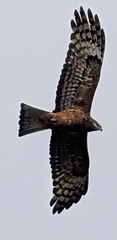
The square-tailed kite is monomorphic with no recorded geographic variations. As an adult the square-tailed kite is a medium-sized raptor, with the following features: Length: 50–56 cm (tail is about half the length of bird)

Wingspan: 130–145 cm Weight: Male-501g, Female-650g As an adult, the squared-tailed kite has a white face, with pale eyes and black streaks across the crown. The breast is also heavily streaked. The ventral surface of the wings has a rufous-brown lining, a dark carpal crescent, and a boldly barred finger. There is also a pale white patch on the ventral surface of the wings, at the base of the primary feathers; the saddle, rump and central upper tail-coverts are blackish, while the upper tail-coverts are grey-brown and fade into a small pale patch above the tail. The tail itself is square with dark sub-terminal band. Square... Wikipedia →

Sounds

Call0:13

Australia · 2026

© Marc Anderson · XC1177049 · CC BY-NC-ND 4.0

Call0:22

Australia · 2019

© Greg McLachlan · XC494230 · CC BY-NC-SA 4.0

Call0:07

Australia · 2020

© Tom Tarrant · XC574553 · CC BY-NC-SA 4.0

Global Distribution

Parks Where Found

# Park Country Daily sighting probability
1 Blue Mountains National Park 🇦🇺 Australia
<5%
2 Royal National Park 🇦🇺 Australia
<5%
3 Booderee National Park 🇦🇺 Australia
<5%
4 Lamington National Park 🇦🇺 Australia
<5%

Cities Where Found

# City Country Daily sighting probability
1 Brisbane 🇦🇺 Australia
<5%
2 Sydney 🇦🇺 Australia
<5%
3 Perth 🇦🇺 Australia
<5%

Before you go

What are the chances of seeing a Square-tailed Kite in Booderee National Park?

Rare

Under 5% of wildlife watchers report a Square-tailed Kite sighting in Booderee National Park on a given day, based on 31 verified sightings from GBIF citizen-science data from 2019 to 2026. It is the 122nd most-seen of the 128 birds we can rate there. Over three days the chance rises to under 5%, and over a week to about 10%, if each day is a fresh chance.

When is the best time to see a Square-tailed Kite in Booderee National Park?

May

In that month about 10% of wildlife watchers report a Square-tailed Kite in Booderee National Park on a given day, against under 5% in June to April, the lowest months.

What time of day is best to see a Square-tailed Kite?

Between 11 am and 2 pm

Across all the parks we cover, that three-hour window holds the most Square-tailed Kite sightings with a recorded time, and nearly all of them come between 6 am and 6 pm: it is a daytime animal.

Is Booderee National Park the best place to see a Square-tailed Kite?

Among the best

Of the 4 parks where we can rate Square-tailed Kite sightings, Booderee National Park ranks 3rd at under 5%, level with the leaders once rounded. The best odds are in Blue Mountains National Park (Australia, under 5%) and Royal National Park (Australia, under 5%).

Which relatives of the Square-tailed Kite live in Booderee National Park?

Same family: Accipitridae

The closest relatives of the Square-tailed Kite that you can see in Booderee National Park (family Accipitridae, Hawks, Eagles, and Kites) are White-Bellied Sea-Eagle (about 40%) and Whistling Kite (about 20%), with each one's daily chance of a sighting.

Where does the Square-tailed Kite sighting chance come from?

GBIF citizen-science records

It is estimated from how often the Square-tailed Kite is recorded against all the birds logged in Booderee National Park (31 verified sightings from 2019 to 2026), calibrated against known sighting rates. Figures are rounded to the nearest 10% because citizen-science data supports honest approximations, not decimals, and months with records from fewer than five people show "—". How it works.

← Back to Booderee National Park