
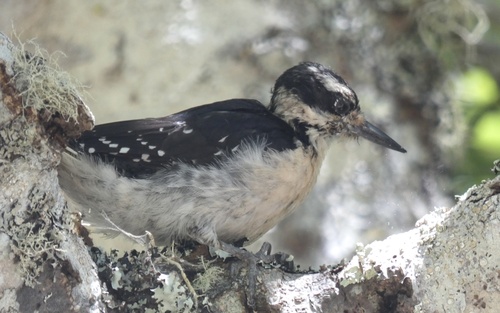
Prong-billed Barbet

Prong-billed Barbet

Semnornis frantzii

Silhouette: Sheatherius · PhyloPic

LCLeast ConcernNTVUENCR
Daily sighting probability ~10% · With luck
at Braulio Carrillo National Park

In 3 days ~40% in a week ~70%

658 Verified sightings at Braulio Carrillo National Park From 2019 to 2026
8,004 In all 7 parks
November Best month
☀️ Diurnal When it's spotted

About the Prong-billed Barbet

The prong-billed barbet (Semnornis frantzii) is a distinctive, relatively large-billed bird native to humid highland forest of Costa Rica and western Panama. The prong-billed barbet was traditionally placed in family Capitonidae sensu lato with both Neotropic and Old World barbets. However, morphological, hybridization, and DNA studies have confirmed that this arrangement is paraphyletic; New World barbets are more closely related to toucans than they are to Old World barbets. Therefore New World (Capitonidae sensu stricto), African (Lybiidae), and Asian (Megalaimidae) barbets were each accorded their own families. The prong-billed barbet and the toucan barbet (Semnornis ramphastinus) were placed in the new family Semnornithidae.

The prong-billed barbet is monotypic. Its specific epithet commemorates the German naturalist Alexander von Frantzius. The prong-billed barbet is 17 to 18.5 cm (6.7 to 7.3 in) long and weighs about 60 to 70 g (2.1 to 2.5 oz). Its bill is silvery gray to bluish with a dark tip; a notch on the tip of the mandible provides its English name. The maxilla has a hooked tip and a notch on the side. Adults have a dull... Wikipedia →

Sounds

Duet0:22

Costa Rica · 2010

© Peter Boesman · XC274430 · CC BY-NC-ND 4.0

Call0:32

Costa Rica · 2026

© Paul Driver · XC1085752 · CC BY-NC-SA 4.0

Song0:18

Costa Rica · 2019

© GABRIEL LEITE · XC489725 · CC BY-NC-SA 4.0

Global Distribution

Parks Where Found

# Park Country Daily sighting probability
1 Poás Volcano National Park 🇨🇷 Costa Rica
~60%
2 Volcán Barú National Park 🇵🇦 Panama
~30%
3 Monteverde Cloud Forest Reserve 🇨🇷 Costa Rica
~20%
4 Braulio Carrillo National Park 🇨🇷 Costa Rica
~10%
5 La Amistad International Park (Panama) 🇵🇦 Panama
~10%
6 Tapantí-Macizo de la Muerte National Park 🇨🇷 Costa Rica
<5%
7 Arenal Volcano National Park 🇨🇷 Costa Rica
<5%

Before you go

What are the chances of seeing a Prong-billed Barbet in Braulio Carrillo National Park?

With luck

About 10% of wildlife watchers report a Prong-billed Barbet sighting in Braulio Carrillo National Park on a given day, based on 658 verified sightings from GBIF citizen-science data from 2019 to 2026. It is the 89th most-seen of the 505 birds we can rate there. Over three days the chance rises to about 40%, and over a week to about 70%, if each day is a fresh chance.

When is the best time to see a Prong-billed Barbet in Braulio Carrillo National Park?

November

In that month about 30% of wildlife watchers report a Prong-billed Barbet in Braulio Carrillo National Park on a given day, against about 10% in August, October and December–March, the lowest months. That is one of Braulio Carrillo National Park's wettest months, with about 550 mm of rain against 170 mm in April.

What time of day is best to see a Prong-billed Barbet?

Between 1 and 4 pm

Across all the parks we cover, that three-hour window holds the most Prong-billed Barbet sightings with a recorded time, and about 9 in 10 of them come between 6 am and 6 pm: it is a daytime animal.

Which relatives of the Prong-billed Barbet live in Braulio Carrillo National Park?

Same order: Piciformes

The closest relatives of the Prong-billed Barbet that you can see in Braulio Carrillo National Park (order Piciformes, Woodpeckers and Allies) are Black-mandibled Toucan (about 40%), Black-cheeked Woodpecker (about 40%) and Collared Aracari (about 30%), with each one's daily chance of a sighting.

Where does the Prong-billed Barbet sighting chance come from?

GBIF citizen-science records

It is estimated from how often the Prong-billed Barbet is recorded against all the birds logged in Braulio Carrillo National Park (658 verified sightings from 2019 to 2026), calibrated against known sighting rates. Figures are rounded to the nearest 10% because citizen-science data supports honest approximations, not decimals, and months with records from fewer than five people show "—". How it works.

← Back to Braulio Carrillo National Park