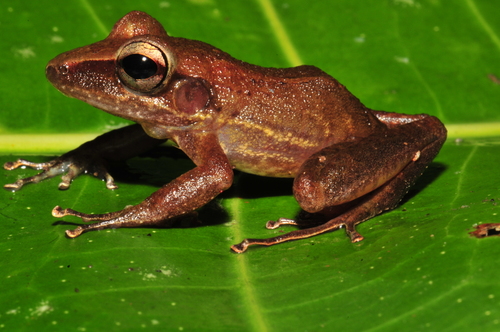
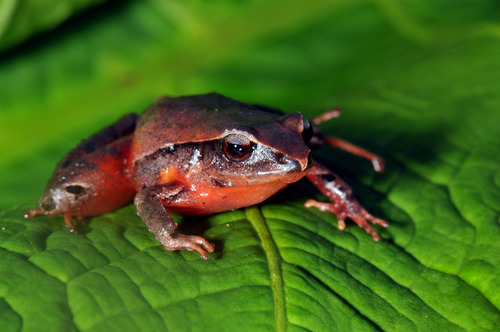
Pygmy Rain Frog

Pygmy Rain Frog

Pristimantis ridens

Silhouette: Dmitry Bogdanov (vectorized by T. Michael Keesey) · PhyloPic

LCLeast ConcernNTVUENCR
Daily sighting probability ~20% · Possible
at Braulio Carrillo National Park

In 3 days ~60% in a week ~90%

56 Verified sightings at Braulio Carrillo National Park From 2019 to 2026
285 In all 5 parks
March Best month
🌙 Nocturnal When it's spotted

About the Pygmy Rain Frog

Pristimantis ridens, also known as the pygmy rain frog and the Rio San Juan robber frog, is a species of frog in the family Strabomantidae. It is found in Nicaragua, Costa Rica, Panama and western Colombia. The first description of the species was published in 1866 by Edward Drinker Cope, who placed it in the genus Phyllobates. The holotype was collected by Robert Kennicott, with the type locality being the San Juan River of Nicaragua. The holotype was deposited into the collection of the United States National Museum, but has since been lost. In 1885, Cope erected the genus Hypodictyon and moved ridens to it.

In 1888, George Albert Boulenger moved the species to Syrrhophus; a genus erected by Cope in 1878 that was later deemed to be synonymous with Eleutherodactylus by George S. Myers in 1962, which was ignored by other writers until 1989, when Stephen Blair Hedges published a paper coming to the same conclusion and treating Syrrhophus as a subgenus of Eleutherodactylus.

By the time that synonymy was established, Edward Harrison Taylor had already moved the species to Eleutherodactylus, doing so in 1952; however, due to a different synonymy, the first placement of the... Wikipedia →

Global Distribution

Parks Where Found

# Park Country Daily sighting probability
1 Tenorio Volcano National Park 🇨🇷 Costa Rica
~30%
2 Monteverde Cloud Forest Reserve 🇨🇷 Costa Rica
~30%
3 Braulio Carrillo National Park 🇨🇷 Costa Rica
~20%
4 Arenal Volcano National Park 🇨🇷 Costa Rica
~20%
5 Chirripó National Park 🇨🇷 Costa Rica
~20%

Zoos & Centres Where Found

# Zoo / Centre Country
1 International Animal Rescue – Costa Rica 🇨🇷 Costa Rica In captivity

Closest Relatives at Braulio Carrillo National Park

Before you go

What are the chances of seeing a Pygmy Rain Frog in Braulio Carrillo National Park?

Possible

About 20% of wildlife watchers report a Pygmy Rain Frog sighting in Braulio Carrillo National Park on a given day, based on 56 verified sightings from GBIF citizen-science data from 2019 to 2026. It is the 16th most-seen of the 46 amphibians we can rate there. Over three days the chance rises to about 60%, and over a week to about 90%, if each day is a fresh chance.

When is the best time to see a Pygmy Rain Frog in Braulio Carrillo National Park?

March

In that month about 40% of wildlife watchers report a Pygmy Rain Frog in Braulio Carrillo National Park on a given day, against under 5% in June, September and November, the lowest months.

What time of day is best to see a Pygmy Rain Frog?

Between 6 and 9 pm

Across all the parks we cover, that three-hour window holds the most Pygmy Rain Frog sightings with a recorded time, and about 9 in 10 of them come between 6 pm and 6 am: it is mostly seen at night.

Is Braulio Carrillo National Park the best place to see a Pygmy Rain Frog?

3rd of 5

Of the 5 parks where we can rate Pygmy Rain Frog sightings, Braulio Carrillo National Park ranks 3rd at about 20%. The best odds are in Tenorio Volcano National Park (Costa Rica, about 30%) and Monteverde Cloud Forest Reserve (Costa Rica, about 30%).

Which relatives of the Pygmy Rain Frog live in Braulio Carrillo National Park?

Same genus: Pristimantis

The closest relatives of the Pygmy Rain Frog that you can see in Braulio Carrillo National Park (genus Pristimantis, Rain and Robber Frogs) are Golden-groined Robber Frog (about 10%) and Clay-colored Rain Frog (about 10%), with each one's daily chance of a sighting.

Where does the Pygmy Rain Frog sighting chance come from?

GBIF citizen-science records

It is estimated from how often the Pygmy Rain Frog is recorded against all the amphibians logged in Braulio Carrillo National Park (56 verified sightings from 2019 to 2026), calibrated against known sighting rates. Figures are rounded to the nearest 10% because citizen-science data supports honest approximations, not decimals, and months with records from fewer than five people show "—". How it works.

← Back to Braulio Carrillo National Park