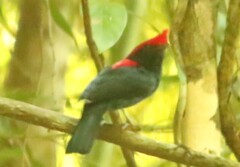
White-crowned Manakin

White-crowned Manakin

Pipra pipra

Silhouette: Edwin Price · PhyloPic

Daily sighting probability <5% · Rare
at Braulio Carrillo National Park

In 3 days ~10% in a week ~20%

114 Verified sightings at Braulio Carrillo National Park From 2019 to 2026
799 In all 9 parks
January Best month
☀️ Diurnal When it's spotted

About the White-crowned Manakin

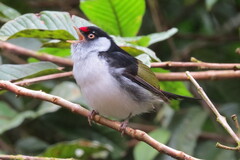
The white-crowned manakin (Pseudopipra pipra) is a small passerine bird in the manakin family Pipridae. This common and extremely widespread manakin is one of the most easily identified, even in female plumage. It is a resident breeder in the tropical New World from Costa Rica to northeastern Peru and eastern Brazil. It was traditionally placed in the genus Pipra, but is now placed in its own monotypic genus Pseudopipra. It is a small, compact bird about 10 cm (3.9 in) long. Males have black plumage with a white crown which can be erected as a crest, the only member of the Pipridae to possess both an all-black body and a gleaming white crown. Females and juveniles are olive-green, with a grey head and throat, and greyish-green or olive underparts. At breeding time, males are involved in a lekking behaviour. This is a fairly common species with a wide range, and the International Union for Conservation of Nature has rated its conservation status as being of "least concern".

The white-crowned manakin was formally described by the Swedish naturalist Carl Linnaeus in 1758 in the tenth edition of his Systema Naturae and given the binomial name Parus pipra. Linnaeus based... Wikipedia →

Sounds

Recording0:10

Brazil · 2015

© Luciano Bernardes · iNaturalist · CC BY-NC 4.0

Recording0:37

Colombia · 2024

© dbeadle · iNaturalist · CC BY-NC 4.0

Global Distribution

Parks Where Found

# Park Country Daily sighting probability
1 Brownsberg Nature Park 🇸🇷 Suriname
~10%
2 Yasuní National Park 🇪🇨 Ecuador
~10%
3 Anavilhanas National Park 🇧🇷 Brazil
~10%
4 Tapantí-Macizo de la Muerte National Park 🇨🇷 Costa Rica
<5%
5 Podocarpus National Park 🇪🇨 Ecuador
<5%
6 Cuyabeno Wildlife Reserve 🇪🇨 Ecuador
<5%
7 Braulio Carrillo National Park 🇨🇷 Costa Rica
<5%
8 Farallones de Cali National Natural Park 🇨🇴 Colombia
<5%
9 La Amistad International Park (Panama) 🇵🇦 Panama
<5%

Zoos & Centres Where Found

# Zoo / Centre Country
1 Dallas World Aquarium 🇺🇸 United States In captivity

Before you go

What are the chances of seeing a White-crowned Manakin in Braulio Carrillo National Park?

Rare

Under 5% of wildlife watchers report a White-crowned Manakin sighting in Braulio Carrillo National Park on a given day, based on 114 verified sightings from GBIF citizen-science data from 2019 to 2026. It is the 320th most-seen of the 505 birds we can rate there. Over three days the chance rises to about 10%, and over a week to about 20%, if each day is a fresh chance.

When is the best time to see a White-crowned Manakin in Braulio Carrillo National Park?

December and January

In those months about 10% of wildlife watchers report a White-crowned Manakin in Braulio Carrillo National Park on a given day, against under 5% in February to November, the lowest months.

What time of day is best to see a White-crowned Manakin?

Between 10 am and 1 pm

Across all the parks we cover, that three-hour window holds the most White-crowned Manakin sightings with a recorded time, and about 9 in 10 of them come between 6 am and 6 pm: it is a daytime animal.

Is Braulio Carrillo National Park the best place to see a White-crowned Manakin?

7th of 9

Of the 9 parks where we can rate White-crowned Manakin sightings, Braulio Carrillo National Park ranks 7th at under 5%. The best odds are in Brownsberg Nature Park (Suriname, about 10%), Yasuní National Park (Ecuador, about 10%) and Anavilhanas National Park (Brazil, about 10%).

Where does the White-crowned Manakin sighting chance come from?

GBIF citizen-science records

It is estimated from how often the White-crowned Manakin is recorded against all the birds logged in Braulio Carrillo National Park (114 verified sightings from 2019 to 2026), calibrated against known sighting rates. Figures are rounded to the nearest 10% because citizen-science data supports honest approximations, not decimals, and months with records from fewer than five people show "—". How it works.

← Back to Braulio Carrillo National Park