Amazonian Pygmy-Owl

Amazonian Pygmy-Owl

Glaucidium hardyi

Silhouette: Edwin Price · PhyloPic

LCLeast ConcernNTVUENCR
Daily sighting probability <5% · Rare
at Brownsberg Nature Park

In 3 days ~10% in a week ~20%

10 Verified sightings at Brownsberg Nature Park From 2019 to 2026
730 In all 3 parks
August Best month
☀️ Diurnal When it's spotted

About the Amazonian Pygmy-Owl

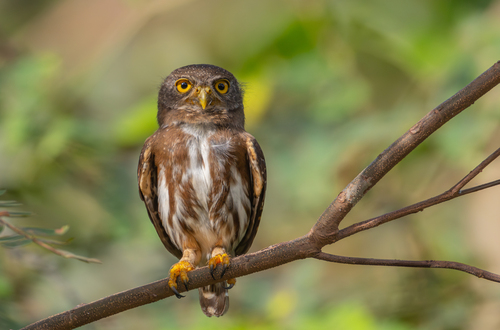
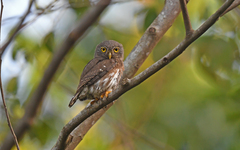
The Amazonian pygmy owl (Glaucidium hardyi), also known as Hardy's pygmy owl, is an owl found in northern South America and the Amazon Basin. A member of the Strigidae family, it is a true owl. The Amazonian pygmy owl is a member of the Strigidae family, the true owls. It is in the genus Glaucidium, the pygmy owls, which are widely distributed across the Americas, Africa, and Eurasia. Until 1989, the Amazonian pygmy owl was not considered distinct from the least pygmy owl (Glaucidium minutissimum). New research suggested that the Amazonian pygmy owl was distinct, restricting the least pygmy owl to Atlantic forests of southeastern Brazil. The holotype for the species is located at the Department of Zoology at the Universidade Estadual de Campinas, Brazil. Phylogenetic studies on Glaucidium have been limited, but some analyses suggest that the Amazonian pygmy owl is closely related to the Andean pygmy owl (Glaucidium jardinii) and the Yungas pygmy owl (Glaucidium bolivianum).

The Amazonian pygmy owl is very small, which is indicated by its name "glaucidium", meaning little owl. Adults have a large round head that is spotted with... Wikipedia →

Sounds

Song1:03

Peru · 2024

© Richard E. Webster · XC964930 · CC BY-NC-SA 4.0

Canto1:13

Brazil · 2015

© Caio Brito · XC427416 · CC BY-NC-SA 4.0

Song0:04

Brazil · 2023

© JAYRSON ARAUJO DE OLIVEIRA · XC821798 · CC BY-NC-SA 4.0

Global Distribution

Parks Where Found

# Park Country Daily sighting probability
1 Tambopata National Reserve 🇵🇪 Peru
~10%
2 Manu National Park 🇵🇪 Peru
~10%
3 Brownsberg Nature Park 🇸🇷 Suriname
<5%

Before you go

What are the chances of seeing an Amazonian Pygmy-Owl in Brownsberg Nature Park?

Rare

Under 5% of wildlife watchers report an Amazonian Pygmy-Owl sighting in Brownsberg Nature Park on a given day, based on 10 verified sightings from GBIF citizen-science data from 2019 to 2026. It is the 182nd most-seen of the 221 birds we can rate there. Over three days the chance rises to about 10%, and over a week to about 20%, if each day is a fresh chance.

When is the best time to see an Amazonian Pygmy-Owl in Brownsberg Nature Park?

April and August

In those months about 10% of wildlife watchers report an Amazonian Pygmy-Owl in Brownsberg Nature Park on a given day, against under 5% in September to March, the lowest months. May to July have too few records to rate.

What time of day is best to see an Amazonian Pygmy-Owl?

Between 8 and 11 am

Across all the parks we cover, that three-hour window holds the most Amazonian Pygmy-Owl sightings with a recorded time, and about 7 in 10 of them come between 6 am and 6 pm: it is a daytime animal.

Is Brownsberg Nature Park the best place to see an Amazonian Pygmy-Owl?

3rd of 3

Of the 3 parks where we can rate Amazonian Pygmy-Owl sightings, Brownsberg Nature Park ranks 3rd at under 5%. The best odds are in Tambopata National Reserve (Peru, about 10%) and Manu National Park (Peru, about 10%).

Which relatives of the Amazonian Pygmy-Owl live in Brownsberg Nature Park?

Same family: Strigidae

The closest relatives of the Amazonian Pygmy-Owl that you can see in Brownsberg Nature Park (family Strigidae, Typical Owls) are Foothill Screech-Owl (about 20%) and Spectacled Owl (about 10%), with each one's daily chance of a sighting.

Where does the Amazonian Pygmy-Owl sighting chance come from?

GBIF citizen-science records

It is estimated from how often the Amazonian Pygmy-Owl is recorded against all the birds logged in Brownsberg Nature Park (10 verified sightings from 2019 to 2026), calibrated against known sighting rates. Figures are rounded to the nearest 10% because citizen-science data supports honest approximations, not decimals, and months with records from fewer than five people show "—". How it works.

← Back to Brownsberg Nature Park