Black-and-white-casqued Hornbill

Black-and-white-casqued Hornbill

Bycanistes subcylindricus

Silhouette: Charles J. Sharp and T. Michael Keesey · PhyloPic

LCLeast ConcernNTVUENCR
Daily sighting probability ~20% · Possible
at Bwindi Impenetrable National Park

In 3 days ~50% in a week ~80%

464 Verified sightings at Bwindi Impenetrable National Park From 2019 to 2026
2,333 In all 9 parks
March Best month
☀️ Diurnal When it's spotted

About the Black-and-white-casqued Hornbill

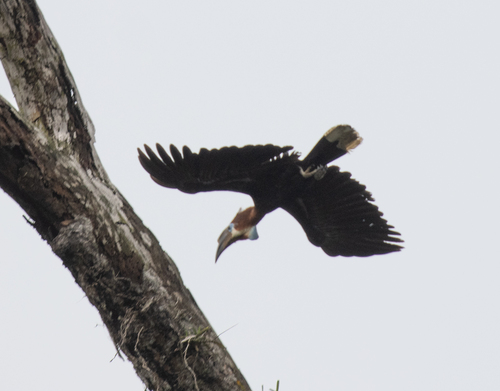
The black-and-white-casqued hornbill (Bycanistes subcylindricus), also known as the grey-cheeked hornbill, is a large black and white hornbill. It has an oversized blackish bill with a large casque on top. The female is slightly smaller than the male and has a significantly smaller casque.

It is a monogamous species, and pairs nest in suitable tree cavities. The female usually lays up to two eggs. The diet consists mainly of figs, fruits, insects and small animals found in the trees. Widespread and still locally common, the black-and-white-casqued hornbill is assessed as least concern on the IUCN Red List of Threatened Species.

Bycanistes subcylindricus is part of the Bycanistes genus of sub-Saharian hornbills which currently include a total of six known species that all share a black and white plummage and are mostly frugivores. This genus has recently been related to the Bucorvus genus, known as Ground Hornbills. Most of the species in that genus have a casque, which is larger in males than females. The closest relative to the black-and-white-casqued hornbill is Bycanistes cylindricus or brown-cheeked hornbill which inhabits a similar habitat range. Wikipedia →

Sounds

Call0:10

Uganda · 2025

© Bernard BOUSQUET · XC1052679 · CC BY-NC-SA 4.0

Call0:14

Kenya · 2023

© Brendan Sloan · XC819142 · CC BY-NC-ND 4.0

Call0:31

Uganda · 2022

© Peter Boesman · XC739459 · CC BY-NC-ND 4.0

Global Distribution

Parks Where Found

# Park Country Daily sighting probability
1 Kibale National Park 🇺🇬 Uganda
~60%
2 Semuliki National Park 🇺🇬 Uganda
~40%
3 Bwindi Impenetrable National Park 🇺🇬 Uganda
~20%
4 Nyungwe National Park 🇷🇼 Rwanda
~10%
5 Queen Elizabeth National Park 🇺🇬 Uganda
~10%
6 Virunga National Park 🇨🇩 Democratic Republic of the Congo
~10%
7 Murchison Falls National Park 🇺🇬 Uganda
<5%
8 Masai Mara National Reserve 🇰🇪 Kenya
<5%
9 Lake Mburo National Park 🇺🇬 Uganda
<5%

Cities Where Found

# City Country Daily sighting probability
1 Kampala 🇺🇬 Uganda
~60%

Zoos & Centres Where Found

# Zoo / Centre Country
1 Réserve africaine de Sigean 🇫🇷 France In captivity
2 Abilene Zoological Gardens 🇺🇸 United States In captivity
3 Ramat Gan Safari 🇮🇱 Israel In captivity
4 La Palmyre Zoo 🇫🇷 France In captivity
5 Chapultepec Zoo 🇲🇽 Mexico In captivity
6 Biotropica 🇫🇷 France In captivity
7 The Abilene Zoo 🇺🇸 United States In captivity
8 World of Birds Wildlife Sanctuary and Monkey Park 🇿🇦 South Africa In captivity
9 Zoo Lagos 🇵🇹 Portugal In captivity

Before you go

What are the chances of seeing a Black-and-white-casqued Hornbill in Bwindi Impenetrable National Park?

Possible

About 20% of wildlife watchers report a Black-and-white-casqued Hornbill sighting in Bwindi Impenetrable National Park on a given day, based on 464 verified sightings from GBIF citizen-science data from 2019 to 2026. It is the 62nd most-seen of the 400 birds we can rate there. Over three days the chance rises to about 50%, and over a week to about 80%, if each day is a fresh chance.

When is the best time to see a Black-and-white-casqued Hornbill in Bwindi Impenetrable National Park?

January to March

In those months about 30% of wildlife watchers report a Black-and-white-casqued Hornbill in Bwindi Impenetrable National Park on a given day, against about 10% in April and October, the lowest months. Those are among Bwindi Impenetrable National Park's driest months, with about 110 mm of rain a month against 320 mm in October.

What time of day is best to see a Black-and-white-casqued Hornbill?

Between 6 and 9 am

Across all the parks we cover, that three-hour window holds the most Black-and-white-casqued Hornbill sightings with a recorded time, and about 8 in 10 of them come between 6 am and 6 pm: it is a daytime animal.

Is Bwindi Impenetrable National Park the best place to see a Black-and-white-casqued Hornbill?

3rd of 9

Of the 9 parks where we can rate Black-and-white-casqued Hornbill sightings, Bwindi Impenetrable National Park ranks 3rd at about 20%. The best odds are in Kibale National Park (Uganda, about 60%) and Semuliki National Park (Uganda, about 40%).

Where does the Black-and-white-casqued Hornbill sighting chance come from?

GBIF citizen-science records

It is estimated from how often the Black-and-white-casqued Hornbill is recorded against all the birds logged in Bwindi Impenetrable National Park (464 verified sightings from 2019 to 2026), calibrated against known sighting rates. Figures are rounded to the nearest 10% because citizen-science data supports honest approximations, not decimals, and months with records from fewer than five people show "—". How it works.

← Back to Bwindi Impenetrable National Park