Mackinnon's Shrike

Mackinnon's Shrike

Lanius mackinnoni

Silhouette: Andy Wilson · PhyloPic

LCLeast ConcernNTVUENCR
Daily sighting probability ~30% · Possible
at Bwindi Impenetrable National Park

In 3 days ~60% in a week ~90%

567 Verified sightings at Bwindi Impenetrable National Park From 2019 to 2026
1,142 In all 7 parks
October Best month
☀️ Diurnal When it's spotted

About the Mackinnon's Shrike

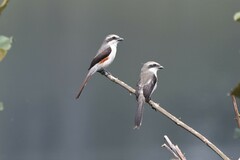
Mackinnon's shrike (Lanius mackinnoni), also called Mackinnon's fiscal, is a songbird species of the family Laniidae. Its natural habitats are subtropical or tropical moist montane forests and moist savanna. It is not considered a threatened species by the IUCN.The population of this species is increasing, which is thought to be due to the degradation of nearby habitat. Its common name and Latin binomial commemorate Archibald Donald MacKinnon.

Mackinnon's shrike grows to a length of about 20 cm (8 in). The adult male has a greyish-black head and mantle, a white supercilium, white scapulars and black wings. The tail is black with white margins and the underparts are white, sometimes tinged with buff. The female is similar except for having rufous patches on the flanks. The juvenile is greyish-brown and heavily barred.

Mackinnon's fiscal is found in tropical humid parts of Central Africa. It has a disjunct range (from the Obudu Plateau to northern Angola on one hand and across northern Congo, the Ruwenzori and Lake Victoria regions on the other). It is found in forest edges, clearings, secondary growth and bushy areas, from sea level up... Wikipedia →

Sounds

Alarm call0:23

Kenya · 2022

© Oliver Fowler · XC709247 · CC BY-NC-SA 4.0

Song1:05

Cameroon · 2015

© Paweł Szymański · XC296081 · CC BY-NC-SA 4.0

Call1:28

Cameroon · 2012

© Mike Nelson · XC99345 · CC BY-NC-ND 2.5

Global Distribution

Parks Where Found

# Park Country Daily sighting probability
1 Bwindi Impenetrable National Park 🇺🇬 Uganda
~30%
2 Volcanoes National Park 🇷🇼 Rwanda
~30%
3 Nyungwe National Park 🇷🇼 Rwanda
~20%
4 Kibale National Park 🇺🇬 Uganda
~10%
5 Virunga National Park 🇨🇩 Democratic Republic of the Congo
~10%
6 Akagera National Park 🇷🇼 Rwanda
<5%
7 Queen Elizabeth National Park 🇺🇬 Uganda
<5%

Cities Where Found

# City Country Daily sighting probability
1 Kigali 🇷🇼 Rwanda
<5%

Before you go

What are the chances of seeing a Mackinnon's Shrike in Bwindi Impenetrable National Park?

Possible

About 30% of wildlife watchers report a Mackinnon's Shrike sighting in Bwindi Impenetrable National Park on a given day, based on 567 verified sightings from GBIF citizen-science data from 2019 to 2026. It is the 48th most-seen of the 400 birds we can rate there. Over three days the chance rises to about 60%, and over a week to about 90%, if each day is a fresh chance.

When is the best time to see a Mackinnon's Shrike in Bwindi Impenetrable National Park?

May–July and October–December

In those months about 30% of wildlife watchers report a Mackinnon's Shrike in Bwindi Impenetrable National Park on a given day, against about 10% in January, the lowest month.

What time of day is best to see a Mackinnon's Shrike?

Between noon and 3 pm

Across all the parks we cover, that three-hour window holds the most Mackinnon's Shrike sightings with a recorded time, and about 8 in 10 of them come between 6 am and 6 pm: it is a daytime animal.

Is Bwindi Impenetrable National Park the best place to see a Mackinnon's Shrike?

Yes

Of the 7 parks where we can rate Mackinnon's Shrike sightings, Bwindi Impenetrable National Park has the highest daily chance: about 30%. Next come Volcanoes National Park (Rwanda, about 30%) and Nyungwe National Park (Rwanda, about 20%).

Where does the Mackinnon's Shrike sighting chance come from?

GBIF citizen-science records

It is estimated from how often the Mackinnon's Shrike is recorded against all the birds logged in Bwindi Impenetrable National Park (567 verified sightings from 2019 to 2026), calibrated against known sighting rates. Figures are rounded to the nearest 10% because citizen-science data supports honest approximations, not decimals, and months with records from fewer than five people show "—". How it works.

← Back to Bwindi Impenetrable National Park