

Blue Bunting

Blue Bunting

Cyanocompsa parellina

Silhouette: Sheatherius · PhyloPic

LCLeast ConcernNTVUENCR
Daily sighting probability ~30% · Possible
at Calakmul Biosphere Reserve

In 3 days ~70% in a week ~90%

303 Verified sightings at Calakmul Biosphere Reserve From 2019 to 2026
1,385 In all 6 parks
July Best month
☀️ Diurnal When it's spotted

About the Blue Bunting

The blue bunting (Cyanocompsa parellina) is a species of passerine in the family Cardinalidae, the cardinals or cardinal grosbeaks. It is found in Belize, El Salvador, Guatemala, Honduras, Mexico, and Nicaragua. French naturalist Charles Lucien Bonaparte described the blue bunting in 1850 as Passerina parellina, and then Cyanoloxia parellina. German ornithologist Jean Cabanis defined the genus Cyanocompsa in 1861, giving it its current binomial name.

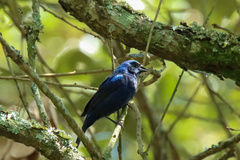
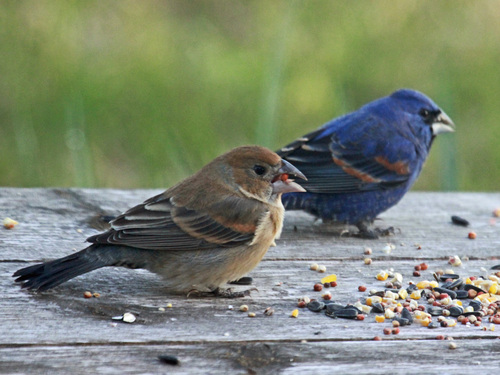
The blue bunting is the only member of its genus. The nominate subspecies of blue bunting is 13 to 14 cm (5.1 to 5.5 in) long. Males weigh 11 to 24 g (0.39 to 0.85 oz) and females 9.8 to 21 g (0.35 to 0.74 oz). The nominate male is various shades of blue, sky blue on the forehead and cheek, blackish blue on the upperparts, ultramarine on the rump, and the underparts from chin to belly deep blue. The adult and immature females are overall dull brownish, with a reddish tinge to the belly. The immature male is overall... Wikipedia →

Sounds

Song0:52

Guatemala · 2024

© Peter Boesman · XC880059 · CC BY-NC-ND 4.0

Call0:20

Belize · 2019

© Paul Driver · XC522430 · CC BY-NC-SA 4.0

Song0:23

Mexico · 2021

© Aziza Cooper · XC643773 · CC BY-NC-SA 4.0

Global Distribution

Parks Where Found

# Park Country Daily sighting probability
1 Calakmul Biosphere Reserve 🇲🇽 Mexico
~30%
2 Sian Ka'an Biosphere Reserve 🇲🇽 Mexico
~20%
3 Tikal National Park 🇬🇹 Guatemala
~20%
4 Cañón del Sumidero National Park 🇲🇽 Mexico
~10%
5 Cumbres de Monterrey National Park 🇲🇽 Mexico
~10%
6 Biotopo Cerro Cahuí 🇬🇹 Guatemala
<5%

Cities Where Found

# City Country Daily sighting probability
1 San Pedro Sula 🇭🇳 Honduras
<5%
2 San Antonio 🇺🇸 United States
<5%

Zoos & Centres Where Found

# Zoo / Centre Country
1 Xcaret 🇲🇽 Mexico In captivity

Before you go

What are the chances of seeing a Blue Bunting in Calakmul Biosphere Reserve?

Possible

About 30% of wildlife watchers report a Blue Bunting sighting in Calakmul Biosphere Reserve on a given day, based on 303 verified sightings from GBIF citizen-science data from 2019 to 2026. It is the 29th most-seen of the 271 birds we can rate there. Over three days the chance rises to about 70%, and over a week to about 90%, if each day is a fresh chance.

When is the best time to see a Blue Bunting in Calakmul Biosphere Reserve?

July

In that month about 50% of wildlife watchers report a Blue Bunting in Calakmul Biosphere Reserve on a given day, against about 20% in January and August, the lowest months.

What time of day is best to see a Blue Bunting?

Between 8 and 11 am

Across all the parks we cover, that three-hour window holds the most Blue Bunting sightings with a recorded time, and about 9 in 10 of them come between 6 am and 6 pm: it is a daytime animal.

Is Calakmul Biosphere Reserve the best place to see a Blue Bunting?

Yes

Of the 6 parks where we can rate Blue Bunting sightings, Calakmul Biosphere Reserve has the highest daily chance: about 30%. Next come Sian Ka'an Biosphere Reserve (Mexico, about 20%) and Tikal National Park (Guatemala, about 20%).

Where does the Blue Bunting sighting chance come from?

GBIF citizen-science records

It is estimated from how often the Blue Bunting is recorded against all the birds logged in Calakmul Biosphere Reserve (303 verified sightings from 2019 to 2026), calibrated against known sighting rates. Figures are rounded to the nearest 10% because citizen-science data supports honest approximations, not decimals, and months with records from fewer than five people show "—". How it works.

← Back to Calakmul Biosphere Reserve