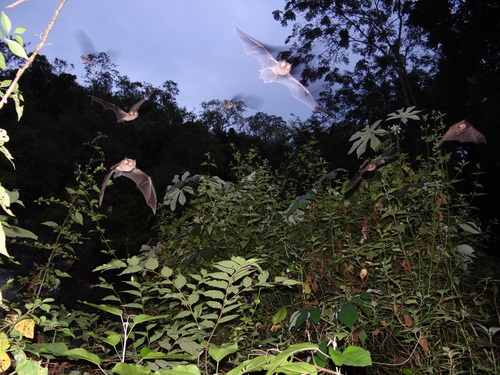
Pygmy Fruit Eating Bat

Pygmy Fruit Eating Bat

Artibeus phaeotis

Silhouette: Jorge D. Carballo-Morales, based on a photo by Mario Barroso · PhyloPic

Daily sighting probability ~10% · With luck
at Calakmul Biosphere Reserve

In 3 days ~30% in a week ~50%

6 Verified sightings at Calakmul Biosphere Reserve From 2019 to 2026
6 In 1 park
July Best month
☀️🌙 Day & Night When it's spotted

About the Pygmy Fruit Eating Bat

The pygmy fruit-eating bat (Dermanura phaeotis) is a bat of the family Phyllostomidae. The specific name phaeotis is of Greek derivation, coming from the word phaios meaning dusky, referring to their dusky gray coloration.

The pygmy fruit-eating bat is a small mammal residing in the southern parts of North America and northern South America. Pygmy fruit eating bats have been found at altitudes as high as 1200 m; however, they are much more commonly found at lower altitudes. The species is registered in Belize, Brazil, Colombia, Costa Rica, Ecuador, El Salvador, Guatemala, Guyana, Honduras, Mexico, Nicaragua, Panama, Peru and Venezuela.

Dermanura phaeotis is a species of bat that is native to tropical deciduous forest in Central America. They are flying mammals that are primarily frugivorous as their common name implies, however they will also eat pollen and insects. Populations of fruit bats are low in density but they are widespread in their regions and evenly dispersed. They are nocturnal and modify leaves to form roosts for the daytime, making 'tents' to take refuge beneath.

D. phaeotis are identified by their uniform dark brown... Wikipedia →

Global Distribution

Parks Where Found

# Park Country Daily sighting probability
1 Calakmul Biosphere Reserve 🇲🇽 Mexico
~10%

More parks will be added in future updates.

Before you go

What are the chances of seeing a Pygmy Fruit Eating Bat in Calakmul Biosphere Reserve?

With luck

About 10% of wildlife watchers report a Pygmy Fruit Eating Bat sighting in Calakmul Biosphere Reserve on a given day, based on 6 verified sightings from GBIF citizen-science data from 2019 to 2026. It is the 17th most-seen of the 19 mammals we can rate there. Over three days the chance rises to about 30%, and over a week to about 50%, if each day is a fresh chance.

When is the best time to see a Pygmy Fruit Eating Bat in Calakmul Biosphere Reserve?

July and August

In those months about 20% of wildlife watchers report a Pygmy Fruit Eating Bat in Calakmul Biosphere Reserve on a given day, against under 5% in May and September–March, the lowest months.

What time of day is best to see a Pygmy Fruit Eating Bat?

Between 7 and 10 pm

Across all the parks we cover, that three-hour window holds the most Pygmy Fruit Eating Bat sightings with a recorded time, and about 7 in 10 of them come between 6 pm and 6 am: it is seen both by day and at night.

Where else can you see a Pygmy Fruit Eating Bat?

Only Calakmul Biosphere Reserve, in our data

Calakmul Biosphere Reserve is the only park on Wallace's Line with enough records to rate Pygmy Fruit Eating Bat sightings: about 10% of wildlife watchers there report one on a given day.

Where does the Pygmy Fruit Eating Bat sighting chance come from?

GBIF citizen-science records

It is estimated from how often the Pygmy Fruit Eating Bat is recorded against all the mammals logged in Calakmul Biosphere Reserve (6 verified sightings from 2019 to 2026), calibrated against known sighting rates. Figures are rounded to the nearest 10% because citizen-science data supports honest approximations, not decimals, and months with records from fewer than five people show "—". How it works.

← Back to Calakmul Biosphere Reserve