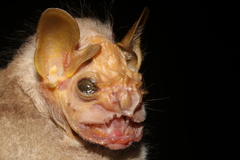
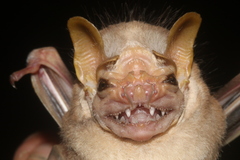

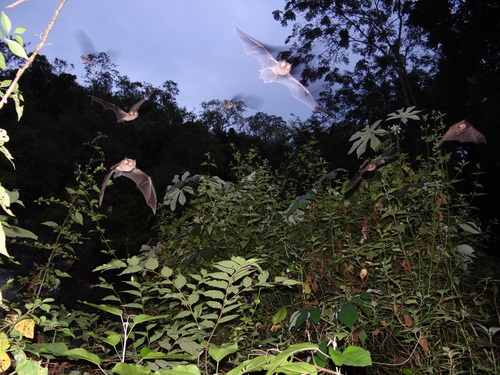
wrinkle-faced bat

wrinkle-faced bat

Centurio senex

Silhouette: Roberto Díaz Sibaja · PhyloPic

LCLeast ConcernNTVUENCR
Daily sighting probability ~10% · With luck
at Calakmul Biosphere Reserve

In 3 days ~30% in a week ~50%

8 Verified sightings at Calakmul Biosphere Reserve From 2019 to 2026
16 In all 2 parks
November Best month
🌙 Nocturnal When it's spotted

About the wrinkle-faced bat

The wrinkle-faced bat (Centurio senex) is a species of bat in the family Phyllostomidae and the only identified member of the genus Centurio. This bat is found in various countries in and around Central America. It eats fruit but is not classified within the fruit bats, and is instead classified as a leaf-nosed bat even though it does not have a leaf nose. It has an unusually shaped skull which is thought to allow it to eat a wider range of foods than other bats.

Centurio senex is tail-less, medium-sized, and generally has a pelage of a drab brown to yellowish-brown color. It weighs around 17g. Its face is hairless and is covered by convoluted outgrowths of skin (hence the name wrinkle-faced). These skin flaps are more pronounced in males than females. Males also possess a skin mask that can be used to cover their face. The wrinkle-faced bat has storage pouches in its mouth to allow it to store fruit. C. senex subsp. greenhalli differs from the more common C. senex subsp. senex by being larger and in having a more domed braincase, better developed sagittal crest, and relatively shorter maxillary toothrow. Their skulls are extremely short and wide, which is thought... Wikipedia →

Global Distribution

Parks Where Found

# Park Country Daily sighting probability
1 Calakmul Biosphere Reserve 🇲🇽 Mexico
~10%
2 Monteverde Cloud Forest Reserve 🇨🇷 Costa Rica
~10%

Before you go

What are the chances of seeing a wrinkle-faced bat in Calakmul Biosphere Reserve?

With luck

About 10% of wildlife watchers report a wrinkle-faced bat sighting in Calakmul Biosphere Reserve on a given day, based on 8 verified sightings from GBIF citizen-science data from 2019 to 2026. It is the 16th most-seen of the 19 mammals we can rate there. Over three days the chance rises to about 30%, and over a week to about 50%, if each day is a fresh chance.

When is the best time to see a wrinkle-faced bat in Calakmul Biosphere Reserve?

November

In that month about 30% of wildlife watchers report a wrinkle-faced bat in Calakmul Biosphere Reserve on a given day, against under 5% in March–May, August–September and December–January, the lowest months.

What time of day is best to see a wrinkle-faced bat?

Between 10 pm and 1 am

Across all the parks we cover, that three-hour window holds the most wrinkle-faced bat sightings with a recorded time, and about 8 in 10 of them come between 6 pm and 6 am: it is mostly seen at night.

Is Calakmul Biosphere Reserve the best place to see a wrinkle-faced bat?

Yes

Of the 2 parks where we can rate wrinkle-faced bat sightings, Calakmul Biosphere Reserve has the highest daily chance: about 10%. Next come Monteverde Cloud Forest Reserve (Costa Rica, about 10%).

Which relatives of the wrinkle-faced bat live in Calakmul Biosphere Reserve?

Same family: Phyllostomidae

The closest relatives of the wrinkle-faced bat that you can see in Calakmul Biosphere Reserve (family Phyllostomidae, New World Leaf-nosed Bats) are Jamaican Fruit-eating Bat (about 10%), Big-eared Woolly Bat (about 10%) and Pygmy Fruit Eating Bat (about 10%), with each one's daily chance of a sighting.

Where does the wrinkle-faced bat sighting chance come from?

GBIF citizen-science records

It is estimated from how often the wrinkle-faced bat is recorded against all the mammals logged in Calakmul Biosphere Reserve (8 verified sightings from 2019 to 2026), calibrated against known sighting rates. Figures are rounded to the nearest 10% because citizen-science data supports honest approximations, not decimals, and months with records from fewer than five people show "—". How it works.

← Back to Calakmul Biosphere Reserve