Beet Webworm Moth

Beet Webworm Moth

Loxostege sticticalis

Daily sighting probability ~10% · With luck
at Camargue

In 3 days ~30% in a week ~50%

7 Verified sightings at Camargue From 2019 to 2026
7 In 1 park
September Best month
☀️🌙 Day & Night When it's spotted

About the Beet Webworm Moth

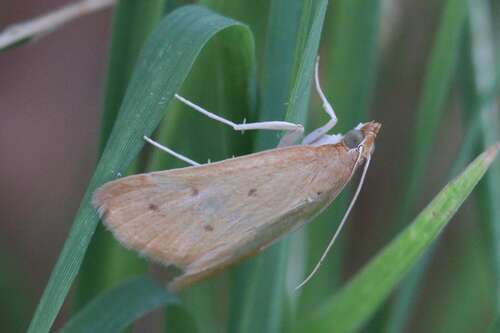
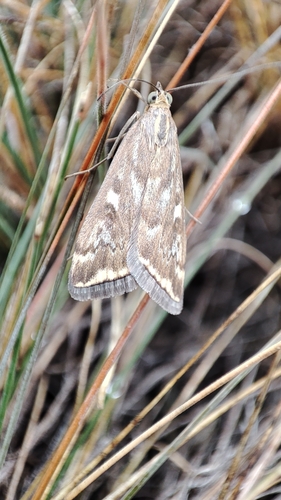
Loxostege sticticalis is a species of moth of the family Crambidae. It was first described by Carl Linnaeus in 1761 and is found in the Palearctic and Nearctic realms. The wingspan is 24–29 millimetres (0.94–1.14 in). The pattern and colour of the wings vary greatly. The ground colour ranges from a light brown to a darker brown to a reddish brown. The darker markings are also very variable; it may have an indistinct inner transverse line, ring, kidney and cone blemishes as well as a usually very distinct, jagged outer transverse line, occasionally other spots also appear in the midfield.

This pattern can also be almost completely absent.The forewings can then be almost uniformly grey-brown, with occasionally still faintly indicated individual blemishes. Grey fringes are typical, a dark narrow fringe line towards the base followed by a narrow yellow to whitish transverse band. This is somewhat thickened in the front half (towards the costal edge), but near the middle. Often, in the contact area of the outer transverse line with the costal edge, another bright spot is developed towards the edge of the seam. Very characteristic of most specimens is also a rectangular, concave light spot between the ring and kidney blemish, which is usually present even in specimens with little markings; in extreme cases, however, in almost uniformly grey-brown coloured specimens, it may also be missing.

The uppersides of the hind wings are grey with a dark fringing line, which in turn is lined with a narrow light line towards the roots. Often, a more or less complete, relatively wide outer transverse line is also formed. The inner edge may be lightened. The undersides of the forewings and hindwings are yellowish with a broad brown border area and usually two further, broad, brown to dark brown transverse bands.

The moth flies from May to September depending on the location. The larvae feed on various herbaceous plants, such as mugwort (Artemisia vulgaris), beet, Chenopodium album and Artemisia campestris. It can become a pest for sugar beet and tobacco. Wikipedia →
Global Distribution

Parks Where Found

# Park Country Daily sighting probability
1 Camargue 🇫🇷 France
~10%

More parks will be added in future updates.

Cities Where Found

# City Country Daily sighting probability
1 Astana 🇰🇿 Kazakhstan
~20%
2 Kharkiv 🇺🇦 Ukraine
~20%
3 Istanbul 🇹🇷 Turkey
~10%
4 Bucharest 🇷🇴 Romania
~10%
5 Novosibirsk 🇷🇺 Russia
~10%
6 Kyiv 🇺🇦 Ukraine
~10%
7 Nizhny Novgorod 🇷🇺 Russia
<5%
8 Kazan 🇷🇺 Russia
<5%
9 Moscow 🇷🇺 Russia
<5%
10 Vienna 🇦🇹 Austria
<5%

Before you go

What are the chances of seeing a Beet Webworm Moth in Camargue?

With luck

About 10% of wildlife watchers report a Beet Webworm Moth sighting in Camargue on a given day, based on 7 verified sightings from GBIF citizen-science data from 2019 to 2026. It is the 37th most-seen of the 75 insects we can rate there. Over three days the chance rises to about 30%, and over a week to about 50%, if each day is a fresh chance.

When is the best time to see a Beet Webworm Moth in Camargue?

September

In that month about 20% of wildlife watchers report a Beet Webworm Moth in Camargue on a given day, against under 5% in June and October–March, the lowest months. That is one of Camargue's wettest months, with about 70 mm of rain against 10 mm in July.

What time of day is best to see a Beet Webworm Moth?

Between midnight and 3 am

Across all the parks we cover, that three-hour window holds the most Beet Webworm Moth sightings with a recorded time, and about 6 in 10 of them come between 6 am and 6 pm: it is seen both by day and at night.

Where else can you see a Beet Webworm Moth?

Only Camargue, in our data

Camargue is the only park on Wallace's Line with enough records to rate Beet Webworm Moth sightings: about 10% of wildlife watchers there report one on a given day.

Which relatives of the Beet Webworm Moth live in Camargue?

Same family: Crambidae

The closest relatives of the Beet Webworm Moth that you can see in Camargue (family Crambidae, Crambid Snout Moths) are Ringed China-Mark (about 10%) and Orange Naked Pearl (about 10%), with each one's daily chance of a sighting.

Where does the Beet Webworm Moth sighting chance come from?

GBIF citizen-science records

It is estimated from how often the Beet Webworm Moth is recorded against all the insects logged in Camargue (7 verified sightings from 2019 to 2026), calibrated against known sighting rates. Figures are rounded to the nearest 10% because citizen-science data supports honest approximations, not decimals, and months with records from fewer than five people show "—". How it works.

← Back to Camargue