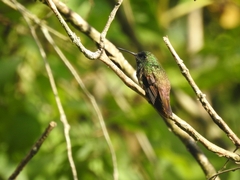
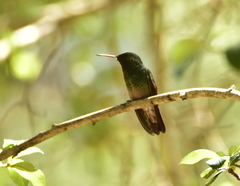
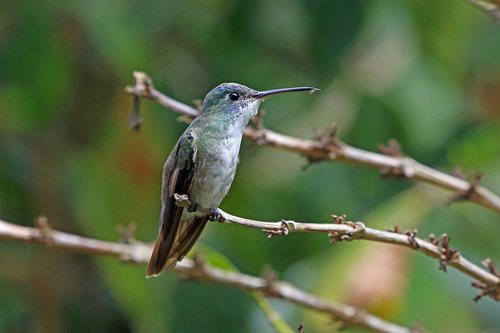
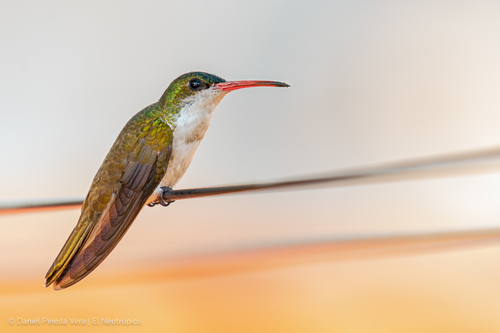
Berylline Hummingbird

Berylline Hummingbird

Saucerottia beryllina

Silhouette: Ferran Sayol · PhyloPic

LCLeast ConcernNTVUENCR
Daily sighting probability ~30% · Possible
at Cañón del Sumidero National Park

In 3 days ~70% in a week ~90%

237 Verified sightings at Cañón del Sumidero National Park From 2019 to 2026
429 In all 5 parks
January Best month
☀️ Diurnal When it's spotted

About the Berylline Hummingbird

The berylline hummingbird (Saucerottia beryllina) is a species of hummingbird in the "emeralds", tribe Trochilini of subfamily Trochilinae. It is found in El Salvador, Guatemala, Honduras, Mexico, and the southern United States.

The berylline hummingbird was formerly placed in the genus Amazilia. A molecular phylogenetic study published in 2014 found that the genus Amazilia was polyphyletic. In the revised classification to create monophyletic genera, the berylline hummingbird was moved by most taxonomic systems to the resurrected genus Saucerottia. However, BirdLife International's Handbook of the Birds of the World retains it in Amazilia.

The berylline hummingbird has five subspecies: The berylline hummingbird primarily inhabits arid landscapes. The wide variety includes dense oak and pine-oak forest, scrublands, deciduous and thorn forest, gallery forest, plantations, and parks and gardens. In elevation it is found from near sea level to the submontane zone, though it is most common between 500 and 1,800 m (1,600 and 5,900 ft).

The berylline hummingbird is 8 to 10 cm (3.1 to 3.9 in) long. Males weigh... Wikipedia →

Sounds

Call0:13

Mexico · 2024

© Étienne Leroy · XC956892 · CC BY-NC-SA 4.0

Flight call0:10

Mexico · 2022

© Pritam Baruah · XC773205 · CC BY-NC-SA 4.0

Alarm call0:12

Mexico · 2020

© Manuel Grosselet · XC611102 · CC BY-NC-SA 4.0

Global Distribution

Parks Where Found

# Park Country Daily sighting probability
1 El Triunfo 🇲🇽 Mexico
~60%
2 Cañón del Sumidero National Park 🇲🇽 Mexico
~30%
3 Reserva de la Biosfera Mariposa Monarca 🇲🇽 Mexico
~10%
4 Cerro Azul Meámbar National Park 🇭🇳 Honduras
<5%
5 Lago de Yojoa 🇭🇳 Honduras
<5%

Cities Where Found

# City Country Daily sighting probability
1 Mexico City 🇲🇽 México
~60%
2 Puebla 🇲🇽 México
~30%
3 Toluca 🇲🇽 México
~20%
4 Guadalajara 🇲🇽 México
~10%
5 Guatemala City 🇬🇹 Guatemala
~10%
6 San Salvador 🇸🇻 El Salvador
<5%

Before you go

What are the chances of seeing a Berylline Hummingbird in Cañón del Sumidero National Park?

Possible

About 30% of wildlife watchers report a Berylline Hummingbird sighting in Cañón del Sumidero National Park on a given day, based on 237 verified sightings from GBIF citizen-science data from 2019 to 2026. It is the 29th most-seen of the 243 birds we can rate there. Over three days the chance rises to about 70%, and over a week to about 90%, if each day is a fresh chance.

When is the best time to see a Berylline Hummingbird in Cañón del Sumidero National Park?

January

In that month about 50% of wildlife watchers report a Berylline Hummingbird in Cañón del Sumidero National Park on a given day, against about 10% in July and September, the lowest months. That is one of Cañón del Sumidero National Park's driest months, with about 10 mm of rain against 260 mm in June.

What time of day is best to see a Berylline Hummingbird?

Between 7 and 10 am

Across all the parks we cover, that three-hour window holds the most Berylline Hummingbird sightings with a recorded time, and about 9 in 10 of them come between 6 am and 6 pm: it is a daytime animal.

Is Cañón del Sumidero National Park the best place to see a Berylline Hummingbird?

2nd of 5

Of the 5 parks where we can rate Berylline Hummingbird sightings, Cañón del Sumidero National Park ranks 2nd at about 30%. The best odds are in El Triunfo (Mexico, about 60%).

Where does the Berylline Hummingbird sighting chance come from?

GBIF citizen-science records

It is estimated from how often the Berylline Hummingbird is recorded against all the birds logged in Cañón del Sumidero National Park (237 verified sightings from 2019 to 2026), calibrated against known sighting rates. Figures are rounded to the nearest 10% because citizen-science data supports honest approximations, not decimals, and months with records from fewer than five people show "—". How it works.

← Back to Cañón del Sumidero National Park