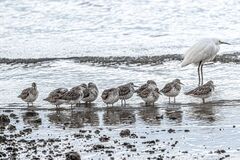
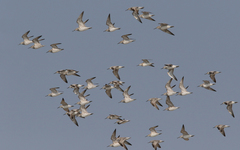
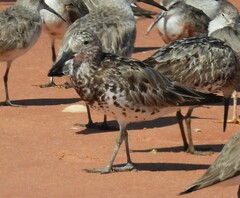
Great Knot

Great Knot

Calidris tenuirostris

Silhouette: Edwin Price · PhyloPic

LCNTVUENEndangeredCR
Daily sighting probability <5% · Rare
at Cape Range

In 3 days ~10% in a week ~20%

7 Verified sightings at Cape Range From 2019 to 2026
14 In all 2 parks
September Best month
☀️ Diurnal When it's spotted

About the Great Knot

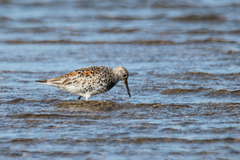
The great knot (Calidris tenuirostris) is a medium-sized wader. It is one of the largest species in the genus Calidris. It is a migratory bird which breeds in eastern Siberia, Russia, and flies to southern Asia and Australia in the northern winter.

Within the genus Calidris the great knot is most closely related to the surfbird (Calidris virgata). The genus name is from Ancient Greek kalidris or skalidris, a term used by Aristotle for some grey-coloured waterside birds. The specific tenuirostris is from Latin tenuis "slender" and rostrum "bill".

Their breeding habitat is tundra in northeast Siberia, Russia. They nest on the ground laying about four eggs in a ground scrape. They are strongly migratory wintering on coasts in southern Asia through to Australia. This species forms enormous flocks in winter.

The species is also recorded in summer in low numbers in western Alaska, United States in most years, and in winter in small numbers west to Pakistan, Oman, and the United Arab Emirates. It has occurred as a vagrant in Great Britain, Morocco, New Zealand, British Columbia in Canada, and in the lower 48 states of the USA in Oregon, West Virginia, and... Wikipedia →

Sounds

Alarm call0:15

Russian Federation · 2017

© Christian A. Jensen · XC396375 · CC BY-NC-SA 4.0

Global Distribution

Parks Where Found

# Park Country Daily sighting probability
1 Cape Range 🇦🇺 Australia
<5%
2 Ningaloo Marine Park 🇦🇺 Australia
<5%

Cities Where Found

# City Country Daily sighting probability
1 Manila 🇵🇭 Philippines
<5%
2 Brisbane 🇦🇺 Australia
<5%
3 Tokyo 🇯🇵 Japan
<5%
4 Nagoya 🇯🇵 Japan
<5%
5 Osaka 🇯🇵 Japan
<5%
6 Seoul 🇰🇷 South Korea
<5%
7 Kochi 🇮🇳 India
<5%
8 Kozhikode 🇮🇳 India
<5%
9 Perth 🇦🇺 Australia
<5%
10 Kaohsiung 🇹🇼 Taiwan
<5%

Before you go

What are the chances of seeing a Great Knot in Cape Range?

Rare

Under 5% of wildlife watchers report a Great Knot sighting in Cape Range on a given day, based on 7 verified sightings from GBIF citizen-science data from 2019 to 2026. It is the 76th most-seen of the 84 birds we can rate there. Over three days the chance rises to about 10%, and over a week to about 20%, if each day is a fresh chance.

When is the best time to see a Great Knot in Cape Range?

April, July, September and November

In those months about 10% of wildlife watchers report a Great Knot in Cape Range on a given day, against under 5% in March, May–June, August, October and December–January, the lowest months. February has too few records to rate.

What time of day is best to see a Great Knot?

Between 9 am and noon

Across all the parks we cover, that three-hour window holds the most Great Knot sightings with a recorded time, and about 9 in 10 of them come between 6 am and 6 pm: it is a daytime animal.

Is Cape Range the best place to see a Great Knot?

Yes

Of the 2 parks where we can rate Great Knot sightings, Cape Range has the highest daily chance: under 5%. Next come Ningaloo Marine Park (Australia, under 5%).

Which relatives of the Great Knot live in Cape Range?

Same genus: Calidris

The closest relatives of the Great Knot that you can see in Cape Range (genus Calidris, Calidris Sandpipers) are Red-necked Stint (about 10%) and Sanderling (about 10%), with each one's daily chance of a sighting.

Where does the Great Knot sighting chance come from?

GBIF citizen-science records

It is estimated from how often the Great Knot is recorded against all the birds logged in Cape Range (7 verified sightings from 2019 to 2026), calibrated against known sighting rates. Figures are rounded to the nearest 10% because citizen-science data supports honest approximations, not decimals, and months with records from fewer than five people show "—". How it works.

← Back to Cape Range