Sharp-tailed Sandpiper

Sharp-tailed Sandpiper

Calidris acuminata

Silhouette: Edwin Price · PhyloPic

LCNTVUVulnerableENCR
Daily sighting probability <5% · Rare
at Cape Range

In 3 days ~10% in a week ~30%

12 Verified sightings at Cape Range From 2019 to 2026
139 In all 7 parks
November Best month
☀️ Diurnal When it's spotted

About the Sharp-tailed Sandpiper

The sharp-tailed sandpiper (Calidris acuminata) is a small-medium migratory wader or shorebird, found mostly in Siberia during the summer breeding period (June to August) and Australia for wintering (September to March).

Within the genus Calidris the sharp-tailed sandpiper is most closely related to the broad-billed sandpiper (Calidris falcinellus). The genus name calidris comes from the Ancient Greek kalidris or skalidris, a term used by Aristotle for some grey-coloured waterside birds. The specific acuminata is from Latin acuminatus, 'sharp, pointed'.

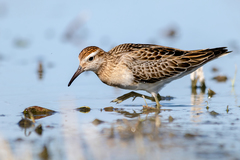
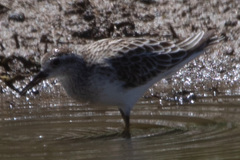
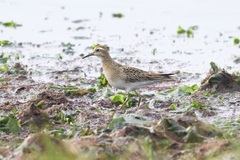
A small-medium wader, the portly sandpiper has a pot belly, flat back and somewhat drawn-out rear end. It has a mottled chestnut-brown upper body with sharp-looking feathers with a dark centre, a chestnut cap on its head and a brown stripe through each eye. Its bill is dark grey to black and straight, and its legs are olive- to yellow-coloured. The underparts are white or paler in colour, with the mottling similar to that on the breast and sides of the belly. The plumage is more vivid during the breeding season and duller in its winter plumage. The juveniles are brighter in colour in autumn and early... Wikipedia →

Sounds

Song0:07

Russian Federation · 2017

© Andrew Spencer · XC425083 · CC BY-NC-ND 4.0

Uncertain0:17

Mongolia · 2025

© Lim Ying Hien 林勇贤 · XC1032738 · CC BY-NC-ND 4.0

Flight call0:06

Australia · 2017

© Marc Anderson · XC389385 · CC BY-NC-ND 4.0

Global Distribution

Parks Where Found

# Park Country Daily sighting probability
1 Rottnest Island 🇦🇺 Australia
~10%
2 Cape Range 🇦🇺 Australia
<5%
3 Ningaloo Marine Park 🇦🇺 Australia
<5%
4 Kakadu National Park 🇦🇺 Australia
<5%
5 Wilsons Promontory National Park 🇦🇺 Australia
<5%
6 Daintree National Park 🇦🇺 Australia
<5%
7 Bali Barat National Park 🇮🇩 Indonesia
<5%

Cities Where Found

# City Country Daily sighting probability
1 Quanzhou 🇨🇳 China
~10%
2 Davao City 🇵🇭 Philippines
<5%
3 Seattle 🇺🇸 United States
<5%
4 Naha 🇯🇵 Japan
<5%
5 San Francisco 🇺🇸 United States
<5%
6 Melbourne 🇦🇺 Australia
<5%
7 Brisbane 🇦🇺 Australia
<5%
8 Sydney 🇦🇺 Australia
<5%
9 Auckland 🇳🇿 New Zealand
<5%
10 Colombo [Sri Jayawardenepura Kotte] 🇱🇰 Sri Lanka
<5%

Before you go

What are the chances of seeing a Sharp-tailed Sandpiper in Cape Range?

Rare

Under 5% of wildlife watchers report a Sharp-tailed Sandpiper sighting in Cape Range on a given day, based on 12 verified sightings from GBIF citizen-science data from 2019 to 2026. It is the 73rd most-seen of the 84 birds we can rate there. Over three days the chance rises to about 10%, and over a week to about 30%, if each day is a fresh chance.

When is the best time to see a Sharp-tailed Sandpiper in Cape Range?

September and November

In those months about 20% of wildlife watchers report a Sharp-tailed Sandpiper in Cape Range on a given day, against under 5% in March, May–August, October and December–January, the lowest months. Those are among Cape Range's driest months, with almost no rain against 55 mm in June. February has too few records to rate.

What time of day is best to see a Sharp-tailed Sandpiper?

Between noon and 3 pm

Across all the parks we cover, that three-hour window holds the most Sharp-tailed Sandpiper sightings with a recorded time, and about 9 in 10 of them come between 6 am and 6 pm: it is a daytime animal.

Is Cape Range the best place to see a Sharp-tailed Sandpiper?

2nd of 7

Of the 7 parks where we can rate Sharp-tailed Sandpiper sightings, Cape Range ranks 2nd at under 5%. The best odds are in Rottnest Island (Australia, about 10%).

Which relatives of the Sharp-tailed Sandpiper live in Cape Range?

Same genus: Calidris

The closest relatives of the Sharp-tailed Sandpiper that you can see in Cape Range (genus Calidris, Calidris Sandpipers) are Red-necked Stint (about 10%) and Sanderling (about 10%), with each one's daily chance of a sighting.

Where does the Sharp-tailed Sandpiper sighting chance come from?

GBIF citizen-science records

It is estimated from how often the Sharp-tailed Sandpiper is recorded against all the birds logged in Cape Range (12 verified sightings from 2019 to 2026), calibrated against known sighting rates. Figures are rounded to the nearest 10% because citizen-science data supports honest approximations, not decimals, and months with records from fewer than five people show "—". How it works.

← Back to Cape Range