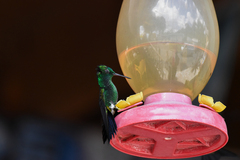
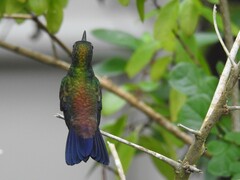
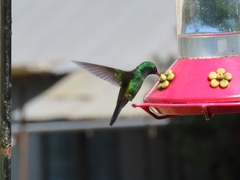

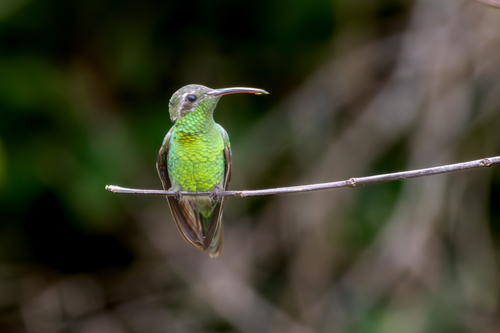
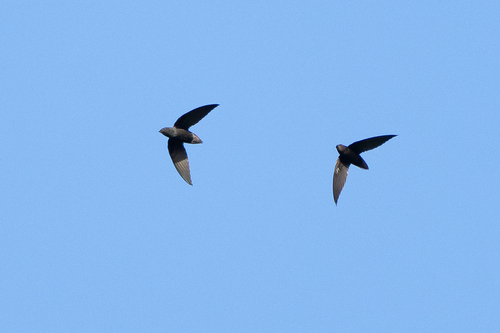
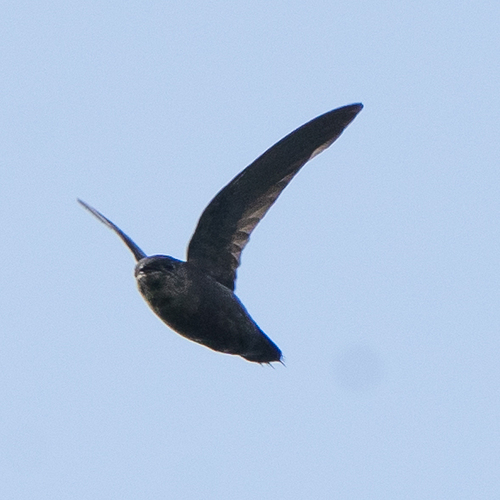
Copper-rumped Hummingbird

Copper-rumped Hummingbird

Saucerottia tobaci

Silhouette: Ferran Sayol · PhyloPic

LCLeast ConcernNTVUENCR
Daily sighting probability ~10% · With luck
at Caroni Swamp

In 3 days ~30% in a week ~60%

63 Verified sightings at Caroni Swamp From 2019 to 2026
924 In all 3 parks
December Best month
☀️ Diurnal When it's spotted

About the Copper-rumped Hummingbird

The copper-rumped hummingbird (Saucerottia tobaci) is a species of hummingbird in the "emeralds", tribe Trochilini of subfamily Trochilinae. It is found in Tobago, Trinidad, Venezuela, and possibly Grenada. The copper-rumped hummingbird was formally described in 1788 by the German naturalist Johann Friedrich Gmelin in his revised and expanded edition of Carl Linnaeus's Systema Naturae. He placed it with all the other hummingbirds in the genus Trochilus and coined the binomial name Trochilus tobaci. Gmelin based his description on the "Tobago Humming-Bird" that had been described in 1782 by the English ornithologist John Latham in his A General Synopsis of Birds. The copper-rumped hummingbird was formerly placed in the genus Amazilia. A molecular phylogenetic study published in 2014 found that the genus Amazilia was polyphyletic. In the revised classification to create monophyletic genera, the copper-rumped hummingbird was moved by most taxonomic systems to the resurrected genus Saucerottia. However, BirdLife International's Handbook of the Birds of the World (HBW) retains it in Amazilia.

The genus Saucerottia had been introduced in 1850 by the French naturalist... Wikipedia →

Sounds

Call0:27

Venezuela · 2020

© Rafael Gianni-Zurita · XC1007717 · CC BY-NC-ND 4.0

Song0:14

Venezuela · 1996

© Peter Boesman · XC218320 · CC BY-NC-ND 4.0

Flight call1:01

Trinidad & Tobago · 2019

© Dan Lane · XC462254 · CC BY-NC-SA 4.0

Global Distribution

Parks Where Found

# Park Country Daily sighting probability
1 Main Ridge Forest Reserve 🇹🇹 Trinidad and Tobago
~70%
2 Henri Pittier National Park 🇻🇪 Venezuela
~20%
3 Caroni Swamp 🇹🇹 Trinidad and Tobago
~10%

Cities Where Found

# City Country Daily sighting probability
1 Caracas 🇻🇪 Venezuela
~50%
2 Valencia 🇻🇪 Venezuela
<5%

Before you go

What are the chances of seeing a Copper-rumped Hummingbird in Caroni Swamp?

With luck

About 10% of wildlife watchers report a Copper-rumped Hummingbird sighting in Caroni Swamp on a given day, based on 63 verified sightings from GBIF citizen-science data from 2019 to 2026. It is the 83rd most-seen of the 169 birds we can rate there. Over three days the chance rises to about 30%, and over a week to about 60%, if each day is a fresh chance.

When is the best time to see a Copper-rumped Hummingbird in Caroni Swamp?

December

In that month about 20% of wildlife watchers report a Copper-rumped Hummingbird in Caroni Swamp on a given day, against under 5% in August and October, the lowest months.

What time of day is best to see a Copper-rumped Hummingbird?

Between 11 am and 2 pm

Across all the parks we cover, that three-hour window holds the most Copper-rumped Hummingbird sightings with a recorded time, and about 9 in 10 of them come between 6 am and 6 pm: it is a daytime animal.

Is Caroni Swamp the best place to see a Copper-rumped Hummingbird?

3rd of 3

Of the 3 parks where we can rate Copper-rumped Hummingbird sightings, Caroni Swamp ranks 3rd at about 10%. The best odds are in Main Ridge Forest Reserve (Trinidad and Tobago, about 70%) and Henri Pittier National Park (Venezuela, about 20%).

Which relatives of the Copper-rumped Hummingbird live in Caroni Swamp?

Same family: Trochilidae

The closest relatives of the Copper-rumped Hummingbird that you can see in Caroni Swamp (family Trochilidae, Hummingbirds) are Green-throated Mango (about 40%) and White-tailed Goldenthroat (about 10%), with each one's daily chance of a sighting.

Where does the Copper-rumped Hummingbird sighting chance come from?

GBIF citizen-science records

It is estimated from how often the Copper-rumped Hummingbird is recorded against all the birds logged in Caroni Swamp (63 verified sightings from 2019 to 2026), calibrated against known sighting rates. Figures are rounded to the nearest 10% because citizen-science data supports honest approximations, not decimals, and months with records from fewer than five people show "—". How it works.

← Back to Caroni Swamp