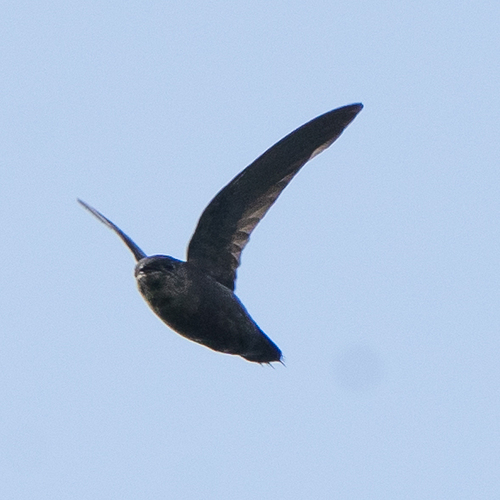
Blue-chinned Sapphire

Blue-chinned Sapphire

Chlorestes notata

Silhouette: Ferran Sayol · PhyloPic

LCLeast ConcernNTVUENCR
Daily sighting probability <5% · Rare
at Caroni Swamp

In 3 days ~10% in a week ~20%

13 Verified sightings at Caroni Swamp From 2019 to 2026
71 In all 4 parks
April Best month
☀️ Diurnal When it's spotted

About the Blue-chinned Sapphire

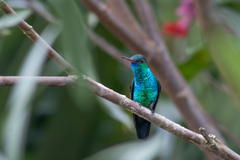
The blue-chinned sapphire or blue-chinned emerald (Chlorestes notata) is a hummingbird that ranges from Colombia south and east to the Guianas, Trinidad and Tobago, Peru, and Brazil. There have been occasional records from Tobago. For Brazil, the species' range is along the main Amazon River Basin, as well as the Atlantic Forest, both in the northeast, as well as far south on the southeast coastal strip, (an entire coastal strip, north-east-south of about 3,000 km (1,900 mi)). It is sometimes placed in the genus Chlorostilbon.

It is a bird of forests and sometimes cultivated areas with large trees. The female lays her eggs in a deep cup nest, made of lichen and other fine plant material and placed on a horizontal tree branch. Incubation is 16 days with a further 18–19 days to fledging.

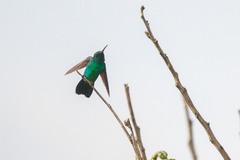
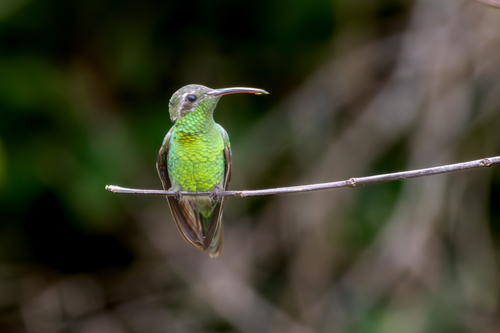
Blue-chinned sapphires feed on insects and nectar, mainly in trees but sometimes on vines, shrubs, herbs, epiphytes or smaller plants like Heliconia. The song is a high metallic ssooo-ssooo-ssooo. The blue-chinned sapphire is 8.9 cm (3.5 in) long and weighs 3.8 g (1⁄8 oz). The bill is fairly straight, with the upper mandible black and the lower reddish. The male has mainly green plumage... Wikipedia →

Sounds

Song0:11

Brazil · 2025

© JAYRSON ARAUJO DE OLIVEIRA · XC1034676 · CC BY-NC-SA 4.0

Canto0:47

Brazil · 2014

© Caio Brito · XC427210 · CC BY-NC-SA 4.0

Call0:21

Brazil · 2017

© GABRIEL LEITE · XC358237 · CC BY-NC-SA 4.0

Global Distribution

Parks Where Found

# Park Country Daily sighting probability
1 Henri Pittier National Park 🇻🇪 Venezuela
~10%
2 Anavilhanas National Park 🇧🇷 Brazil
~10%
3 Caroni Swamp 🇹🇹 Trinidad and Tobago
<5%
4 Brownsberg Nature Park 🇸🇷 Suriname
<5%

Cities Where Found

# City Country Daily sighting probability
1 Belém 🇧🇷 Brazil
~30%
2 Maceió 🇧🇷 Brazil
~20%
3 João Pessoa 🇧🇷 Brazil
~10%
4 Salvador 🇧🇷 Brazil
<5%
5 Valencia 🇻🇪 Venezuela
<5%
6 Caracas 🇻🇪 Venezuela
<5%

Before you go

What are the chances of seeing a Blue-chinned Sapphire in Caroni Swamp?

Rare

Under 5% of wildlife watchers report a Blue-chinned Sapphire sighting in Caroni Swamp on a given day, based on 13 verified sightings from GBIF citizen-science data from 2019 to 2026. It is the 132nd most-seen of the 169 birds we can rate there. Over three days the chance rises to about 10%, and over a week to about 20%, if each day is a fresh chance.

When is the best time to see a Blue-chinned Sapphire in Caroni Swamp?

April

In that month about 10% of wildlife watchers report a Blue-chinned Sapphire in Caroni Swamp on a given day, against under 5% in May to March, the lowest months. That is one of Caroni Swamp's driest months, with about 35 mm of rain against 130 mm in August.

What time of day is best to see a Blue-chinned Sapphire?

Between 8 and 11 am

Across all the parks we cover, that three-hour window holds the most Blue-chinned Sapphire sightings with a recorded time, and about 9 in 10 of them come between 6 am and 6 pm: it is a daytime animal.

Is Caroni Swamp the best place to see a Blue-chinned Sapphire?

3rd of 4

Of the 4 parks where we can rate Blue-chinned Sapphire sightings, Caroni Swamp ranks 3rd at under 5%. The best odds are in Henri Pittier National Park (Venezuela, about 10%) and Anavilhanas National Park (Brazil, about 10%).

Where does the Blue-chinned Sapphire sighting chance come from?

GBIF citizen-science records

It is estimated from how often the Blue-chinned Sapphire is recorded against all the birds logged in Caroni Swamp (13 verified sightings from 2019 to 2026), calibrated against known sighting rates. Figures are rounded to the nearest 10% because citizen-science data supports honest approximations, not decimals, and months with records from fewer than five people show "—". How it works.

← Back to Caroni Swamp