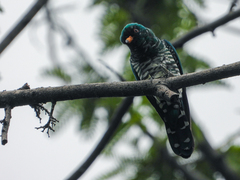
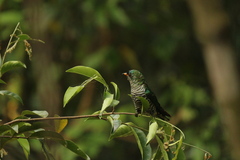
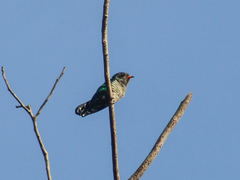

Asian Emerald Cuckoo

Asian Emerald Cuckoo

Chrysococcyx maculatus

Silhouette: Nicolas Huet le Jeune and Jean-Gabriel Prêtre (vectorized by T. Michael Keesey) · PhyloPic

LCLeast ConcernNTVUENCR
Daily sighting probability <5% · Rare
at Cat Tien National Park

In 3 days <5%

9 Verified sightings at Cat Tien National Park From 2019 to 2026
702 In all 6 parks
April Best month
☀️ Diurnal When it's spotted

About the Asian Emerald Cuckoo

The Asian emerald cuckoo (Chrysococcyx maculatus) is a species of cuckoo in the family Cuculidae. It is found in Bangladesh, Bhutan, Cambodia, China, India, Indonesia, Laos, Malaysia, Myanmar, Nepal, Sri Lanka, Thailand, and Vietnam. Its natural habitats are subtropical or tropical moist lowland forests and subtropical or tropical moist montane forest.

The Asian emerald cuckoo was formally described in 1788 by the German naturalist Johann Friedrich Gmelin in his revised and expanded edition of Carl Linnaeus's Systema Naturae. He placed it with all the other cuckoos in the genus Cuculus and coined the binomial name Cuculus maculatus. Gmelin based his description on the "Spotted Curucui" from Ceylon that had been described and illustrated in 1776 by the English naturalist Peter Brown. The Asian emerald cuckoo is now placed together with 12 other species in the genus Chrysococcyx that was introduced in 1826 by the German zoologist Friedrich Boie. The genus name combines the Ancient Greek χρυσος khrusos meaning "gold" with κοκκυξ kokkux "cuckoo". The specific epithet maculatus is from Latin and means "spotted" or "blotched". The species is monotypic: no subspecies are recognised... Wikipedia →

Sounds

Call0:15

Thailand · 2025

© Peter Ericsson · XC975806 · CC BY-NC-SA 4.0

Song0:09

Laos · 2023

© Bram Piot · XC794310 · CC BY-NC-SA 4.0

Call0:12

Vietnam · 2023

© Teus Luijendijk · XC820488 · CC BY-NC-ND 4.0

Global Distribution

Parks Where Found

# Park Country Daily sighting probability
1 Doi Inthanon National Park 🇹🇭 Thailand
~10%
2 Manas National Park 🇮🇳 India
~10%
3 Khao Yai National Park 🇹🇭 Thailand
~10%
4 Kaeng Krachan National Park 🇹🇭 Thailand
<5%
5 Royal Manas National Park 🇧🇹 Bhutan
<5%
6 Cat Tien National Park 🇻🇳 Vietnam
<5%

Cities Where Found

# City Country Daily sighting probability
1 Singapore 🇸🇬 Singapore
<5%
2 Bangkok 🇹🇭 Thailand
<5%
3 Guangzhou 🇨🇳 China
<5%

Before you go

What are the chances of seeing an Asian Emerald Cuckoo in Cat Tien National Park?

Rare

Under 5% of wildlife watchers report an Asian Emerald Cuckoo sighting in Cat Tien National Park on a given day, based on 9 verified sightings from GBIF citizen-science data from 2019 to 2026. It is the 227th most-seen of the 244 birds we can rate there. Over three days the chance rises to under 5%, if each day is a fresh chance.

When is the best time to see an Asian Emerald Cuckoo in Cat Tien National Park?

Any time of year

In every month with enough records, under 5% of wildlife watchers report an Asian Emerald Cuckoo in Cat Tien National Park on a given day, so our monthly data shows no clear season.

What time of day is best to see an Asian Emerald Cuckoo?

Between 8 and 11 am

Across all the parks we cover, that three-hour window holds the most Asian Emerald Cuckoo sightings with a recorded time, and about 9 in 10 of them come between 6 am and 6 pm: it is a daytime animal.

Is Cat Tien National Park the best place to see an Asian Emerald Cuckoo?

6th of 6

Of the 6 parks where we can rate Asian Emerald Cuckoo sightings, Cat Tien National Park ranks 6th at under 5%. The best odds are in Doi Inthanon National Park (Thailand, about 10%), Manas National Park (India, about 10%) and Khao Yai National Park (Thailand, about 10%).

Where does the Asian Emerald Cuckoo sighting chance come from?

GBIF citizen-science records

It is estimated from how often the Asian Emerald Cuckoo is recorded against all the birds logged in Cat Tien National Park (9 verified sightings from 2019 to 2026), calibrated against known sighting rates. Figures are rounded to the nearest 10% because citizen-science data supports honest approximations, not decimals, and months with records from fewer than five people show "—". How it works.

← Back to Cat Tien National Park