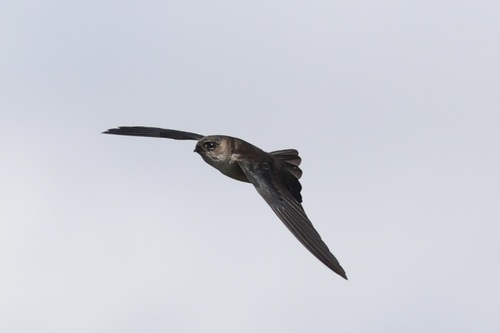
Slaty-legged Crake

Slaty-legged Crake

Rallina eurizonoides

Silhouette: Sheatherius · PhyloPic

LCLeast ConcernNTVUENCR
Daily sighting probability ~10% · With luck
at Cat Tien National Park

In 3 days ~20% in a week ~50%

131 Verified sightings at Cat Tien National Park From 2019 to 2026
350 In all 4 parks
March Best month
🌅 Crepuscular When it's spotted

About the Slaty-legged Crake

The slaty-legged crake or banded crake (Rallina eurizonoides) is a waterbird in the rail and crake family, Rallidae. Its breeding habitat is swamps and similar wet areas in well-wooded country across south Asia east from India, Pakistan, and Sri Lanka to the Philippines and Indonesia. The rails are mainly permanent residents throughout their range, but some northern populations migrate further south in winter.

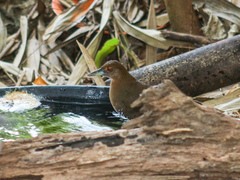
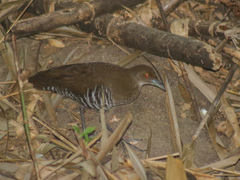
The slaty-legged crake is about 25 cm long. Its body is flattened laterally to allow easier passage through the undergrowth. It has long toes and a short tail. Colouring includes a brown back, chestnut head and breast, and strong black-and-white barring on the flanks, belly and undertail. The throat is white, the bill is yellowish, and the legs are green. Sexes are similar; juveniles are dark brown above and below, although they have the belly barring and white throat.

Slaty-legged crakes are territorial, but are quite secretive, hiding in bushes when disturbed. They probe with their bill in mud or shallow water, also picking up food by sight. They forage for berries and insects on the ground, or clambering through... Wikipedia →

Sounds

Song0:15

China · 2024

© 脉动 · XC917566 · CC BY-NC-ND 4.0

Flight call0:42

China · 2021

© Geoff Carey · XC812438 · CC BY-NC-SA 4.0

Alarm call0:57

Taiwan · 2021

© 蔡明剛 · XC652488 · CC BY-NC-SA 4.0

Global Distribution

Parks Where Found

# Park Country Daily sighting probability
1 Cat Tien National Park 🇻🇳 Vietnam
~10%
2 Sinharaja Forest Reserve 🇱🇰 Sri Lanka
~10%
3 Kaeng Krachan National Park 🇹🇭 Thailand
<5%
4 Minneriya National Park 🇱🇰 Sri Lanka
<5%

Cities Where Found

# City Country Daily sighting probability
1 Kuala Lumpur 🇲🇾 Malaysia
<5%
2 Hong Kong 🇨🇳 China
<5%
3 Kaohsiung 🇹🇼 Taiwan
<5%
4 Manila 🇵🇭 Philippines
<5%
5 Bengaluru 🇮🇳 India
<5%
6 Bangkok 🇹🇭 Thailand
<5%
7 Mumbai 🇮🇳 India
<5%
8 Taipei 🇹🇼 Taiwan
<5%

Before you go

What are the chances of seeing a Slaty-legged Crake in Cat Tien National Park?

With luck

About 10% of wildlife watchers report a Slaty-legged Crake sighting in Cat Tien National Park on a given day, based on 131 verified sightings from GBIF citizen-science data from 2019 to 2026. It is the 131st most-seen of the 244 birds we can rate there. Over three days the chance rises to about 20%, and over a week to about 50%, if each day is a fresh chance.

When is the best time to see a Slaty-legged Crake in Cat Tien National Park?

March and December

In those months about 20% of wildlife watchers report a Slaty-legged Crake in Cat Tien National Park on a given day, against under 5% in January and May–September, the lowest months. Those are among Cat Tien National Park's driest months, with about 40 mm of rain a month against 490 mm in July.

What time of day is best to see a Slaty-legged Crake?

Between 4 and 7 pm

Across all the parks we cover, that three-hour window holds the most Slaty-legged Crake sightings with a recorded time, and about 7 in 10 of them come between 6 am and 6 pm: it is most active around dawn and dusk.

Is Cat Tien National Park the best place to see a Slaty-legged Crake?

Yes

Of the 4 parks where we can rate Slaty-legged Crake sightings, Cat Tien National Park has the highest daily chance: about 10%. Next come Sinharaja Forest Reserve (Sri Lanka, about 10%) and Kaeng Krachan National Park (Thailand, under 5%).

Where does the Slaty-legged Crake sighting chance come from?

GBIF citizen-science records

It is estimated from how often the Slaty-legged Crake is recorded against all the birds logged in Cat Tien National Park (131 verified sightings from 2019 to 2026), calibrated against known sighting rates. Figures are rounded to the nearest 10% because citizen-science data supports honest approximations, not decimals, and months with records from fewer than five people show "—". How it works.

← Back to Cat Tien National Park