Aesculapian Snake

Aesculapian Snake

Zamenis longissimus

Silhouette: Beth Reinke · PhyloPic

LCLeast ConcernNTVUENCR
Daily sighting probability ~30% · Possible
at Cévennes National Park

In 3 days ~70% in a week ~90%

77 Verified sightings at Cévennes National Park From 2019 to 2026
230 In all 7 parks
May Best month
☀️ Diurnal When it's spotted

About the Aesculapian Snake

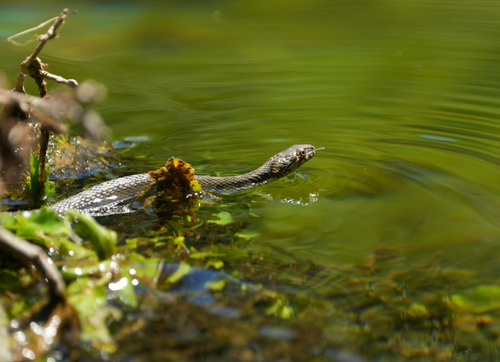
The Aesculapian snake (Zamenis longissimus, previously Elaphe longissima) is a species of non-venomous constrictor snake native to Europe, a member of the subfamily Colubrinae of the family Colubridae. Growing up to 2 metres (6.6 ft) in length, it is among the largest European snakes, similar in size to the four-lined snake (Elaphe quatuorlineata) and the Montpellier snake (Malpolon monspessulanus). The Aesculapian snake has been of cultural and historical significance for its role in ancient Greek, Roman, and Illyrian mythology and derived symbolism.

Zamenis longissimus hatches at around 30 cm (11.8 in). Adults are usually from 110 cm (43.3 in) to 160 cm (63 in) in total length (tail included), but can grow to 200 cm (79 in), with the record size being 225 cm (7.38 ft). Expected body mass in adult Aesculapian snakes is from 350 to 890 g (0.77 to 1.96 lb). It is dark, long, slender, and typically bronzy in colour, with smooth scales that give it a metallic sheen.

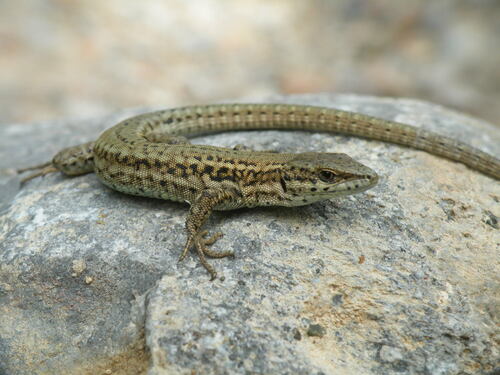
Juveniles can easily be confused with juvenile grass snakes (Natrix natrix) and barred grass snakes (Natrix helvetica), because juvenile Aesculapians also have a yellow collar on the neck that may persist... Wikipedia →

Global Distribution

Parks Where Found

# Park Country Daily sighting probability
1 Triglav National Park 🇸🇮 Slovenia
~40%
2 Cévennes National Park 🇫🇷 France
~30%
3 Mercantour National Park 🇫🇷 France
~20%
4 Ordesa y Monte Perdido National Park 🇪🇸 Spain
~20%
5 Bavarian Forest National Park 🇩🇪 Germany
~20%
6 Pyrénées National Park 🇫🇷 France
~10%
7 Fertő-Hanság National Park 🇭🇺 Hungary
~10%

Cities Where Found

# City Country Daily sighting probability
1 Vienna 🇦🇹 Austria
~30%
2 Budapest 🇭🇺 Hungary
~20%
3 London 🇬🇧 United Kingdom
~10%
4 Paris 🇫🇷 France
<5%

Zoos & Centres Where Found

# Zoo / Centre Country
1 Łódź Zoo 🇵🇱 Poland In captivity
2 Tiergarten Straubing 🇩🇪 Germany In captivity
3 Zagreb Zoo 🇭🇷 Croatia In captivity
4 Cherkasy Zoo 🇺🇦 Ukraine In captivity
5 Alpenzoo Innsbruck 🇦🇹 Austria In captivity
6 zoo delle Maitine 🇮🇹 Italy In captivity
7 Reptiland 🇫🇷 France In captivity
8 Lake Tisza Ecocentre 🇭🇺 Hungary In captivity

Before you go

What are the chances of seeing an Aesculapian Snake in Cévennes National Park?

Possible

About 30% of wildlife watchers report an Aesculapian Snake sighting in Cévennes National Park on a given day, based on 77 verified sightings from GBIF citizen-science data from 2019 to 2026. It is the 6th most-seen of the 18 reptiles we can rate there. Over three days the chance rises to about 70%, and over a week to about 90%, if each day is a fresh chance.

When is the best time to see an Aesculapian Snake in Cévennes National Park?

May to July

In those months about 40% of wildlife watchers report an Aesculapian Snake in Cévennes National Park on a given day, against under 5% in November to February, the lowest months.

What time of day is best to see an Aesculapian Snake?

Between 1 and 4 pm

Across all the parks we cover, that three-hour window holds the most Aesculapian Snake sightings with a recorded time, and about 8 in 10 of them come between 6 am and 6 pm: it is a daytime animal.

Is Cévennes National Park the best place to see an Aesculapian Snake?

2nd of 7

Of the 7 parks where we can rate Aesculapian Snake sightings, Cévennes National Park ranks 2nd at about 30%. The best odds are in Triglav National Park (Slovenia, about 40%).

Where does the Aesculapian Snake sighting chance come from?

GBIF citizen-science records

It is estimated from how often the Aesculapian Snake is recorded against all the reptiles logged in Cévennes National Park (77 verified sightings from 2019 to 2026), calibrated against known sighting rates. Figures are rounded to the nearest 10% because citizen-science data supports honest approximations, not decimals, and months with records from fewer than five people show "—". How it works.

← Back to Cévennes National Park