Western Demoiselle

Western Demoiselle

Calopteryx xanthostoma

Daily sighting probability ~20% · Possible
at Cévennes National Park

In 3 days ~40% in a week ~70%

70 Verified sightings at Cévennes National Park From 2019 to 2026
97 In all 3 parks
June Best month
☀️ Diurnal When it's spotted

About the Western Demoiselle

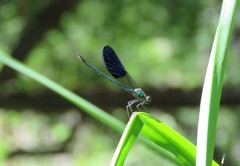
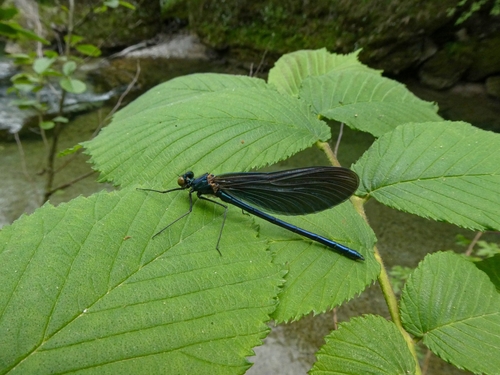
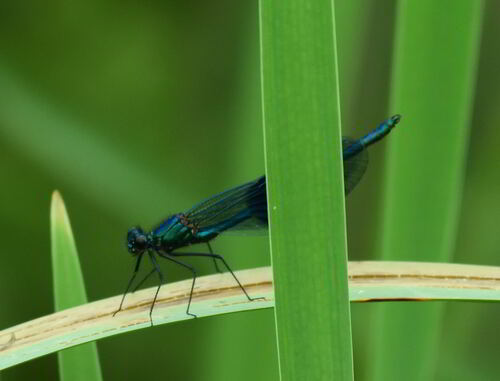
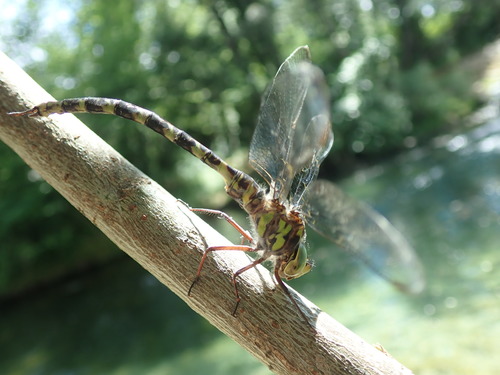
The western demoiselle or yellow-tailed demoiselle (Calopteryx xanthostoma) is a species of damselfly belonging to the family Calopterygidae. It replaces the banded demoiselle (C. splendens) in southern France and the Iberian Peninsula, and is sometimes considered a subspecies of that species (hybrids frequently occur in areas where they overlap).

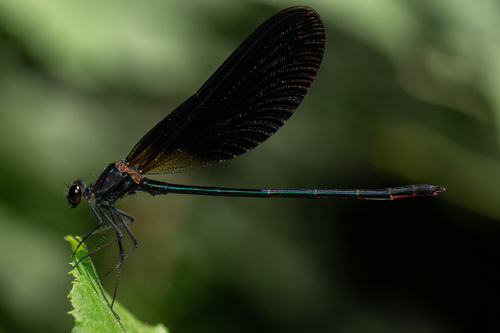
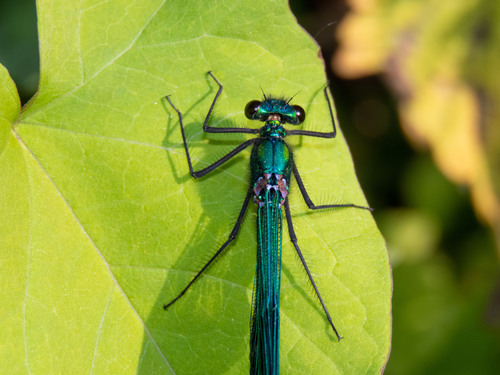
The male of C. xanthostoma generally has more extensive colouring in the wings than that of C.splendens, usually reaching to the wingtips. Unlike C. splendens, the males have clear wings when first emerging as adults, only developing the wing colour during the first week as an adult.

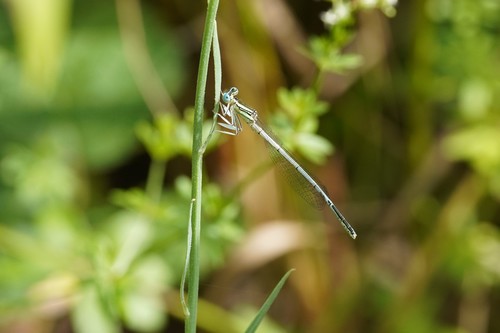
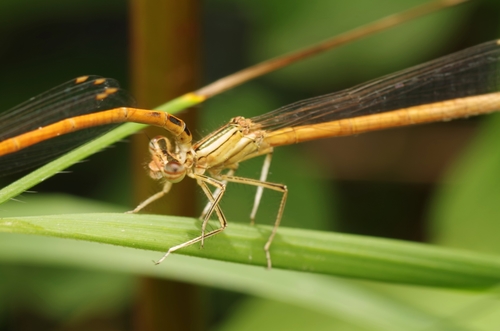
The colour of the underside of the tip of the abdomen is sometimes cited as an identification feature, being said to be yellowish in this species and whitish in C. splendens, but some sources consider this to be unreliable. The metallic green, clear-winged females are virtually identical to female C. splendens and are difficult to separate, even in the hand.

This species lives in habitat around running watercourses, such as streams and rivers, usually in open or somewhat shady areas. Wikipedia →
Global Distribution

Parks Where Found

# Park Country Daily sighting probability
1 Cévennes National Park 🇫🇷 France
~20%
2 Pyrénées National Park 🇫🇷 France
~10%
3 Sierra de Guadarrama National Park 🇪🇸 Spain
<5%

Cities Where Found

# City Country Daily sighting probability
1 Madrid 🇪🇸 Spain
<5%

Before you go

What are the chances of seeing a Western Demoiselle in Cévennes National Park?

Possible

About 20% of wildlife watchers report a Western Demoiselle sighting in Cévennes National Park on a given day, based on 70 verified sightings from GBIF citizen-science data from 2019 to 2026. It is the 97th most-seen of the 996 insects we can rate there. Over three days the chance rises to about 40%, and over a week to about 70%, if each day is a fresh chance.

When is the best time to see a Western Demoiselle in Cévennes National Park?

June

In that month about 30% of wildlife watchers report a Western Demoiselle in Cévennes National Park on a given day, against under 5% in September to March, the lowest months.

What time of day is best to see a Western Demoiselle?

Between 1 and 4 pm

Across all the parks we cover, that three-hour window holds the most Western Demoiselle sightings with a recorded time, and about 8 in 10 of them come between 6 am and 6 pm: it is a daytime animal.

Is Cévennes National Park the best place to see a Western Demoiselle?

Yes

Of the 3 parks where we can rate Western Demoiselle sightings, Cévennes National Park has the highest daily chance: about 20%. Next come Pyrénées National Park (France, about 10%) and Sierra de Guadarrama National Park (Spain, under 5%).

Which relatives of the Western Demoiselle live in Cévennes National Park?

Same genus: Calopteryx

The closest relatives of the Western Demoiselle that you can see in Cévennes National Park (genus Calopteryx, Jewelwings) are Beautiful Demoiselle (about 20%) and Copper Demoiselle (about 10%), with each one's daily chance of a sighting.

Where does the Western Demoiselle sighting chance come from?

GBIF citizen-science records

It is estimated from how often the Western Demoiselle is recorded against all the insects logged in Cévennes National Park (70 verified sightings from 2019 to 2026), calibrated against known sighting rates. Figures are rounded to the nearest 10% because citizen-science data supports honest approximations, not decimals, and months with records from fewer than five people show "—". How it works.

← Back to Cévennes National Park