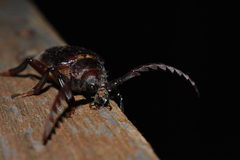
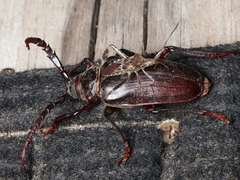
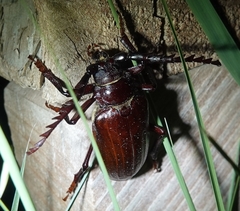
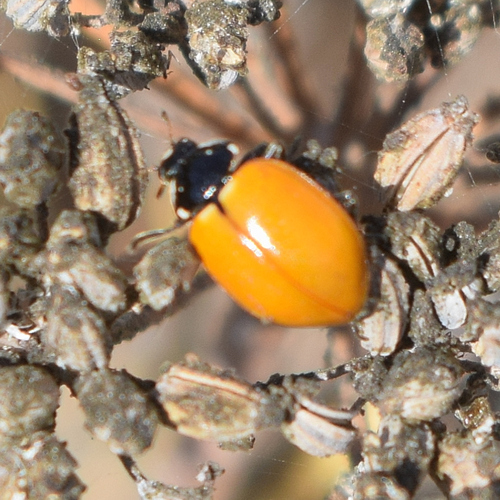
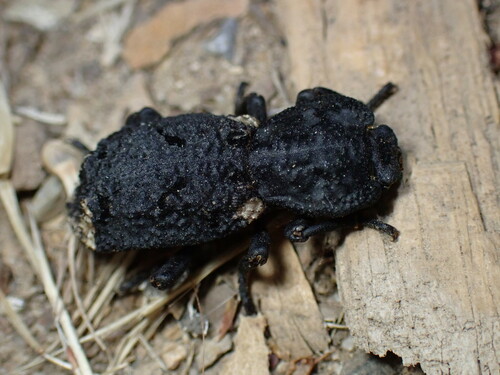
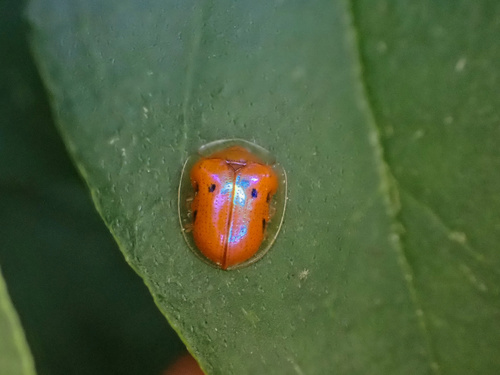
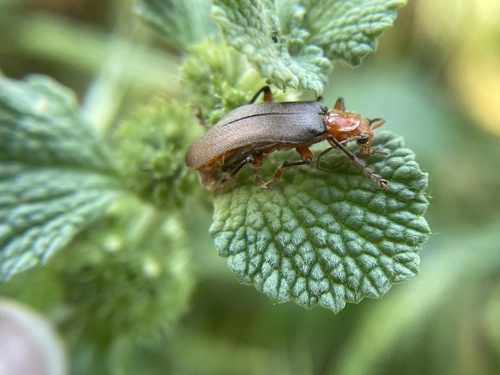
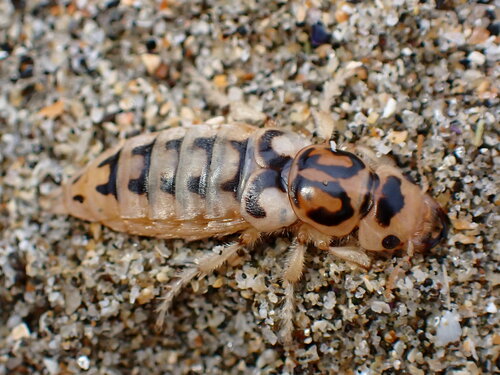
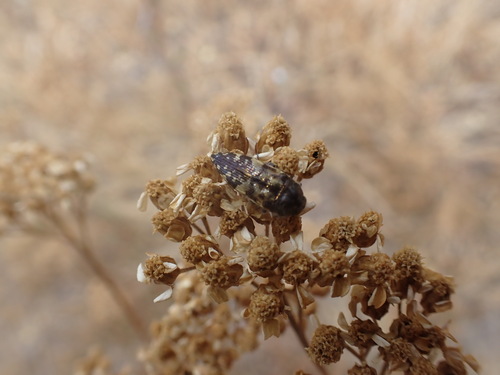
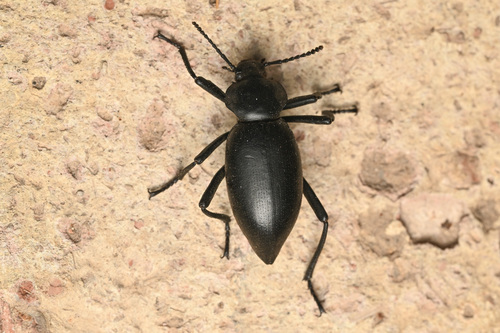
California Root Borer

California Root Borer

Prionus californicus

Daily sighting probability ~10% · With luck
at Channel Islands National Park

In 3 days ~20% in a week ~40%

11 Verified sightings at Channel Islands National Park From 2019 to 2026
65 In all 4 parks
May Best month
🌙 Nocturnal When it's spotted

About the California Root Borer

Prionus californicus, commonly known as the California root borer, is a species of insect in the longhorn beetle family (Cerambycidae). It is native to the American west where it is often a pest of orchard and vine crops.

The California root borer occurs widely in western North America from Alaska to Mexico. It spends most of its life underground feeding on the roots of most deciduous trees and shrubs, as well as some conifers, brambles, and agricultural crops such as hops and grape vines.

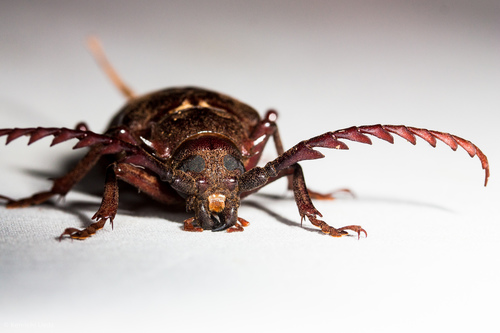
The 2.5 to 5.7 cm adults, which are reddish-brown with smooth shiny wing-cases, emerge from the soil from June to early August. The males are smaller than the females and have more strongly serrated antennae. The adults do not feed. They fly at night, seeking mates. Males appear to be more active, while females produce a pheromone to attract males. The female-produced sex pheromone compound has been identified as an isomer of 3,5-dimethyldodecanoic acid. A synthetic mixture of all four possible isomers of 3,5-dimethyldodecanoic acid is highly attractive to male P. californicus in field trials.

The life span of the adult P. californicus is 10... Wikipedia →
Global Distribution

Parks Where Found

# Park Country Daily sighting probability
1 Sequoia and Kings Canyon National Parks 🇺🇸 United States
~10%
2 Yosemite National Park 🇺🇸 United States
~10%
3 Channel Islands National Park 🇺🇸 United States
~10%
4 Grand Canyon National Park 🇺🇸 United States
~10%

Cities Where Found

# City Country Daily sighting probability
1 Salt Lake City 🇺🇸 United States
<5%
2 San Diego 🇺🇸 United States
<5%
3 San Francisco 🇺🇸 United States
<5%
4 Portland 🇺🇸 United States
<5%
5 Los Angeles 🇺🇸 United States
<5%

Before you go

What are the chances of seeing a California Root Borer in Channel Islands National Park?

With luck

About 10% of wildlife watchers report a California Root Borer sighting in Channel Islands National Park on a given day, based on 11 verified sightings from GBIF citizen-science data from 2019 to 2026. It is the 70th most-seen of the 131 insects we can rate there. Over three days the chance rises to about 20%, and over a week to about 40%, if each day is a fresh chance.

When is the best time to see a California Root Borer in Channel Islands National Park?

April to September

In those months about 10% of wildlife watchers report a California Root Borer in Channel Islands National Park on a given day, against under 5% in October to March, the lowest months. Those are among Channel Islands National Park's driest months, with almost no rain against 60 mm in January.

What time of day is best to see a California Root Borer?

Between 8 and 11 pm

Across all the parks we cover, that three-hour window holds the most California Root Borer sightings with a recorded time, and about 7 in 10 of them come between 6 pm and 6 am: it is mostly seen at night.

Is Channel Islands National Park the best place to see a California Root Borer?

Among the best

Of the 4 parks where we can rate California Root Borer sightings, Channel Islands National Park ranks 3rd at about 10%, level with the leaders once rounded. The best odds are in Sequoia and Kings Canyon National Parks (United States, about 10%) and Yosemite National Park (United States, about 10%).

Where does the California Root Borer sighting chance come from?

GBIF citizen-science records

It is estimated from how often the California Root Borer is recorded against all the insects logged in Channel Islands National Park (11 verified sightings from 2019 to 2026), calibrated against known sighting rates. Figures are rounded to the nearest 10% because citizen-science data supports honest approximations, not decimals, and months with records from fewer than five people show "—". How it works.

← Back to Channel Islands National Park